


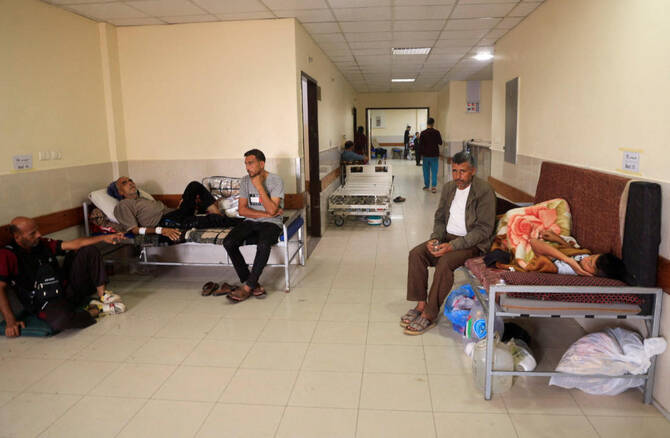

CAIRO/GAZA: Fourteen-year-old Mohammed Wael Helles has been waiting for surgery on a serious spinal injury caused by an Israeli airstrike for nearly two months, one of thousands of Gazans waiting for urgent treatment in Gaza’s battered health system.
Helles was a top student with aspirations of becoming a doctor when he was wounded weeks before a ceasefire that paused two years of warfare. The attack, which killed the driver of his vehicle, tore his spinal cord and fractured three vertebrae.
“I’m still young, at the start of my life,” he said from his hospital bed in Khan Younis after waking from his injury 50 days ago to find he was partially paralyzed.
Israel’s devastating military campaign in Gaza, triggered by the deadly Hamas attacks of October 7, 2023, has injured at least 170,000 Gazans, according to local health authorities, and pushed most Gazans into unsanitary tent camps ravaged by disease, adding to the strains on a shattered health system.
More than a month after Israel and the Palestinian militant group Hamas agreed a ceasefire, only about half of the crowded territory’s 36 hospitals are even partially functional, according to the World Health Organization and they are hobbled by shortages of staff, equipment, medicine and fuel.
HOSPITAL STAFF WORKING DAY AND NIGHT
Despite the severity of Helles’ injury and the fact that Nasser hospital, where he is waiting for treatment, is the biggest in southern Gaza, he may have longer to wait because it now serves a much larger population than before due to the destruction of other facilities.
Mohammed Saqer, the hospital’s head of nursing and spokesperson, said staff were working day and night but could only operate on up to 100 patients a day — a fraction of those who need help.
“Even if they need urgent surgeries we have to postpone them so that we give priority to top urgent cases,” Saqer said of patients on the waiting list.
“This has led to many patients losing their lives.”
DOCTORS MAKE ‘WORST AND MOST DIFFICULT’ DECISIONS
In northern Gaza, where more than half the population lives and where war damage is far worse, the situation is even more critical, said Mohamed Abu Selmia, head of Gaza City’s Al-Shifa hospital.
At Al-Shifa alone, there were 40,000 delayed surgeries, Abu Selmia said, describing the decisions on whose lives to save first — and whose surgeries should be delayed — as the “worst and most difficult test doctors are forced to make.”
Patients whose surgery is delayed often deteriorate, he said, with leg injuries sometimes eventually requiring amputation and cancer patients finding their disease has spread.
Eyad Al-Baqari, 50, was wounded when an Israeli airstrike hit a nearby building in Gaza City and falling masonry broke his leg. He needs surgery to implant pins to fix his leg but has been waiting for three months.
He has no choice but to walk to collect food and water for his family and his injury is worsening. “The doctors told me some of the bones in my foot were damaged further,” he said.
SOME IMPROVEMENT SINCE CEASEFIRE
There have been some improvements since the ceasefire went into effect on October 10, after which more aid started to flow into Gaza. Only 14 hospitals had been operating before the truce, compared to 18 now, more fuel and medical supplies are coming in, and the WHO has launched a vaccination program.
While Israel says it has allowed in the daily 600 trucks of supplies required under the truce deal, the Hamas-run Gaza government says barely 150 a day have been entering.
Israel’s military did not immediately respond to a request for comment on damage to hospitals and delays to the entry of needed medical equipment and medicine.
Abu Selmia said more than 60 percent of medicines he needs at Al-Shifa were completely unavailable and there were no working MRI machines or mammography devices in Gaza.
Fuel shortages cut the amount of electricity available as well as reducing ambulance availability, he said. Staff shortages are also a problem, with 1,700 doctors and nurses killed by bombardment and another 350 in detention in Israel, he said.
“The health sector remains in a state of total collapse,” Abu Selmia told Reuters. “Some patients lose their lives before they get a chance to receive treatment.”


