JERUSALEM: Israel ‘s president on Wednesday condemned what he called a “shocking and serious” attack by Jewish settlers against Palestinians in the West Bank, calling for an end to a growing wave of settler violence in the occupied territory.
President Isaac Herzog’s comments added a powerful voice to what has been muted criticism by top Israeli officials of the settler violence. Herzog’s position, while largely ceremonial, is meant to serve as a moral compass and unifying force for the country.
Herzog said the violence committed by a “handful” of perpetrators “crosses a red line,” adding in a social media post that “all state authorities must act decisively to eradicate the phenomenon and to strengthen the IDF fighters and security forces who protect us day and night.”
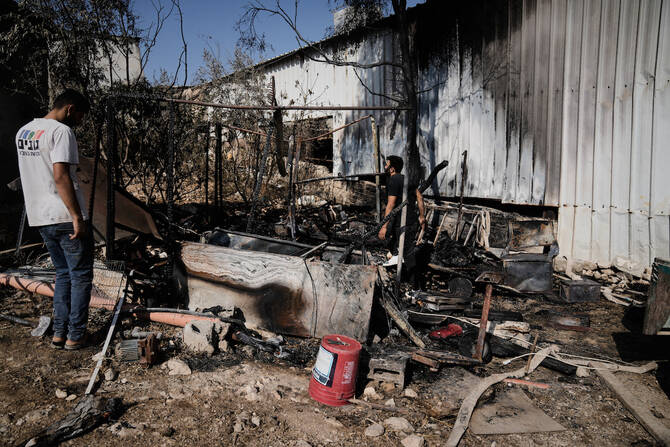
His remarks came after dozens of masked Israeli settlers attacked the Palestinian villages of Beit Lid and Deir Sharaf in the West Bank on Tuesday, setting fire to vehicles and other property before clashing with Israeli soldiers.
A top Israeli commander echoed Herzog, saying that such violence by an “anarchist fringe” from within the Israeli settler community is unacceptable and will be dealt with “firmly.”
Central Command Chief Maj. Gen. Avi Bluth denounced what he called an “unacceptable situation” that forces significant resources to be diverted from bolstering security and conducting counterterrorism operations.”
“The reality in which anarchist fringe youth act violently against innocent civilians and against security forces is unacceptable and is extremely serious,” Bluth said. “It must be dealt with firmly.”
Settler violence has surged
Tuesday’s violence in the West Bank was the latest in a series of attacks by young settlers that have surged since the war in Gaza erupted two years ago. The attacks have intensified in recent weeks as Palestinians harvest their olive trees in an annual ritual.
The UN humanitarian office last week reported more Israeli settler attacks on Palestinians in the West Bank in October than in any other month since it began keeping track in 2006. There were over 260 attacks, the office said.
Palestinians and human rights workers accuse the Israeli army and police of failing to halt attacks by settlers. Israel’s government is dominated by far-right proponents of the settler movement including Finance Minister Bezalel Smotrich, who formulates settlement policy, and Cabinet minister Itamar Ben-Gvir, who oversees the nation’s police force.
In Tuesday’s incident, the army said soldiers responded to settler attacks in two Palestinian villages. It said the settlers fled to a nearby industrial zone and attacked soldiers and damaged a military vehicle. Israeli police said four Israelis were arrested in what it described as “extremist violence,” while the Israeli military said four Palestinians were wounded.
Palestinian official Muayyad Shaaban, who heads the government’s Commission against the Wall and Settlements, said the settlers set fire to four dairy trucks, farmland, tin shacks and tents belonging to a Bedouin community.
He said the attacks were part of a campaign to drive Palestinians from their land and accused Israel of giving the settlers protection and immunity. He called for sanctions against groups that “sponsor and support the colonial settlement terrorism project.”
Palestinians react angrily
In Beit Lid, residents said they don’t want their lives ruled by fear of settler violence.
Mahmoud Edeis said the violence is undermining his family’s right to live in safety.
“To feel that my children are safe, that when I go to sleep I can say, ‘Okay, there’s nothing (to worry about),’” he said. “But at any moment something could happen … This can’t go on. It can’t be that we keep living our whole lives in a state of fear and danger.”
Amjad Amer Al-Juneidi, who works at a dairy factory that was attacked Tuesday, said the “fully organized” attack saw one person carrying gasoline-filled cans, another prying open the factory door with a crowbar and a third individual igniting the fuel.
“Their entry into the company wasn’t random. It was organized, and they had a fully organized tactic for how to carry out the burning,” Al-Juneidi said.


![]()

Israel’s president says ‘shocking’ settler violence against Palestinians must end
Short Url
https://arab.news/4zjnx
Israel’s president says ‘shocking’ settler violence against Palestinians must end
- His remarks came after dozens of masked Israeli settlers attacked the Palestinian villages of Beit Lid and Deir Sharaf in the West Bank on Tuesday


Latest updates


© 2026 SAUDI RESEARCH & PUBLISHING COMPANY, All Rights Reserved And subject to Terms of Use Agreement.