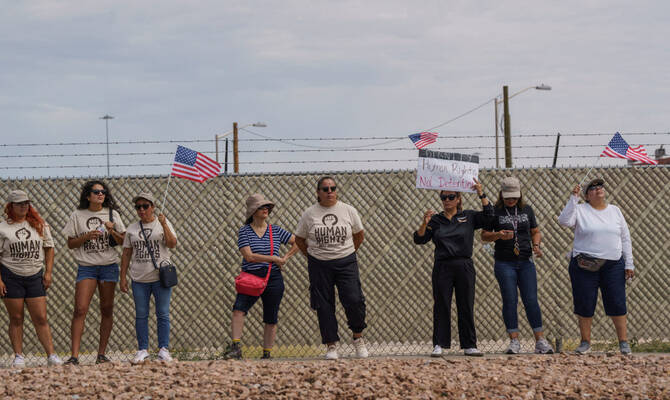
Detainees at the largest US migrant detention camp endure foul-tasting drinking water, rotten food and inadequate health care, according to a US congresswoman who called the tent facility in El Paso, Texas, “inhumane.” US Representative Veronica Escobar, a Texas Democrat, made the allegations in a letter last week to Department of Homeland Security Secretary Kristi Noem based on complaints from migrants at the new $1.2 billion facility, called Camp East Montana. “Conditions at Camp East Montana are dangerous and inhumane,” Escobar wrote. “It is increasingly clear that it is not a safe nor professionally managed facility.” Asked for comment on the letter, the Department of Homeland Security gave a statement issued in September that denied the center violated federal standards for immigrant detention, such as restricting access to legal representation, or was inhumane.
“All detainees are provided with proper meals, medical treatment, and have opportunities to communicate with lawyers and their family members,” DHS said. The center has become a target of criticism by Democratic legislators and immigrant advocates opposed to President Donald Trump’s immigration crackdown. Escobar wrote that conditions at the camp on the Fort Bliss US Army base had not improved since she first protested to Noem weeks after it opened in August.
“The drinking water at the facility continues to taste foul, the food quality for detainees has not improved,” said Escobar, who represents the El Paso area. She added that detainees faced sewage backups and flooding while only the most ill inmates were referred to the camp medical unit. The camp consists of temporary tent structures meant to house up to 5,000 detainees and relieve overcrowding at other Immigration and Customs Enforcement detention facilities. Trump has vowed record deportations of migrants with criminal records in the US illegally. Democrats have argued that federal agents are targeting people indiscriminately to achieve his goals. Immigrant advocate groups have called for the closure of another migrant detention camp in Florida due to alleged inhumane conditions.


Migrants at largest US detention camp face foul water, rotten food, congresswoman says
https://arab.news/2ezjd
Migrants at largest US detention camp face foul water, rotten food, congresswoman says

- “The drinking water at the facility continues to taste foul, the food quality for detainees has not improved,” said Escobar, who represents the El Paso area


Kabul shakes as 5.8-magnitude earthquake hits eastern Afghanistan
- The 5.8-magnitude quake struck a mountainous area around 130 kilometers northeast of Kabul
- Earthquakes are common in Afghanistan, particularly along the Hindu Kush mountain range
KABUL: A strong earthquake rocked eastern Afghanistan including the capital Kabul on Friday, AFP journalists and residents said.
The 5.8-magnitude quake struck a mountainous area around 130 kilometers (80 miles) northeast of Kabul, the United States Geological Survey said.
The epicenter was near several remote villages and struck at 5:39 p.m. (1309 GMT), just as people in the Muslim-majority country were sitting down to break their Ramadan fast.
“We were waiting to do our iftars, a heavy earthquake shook us. It was very strong, it went on for almost 30 seconds,” said Zilgay Talabi, a resident of Khenj district near of the epicenter.
“Everyone was horrified and scared,” Talabi told AFP, saying he feared “landslides and avalanches” may follow.
Power was briefly cut in parts of the capital, while east of Kabul an AFP journalist in Nangarhar province also felt it.
Earthquakes are common in Afghanistan, particularly along the Hindu Kush mountain range, near where the Eurasian and Indian tectonic plates meet.
Haqmal Saad, spokesman for the Panjshir province police, described the quake as “very strong” and said the force was “gathering information on the ground.”
Mohibullah Jahid, head of Panjshir Natural Disaster Management agency, told AFP he was in touch with several officials in the area.
The district governor had told him there were reports of “minor damage, such as cracks in the walls, but we have not received anything serious, such as the collapse of houses or anything similar,” Jahid said.
Residents in Bamiyan and Wardak provinces, west of Kabul, told AFP they also felt the earthquake.
In Pakistan’s Khyber Pakhtunkhwa province, rescue service official Bilal Ahmad Faizi said the quake was felt in border areas.
In August last year, a shallow 6.0-magnitude quake in the country’s east wiped out mountainside villages and killed more than 2,200 people.
Weeks later, a 6.3-magnitude quake in northern Afghanistan killed at least 27 people.
Large tremors in western Herat, near the Iranian border, in 2023, and in Nangarhar province in 2022, killed hundreds and destroyed thousands of homes.
Many homes in the predominantly rural country, which has been devastated by decades of war, are shoddily built.
Poor communication networks and infrastructure in mountainous Afghanistan have hampered disaster responses in the past, preventing authorities from reaching far-flung villages for hours or even days before they could assess the extent of the damage.