

Palestinian medics record 6,000 amputations in Gaza Strip

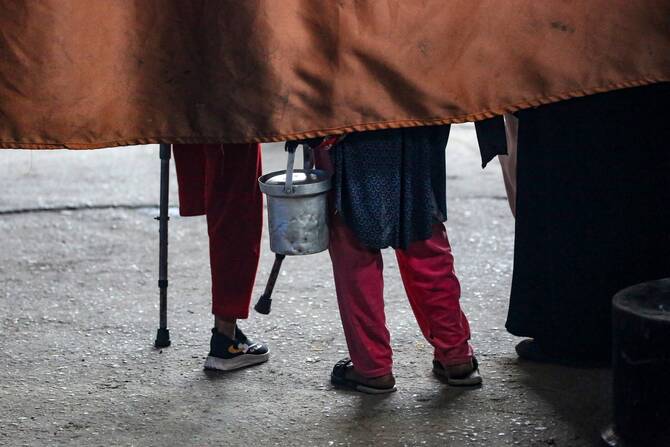
Palestinian children, one of them an amputee, wait to get a hot meal in front of a distribution point at the Nuseirat refugee camp in the central Gaza Strip, May 10, 2025. (AFP)
Short Url
Updated 11 November 2025
Follow

Palestinian medics record 6,000 amputations in Gaza Strip

  • Shortage of medical resources and assistive devices worsens the suffering of amputees, affecting thousands of wounded individuals and their families in Gaza

LONDON: Palestinian health institutions in the Gaza Strip have reported that 6,000 amputations have been carried out since the Israeli military campaign in the territory began in late 2023.

Children account for 25 percent of all amputations, while women make up 12.7 percent. Both groups urgently require long-term rehabilitation programs, according to the Wafa news agency.

The shortage of medical resources and assistive devices worsens the suffering of amputees, affecting thousands of wounded individuals and their families in Gaza, they added.

They called for international organizations to support rehabilitation services and psychosocial support, especially for children facing permanent disabilities at a young age.

A ceasefire agreement between Israel and Hamas in October has ended two years of military conflict in Gaza. Israel is accused of committing genocide in the region, resulting in more than 65,000 deaths, the majority of whom are women and children.


Morocco pushes to reform social security system amid inflation and economic pressure, PM says

Updated 6 sec ago
Follow

Morocco pushes to reform social security system amid inflation and economic pressure, PM says

  • Speaking at the World Economic Forum in Davos, Aziz Akhannouch said his government had expanded healthcare to more than 80 percent of its population

DUBAI: Morocco’s prime minister said on Tuesday that the country was pursuing radical social and economic reforms in the wake of inflationary and economic pressures.

Speaking at the World Economic Forum in Davos, Aziz Akhannouch said his government had expanded healthcare to more than 80 percent of its population, up from just 42 percent when he took office three years ago.

He said this also coincided with consistently strong economic growth and headline inflation reducing to below 1 percent. 

“In a world that doubts itself, Morocco has decided to protect its population, reform and look forward,” he told attendees in Davos.

In late 2025, Morocco was rocked by its largest demonstrations in over a decade as youth‑led groups mobilized nationwide against deteriorating public services, deepening social inequality, and chronic unemployment.

Akhannouch said the country was aware of the difficulties facing Moroccans and was determined to ensure the country would remain on a positive trajectory.

Part of this included the provision of financial aid to more than 12 million citizens, and the formation of trusts for orphans to be paid out when they turn 18.

“Health means dignity, if you want to have a decent life you have to have good health,” he said.

Nevertheless, Akhannouch noted that the government had not forgone its budgetary principles — and had in fact balanced the country’s debt payments and achieved successful fiscal reforms. He noted S&P’s decision in 2025 to raise Morocco’s sovereign rating to BBB‑/A‑3 and restore its investment‑grade status.

Speaking on the World Cup, set to be co-hosted with neighbors Spain and Portugal in 2030, he said the project was seen as a nation-building exercise that would help spur Morocco to develop its underlying infrastructure and provide employment opportunities for young Moroccans.

“It will be a growth accelerator,” he said.

“When we build new rail networks and upgrade cities it will have a long-term impact on people.”