

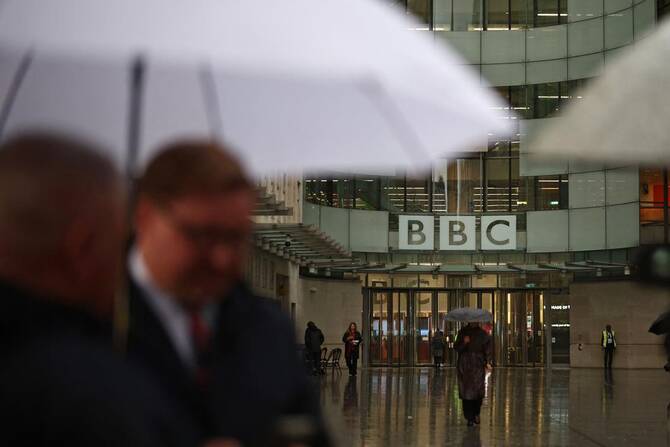

LONDON: US President Donald Trump has threatened the BBC with a billion-dollar lawsuit, US sources said, as the broadcaster apologized Monday for editing a speech that gave the impression he urged “violent action” just before the 2021 assault on the US Capitol.
Trump could seek $1 billion in damages from the BBC, a source close to his legal team said, amid a growing furor that prompted the resignations Sunday of two of the broadcaster’s top brass.
The source said the British broadcaster has been given until Friday to retract the 2024 documentary and apologize for the documentary broadcast just before the 2024 US presidential election.
Trump has been accused of launching lawsuits to stifle US media. But the latest controversy has reignited a debate over the British broadcaster, cherished by many but which has faced long-standing accusations of bias, from both ends of the political spectrum.
A spokesman for Trump’s private legal team confirmed that a letter had been sent to the BBC but did not give details.
“The BBC defamed President Trump by intentionally and deceitfully editing its documentary in order to try and interfere in the presidential election,” the spokesman said in a statement to AFP.
“President Trump will continue to hold accountable those who traffic in lies, deception, and fake news.”
A BBC spokesperson said: “We will review the letter and respond directly in due course.”
‘Vital role’
In a letter sent to MPs, BBC chairman Samir Shah said the broadcaster accepted that the editing of Trump’s speech for the documentary “did give the impression of a direct call for violent action.”
“The BBC would like to apologize for that error of judgment,” he added, vowing to reform oversight within the broadcaster.
Director general Tim Davie and BBC News CEO Deborah Turness stepped down over the escalating backlash on Sunday.
Trump promptly celebrated, accusing BBC journalists of being “corrupt” and “dishonest.” His press secretary called the broadcaster “100-percent fake news.”
However, Prime Minister Keir Starmer’s spokesman told reporters the organization “has a vital role in an age of disinformation.”
“It’s important that the BBC acts swiftly to maintain trust and correct mistakes quickly when they occur,” he added.
The government is preparing a review of the BBC’s charter, which outlines the corporation’s governance and funding framework. The current charter ends in 2027.
The broadcaster, which has cut hundreds of jobs amid stretched finances, is funded by a license fee paid by anyone who watches live TV in Britain.
Some have welcomed the resignations as a timely reckoning for the BBC, while others fear the influence of right-wing detractors, including in the United States.
Ed Davey, leader of the centrist Liberal Democrats, urged Starmer to tell Trump to “keep his hands off” the BBC.
Former BBC journalist Karen Fowler-Watt, head of the journalism department at City St. George’s University in London, told AFP the institution was “now really in a situation of crisis.”
She noted it was “very difficult not to see this as a right-wing attack, given the media ecosystem in which we all now live.”
Controversies
In London, Britons were both critical and sympathetic.
Jimmy, who works in construction and declined to give his surname, told AFP the BBC’s reputation had been “tarnished” and it had “shown that they’re not impartial.”
But 78-year-old writer Jennifer Kavanagh said it has “always been attacked from the right and from the left.”
“They can never get it right,” she added.
Its latest crisis intensified after the right-wing Daily Telegraph newspaper reported last week that a former external standards adviser’s warnings of serious and widespread failings of impartiality and systemic bias had been ignored.
That included the editing of sections of Trump’s January 6, 2021, speech ahead of the mob attack on the US Capitol following the 2020 US presidential election.
It appeared he had told supporters he was going to walk there with them and “fight like hell,” whereas the president also told the audience in the intervening period “we’re going to cheer on our brave senators and congressmen and women.”
Earlier this year, the BBC apologized for “serious flaws” in the making of another documentary, about the Gaza war, which the UK’s media watchdog deemed “materially misleading.”
It also faced criticism for failing to pull a livestream of punk-rap duo Bob Vylan during this year’s Glastonbury festival after its frontman made anti-Israel comments.


