

UN Tourism: Riyadh Declaration charts future of industry with AI, sustainability at core

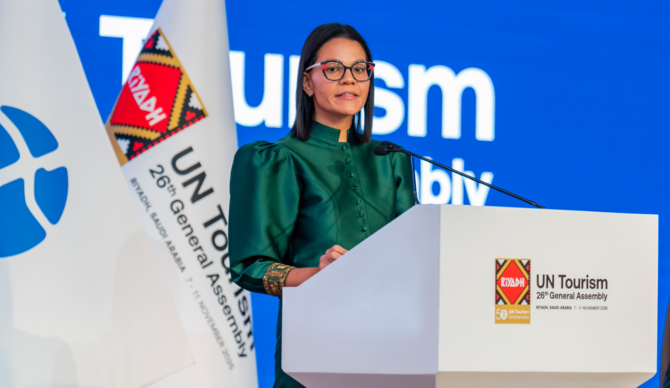
UN Tourism Executive Director Natalia Bayona led a press conference after the Riyadh Declaration was released. X/@UNWTO
Short Url
Updated 10 November 2025
Follow

UN Tourism: Riyadh Declaration charts future of industry with AI, sustainability at core

  • Member states unite to address environmental pressures, talent gaps, and digital innovation in tourism

RIYADH: Countries worldwide have committed to advancing a more sustainable tourism sector that embraces digital transformation and addresses workforce challenges.

The Riyadh Declaration on the Future of Tourism was unveiled during the UN Tourism 26th General Assembly, hosted in Saudi Arabia.

The declaration emphasizes that ministers “acknowledge that the global tourism sector is at a turning point in how people travel, how destinations evolve, and how communities thrive.” It also recognizes that rapid technological advancements — including artificial intelligence and other emerging technologies — are reshaping the global tourism landscape.

The document outlines 11 pledges, starting with a commitment for all member states to “act immediately to advance and accelerate progress towards a more sustainable tourism sector that balances environmental stewardship, economic vitality, and social well-being.”

It also encourages countries to “advance and promote the responsible adoption of digital transformation and innovation in the tourism sector by incentivizing investment in digital infrastructure, taking into account different levels of infrastructural development.”

Other pledges focus on strengthening the sector’s resilience, including advancing risk assessments, investing in “adaptive infrastructure and systems,” and fostering rapid response and recovery mechanisms.

Highlighting the importance of collaborative efforts, one goal calls on member states to “address workforce shortages and skills gaps by encouraging investments in tourism education and training, and sharing knowledge among all member states.”

Cultural preservation is also addressed, with countries urged to “promote culturally respectful and socially inclusive tourism by engaging authentically with local communities, safeguarding cultural heritage, and protecting the social fabric of host societies, while preserving cultural identity.”

The declaration notes that adopting new technologies will have “profound and multifaceted effects on the future of tourism,” and identifies sustainability, environmental pressures, accessibility, and digital innovation gaps as key areas of concern. It also highlights challenges such as exposure to crises, workforce shortages, talent mismatches, social integration, unbalanced visitor flows, and infrastructure limitations.

Public safety and the equitable distribution of tourism benefits are also raised as priorities.

At a press conference announcing the declaration, UN Tourism Executive Director Natalia Bayona said the General Assembly aimed “to set a clear vision for the future with tourism as a driver of peace, prosperity, innovation and sustainability for all.”

She added: “This is the biggest General Assembly that we have done in the history of the organization, more than 150 delegations, 90 ministers, 70 ambassadors, 17 deputy ministers of vice-ministers. Our affiliate members, the private sector, more than 120 companies from the private sector.”

Beyond setting pledges, the declaration directs UN Tourism Secretary-General Shaikha Al-Nowais to develop a “strategic roadmap” on the future of tourism, to be presented to the Executive Council within a year.

It also calls on Al-Nowais to implement the AI Impact on Tourism Report and Recommendation Guide and create a global maturity framework or index for AI in tourism. This tool will help countries assess readiness, identify gaps, unlock opportunities, and ensure the responsible and safe adoption of AI in the sector.

Member states requested UN Tourism to track AI adoption globally and develop recommendations for improvement. This report is expected at the Executive Council’s first ordinary session in 2027.

Also speaking at the press conference, Saudi Arabia’s Minister of Tourism Ahmed Al-Khateeb described the Riyadh Declaration as a “roadmap,” highlighting the commitment of member states and the secretary-general to its implementation.

“All decisions during the event were taken in a positive atmosphere, underscoring the Kingdom’s coordination abilities,” he said.


Saudi PIF executes 10 investment deals in MENA markets, says official 

Updated 11 December 2025
Follow

Saudi PIF executes 10 investment deals in MENA markets, says official 

RIYADH: Saudi Arabia’s Public Investment Fund has executed more than 10 investment deals across several markets in the Middle East and North Africa over the past two years, according to Muteb Al-Shathri, head of PIF’s Securities Investments Private Equity Section, who described the returns as “rewarding.” 

Al-Shathri said these markets included Egypt, Bahrain, Jordan, and Oman, noting that the search for opportunities continues through collaboration with the fund’s public and private sector partners, provided a suitable investment climate exists in other regional markets. 

Muteb Al-Shathri, head of PIF’s Securities Investments Private Equity Section. AL-EQTISADIAH

He added that the launch of the fund’s regional investment companies reflects the attractiveness and promising opportunities in the MENA region — among the fastest-growing markets globally — while also aiming to strengthen the PIF’s investment partnerships, those of its portfolio companies, and Saudi private sector engagement with targeted regional markets. 

This approach, he added, supports the development of long-term strategic economic partnerships to achieve sustainable returns, enhance the fund’s assets, and diversify Saudi Arabia’s revenue sources in line with Vision 2030 objectives. 

Al-Shathri said: “The PIF’s recent regional activities are fully aligned with Saudi Arabia’s Vision 2030 strategy.” 

The regional investment companies also enable the Saudi private sector to expand its investment footprint across MENA, creating strategic economic collaboration opportunities with private sector players in target markets, while supporting the growth and diversification of the Saudi economy. 

Regarding the scale of the deals, Al-Shathri noted that some were announced as private acquisitions, while many of the companies PIF invested in are now publicly traded, adding that comparing share prices at the time of entry with current levels demonstrates strong returns. 

According to Al-Shathri, PIF has established offices for its regional investment companies in four key markets — Cairo, Manama, Amman, and Muscat — bringing together the fund’s investment expertise alongside national talent from each country. 

“These offices, set up more than two years ago, have been pivotal in identifying suitable opportunities and helping PIF’s companies and the Saudi private sector enter these markets,” he said. 

He further said that over the past two years, they have completed more than 10 investment deals across a range of companies and new projects, all of which have seen growth in size, scope, revenues, and profits. 

On the performance of regional companies, he explained that activity levels vary depending on market conditions, but operations and asset management continue, adding that the Egyptian market remains one of the largest, with many high-performing companies present. 

Highlighting key investments, Al-Shathri pointed to PIF’s 2021 investment in ADES, a well-known oil well drilling company that was traded on the London market before being taken private for two years and later publicly listed. ADES recently signed an agreement with the Syrian Petroleum Co. to develop oil and gas fields and operates in over 20 countries across four continents. 

Diverse and promising acquisitions 

Al-Shathri detailed specific market investments, beginning with the Saudi-Egyptian Investment Co., which initially acquired stakes in three private-sector companies: B.Tech, a leading electronics and home appliance distributor; CERA Group, the largest private education provider in Egypt; and Cleopatra Hospitals Group. 

The company also invested in four public-sector entities: Abu Qir Fertilizers and Chemicals Industries Co., Misr Fertilizers Production Co., e-Finance for financial and digital investments, and Alexandria Container & Cargo Handling Co., the latter of which was recently fully divested. 

The Saudi-Jordanian Investment Co. invested in three promising Jordanian firms: Opensooq platform, Capital Bank Group, and Al-Youm Bakery, and announced a major project in healthcare and medical education — the Kingdom Healthcare and Medical Education Project. 

The Saudi-Bahraini Investment Co. recently signed an agreement with Mumtalakat, Bahrain’s sovereign wealth fund, to enhance cooperation and investment in strategic sectors. This follows a memorandum of understanding between PIF and Mumtalakat in March 2024 to expand collaboration opportunities. 

Al-Shathri added that the Saudi-Omani Investment Co. acquired a 9.8 percent stake in Abraj Energy Services, 3.75 percent in OQ Basic Industries, and 4.9 percent in OQ Oman Gas Networks, for a total investment of $163 million. The company also signed an MoU with the Oman Investment Authority to expand cooperation and support new investment opportunities in the sultanate. 

Investment based on clear principles 

Al-Shathri emphasized that PIF establishes companies based on strict investment criteria, aiming for sustainable returns in line with calculated risk levels, stressing that returns are received as expected. 

“Our investment policy is open to all sectors in every market, though each market has its own competitive advantages,” he said. 

He added: “We always target quality investments with rewarding, sustainable returns while creating positive social and economic impact in each market.” 

Ongoing market monitoring and research 

As for future announcements, Al-Shathri said: “We are constantly monitoring the markets and have a team of experts at the fund working in the research sector. If we identify opportunities in other markets, they will be presented in line with PIF’s standard procedures.” 

He added that the fund always pays close attention to the capabilities of the company and other shareholders, “ensuring they are of a very high standard not just in terms of the company’s financial value, because financial value can only be preserved and grown by strong management and partners.” 

Domestic focus and strategic partnerships 

Regarding the Saudi economy, Al-Shathri said that domestic matters are a priority for the PIF, especially since Saudi Arabia has the largest economy in the region. 

He added: “We are always keen to allocate most of our investments within Saudi Arabia and attract investment funds to the country.” 

Recently, the fund closed a deal between a consortium of BlackRock investors and Saudi Aramco in the Al-Jafurah field. It is worth noting that BlackRock’s infrastructure investments in Saudi Arabia exceed $20 billion, according to previous announcements. 

On the key companies targeted by the fund, Al-Shathri said some will be announced soon, emphasizing that PIF’s strategy is clear: to seek high-growth companies that serve the fund’s objectives and align with Vision 2030 goals. 

He pointed out that the fund engages with numerous companies that see significant value in partnering with it, adding that PIF’s efforts go beyond launching investment opportunities and providing regional expansion capabilities, emphasizing that they also include contributing to the companies’ growth, improving governance, and enhancing prospects for public listing.