

France’s ex-leader Sarkozy says after jail release ‘truth will prevail’

1 / 2
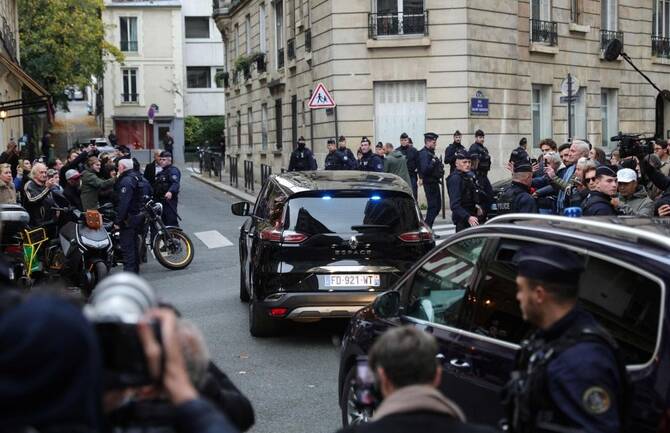
The car and vehicle delegation transporting former French President Nicolas Sarkozy arrive at Sarkozy’s home after leaving La Sante Prison, Paris, France, Nov. 10, 2025. (AFP)
2 / 2
Former French president Nicolas Sarkozy leaves in front of his wife French-Italian singer Carla Bruni after the verdict in his trial for illegal campaign financing from Libya for his successful 2007 presidential bid, at the Tribunal de Paris courthouse in Paris, on September 25, 2025. (AFP)
Short Url
Updated 10 November 2025
Follow

France’s ex-leader Sarkozy says after jail release ‘truth will prevail’

  • Nicolas Sarkozy, 70, left La Sante prison in Paris — a 20-day experience the former president called a ‘nightmare,’ after a judge ordered his release
  • Sarkozy, who maintains his innocence, arrived home in a car with tinted windows, escorted by police motorcyclists

PARIS: France’s former president Nicolas Sarkozy vowed on Monday that the truth would win out after he was released from prison under judicial supervision ahead of an appeal trial over Libyan funding.
Sarkozy, 70, earlier Monday left La Sante prison in Paris — a 20-day experience the former president called a “nightmare,” after a judge ordered his release.
Sarkozy, who maintains his innocence, arrived home in a car with tinted windows, escorted by police motorcyclists.
“The truth will prevail,” he wrote on X shortly afterwards.
“I will now prepare for an appeal. My energy is focused solely on proving my innocence,” he added, thanking his supporters.
“Your thousands of messages moved me deeply and gave me the strength to endure this ordeal.”
A lower court in September found the right-wing politician — who was head of state from 2007 to 2012 — guilty of seeking to acquire funding from Muammar Qaddafi’s Libya for the campaign that saw him elected.
He was sentenced to five years behind bars.
He entered jail on October 21, becoming the first former head of a European Union state to be incarcerated, and his lawyers swiftly sought his release.
But the appeal case means that Sarkozy is now presumed innocent again.
During the examination of Sarkozy’s request in court earlier Monday, prosecutors had called for him to be freed ahead of the appeal trial set to start in March.
“Long live freedom,” one of Sarkozy’s sons, Louis, said on X.

Very hard

During the court hearing earlier Monday, Sarkozy, speaking via video call from jail, said his time in prison was tough.
“It’s hard, very hard, certainly for any prisoner. I would even say it’s gruelling,” he said.
He thanked the prison staff, whom he said “showed exceptional humanity and made this nightmare — because it is a nightmare — bearable.”
In the prison, the former president was separated from the general population, with two bodyguards occupying a neighboring cell to ensure his safety.
In the courtroom showing their support were his wife, the singer and model Carla Bruni-Sarkozy, and two of the former president’s sons.

Finally free

The lower court in late September ordered Sarkozy to go to jail, even if he appealed, due to the “exceptional gravity” of the conviction.
Under the terms of his release on Monday, the court banned Sarkozy from leaving France.
The former president was also prohibited from contacting former Libyan officials as well as senior French judicial officials including Justice Minister Gerald Darmanin.
Sarkozy last month received a visit from Darmanin, despite warnings from France’s top prosecutor Remy Heitz that it risked “undermining the independence of magistrates.”
Sarkozy, seen as a mentor to many conservative politicians, still enjoys considerable influence on the French right.
“The former president, presumed innocent, is finally free again,” Bruno Retailleau, head of the conservative Republicans, said on X, praising his “courage.”
Sarkozy is the first French leader to be incarcerated since Philippe Petain, the Nazi collaborationist head of state, who was jailed after World War II.
Sarkozy’s social media account last week posted a video of piles of letters, postcards and packages it said had been sent to him, some including a collage, a chocolate bar or a book.

Legal woes

Sarkozy has faced a flurry of legal woes since losing his re-election bid in 2012, and has already been convicted in two other cases.
In one, he served a sentence for graft — over seeking to secure favors from a judge — under house arrest while wearing an electronic ankle tag, which was removed after several months.
In another, France’s top court is later this month to rule over accusations of illegal campaign financing in 2012.
In the so-called “Libyan case,” prosecutors said his aides, acting in Sarkozy’s name, struck a deal with Qaddafi in 2005 to illegally fund his victorious presidential election bid.
Investigators believe that in return, Qaddafi was promised help to restore his international image after Tripoli was blamed for the 1988 bombing of a plane over Lockerbie, Scotland, and another over Niger in 1989, killing hundreds of passengers.
The court convicted Sarkozy of criminal conspiracy over the plan. But it did not conclude that he received or used the funds for his campaign.


US intel did not suggest a preemptive strike from Iran before US-Israeli attacks, AP sources say

Updated 58 min 25 sec ago
Follow

US intel did not suggest a preemptive strike from Iran before US-Israeli attacks, AP sources say

  • The official said a variety of factors created a golden opportunity to take out much of Iran’s leadership

WASHINGTON: Trump administration officials told congressional staff in private briefings Sunday that US intelligence did not suggest Iran was preparing to launch a preemptive strike against the US, three people familiar with the briefings said.
The administration officials instead acknowledged there was a more general threat in the region from Iran’s missiles and proxy forces, two of the people said. The third person, however, said the administration emphasized that Iran’s missiles and proxy forces posed an imminent threat to US personnel and allies in the region.
The officials did not provide any clarity about what would happen next in Iran after the joint US-Israeli operation, the two people said. All three people insisted on anonymity to discuss details that have not been made public.
The information conveyed to the congressional staff contrasts with the message from President Donald Trump. “Our objective is to defend the American people by eliminating imminent threats from the Iranian regime. A vicious group of very hard, terrible people,” he said in a video message after launching strikes on Iran.
Senior Trump administration officials, who like others were not authorized to comment publicly and spoke on condition of anonymity, had told reporters Saturday that there were indicators that the Iranians could launch a preemptive attack.
The White House and Pentagon did not immediately reply to requests for comment on Sunday night. Details of the briefing were first reported by Politico.
On Tuesday, Secretary of State Marco Rubio, Defense Secretary Pete Hegseth, CIA Director John Ratcliffe and Gen. Dan Caine, chairman of the Joint Chiefs of Staff, will brief the full membership of Congress on the US military operation against Iran, the White House said Sunday. Rubio also was slated to brief Hill leadership Monday, the same day Hegseth and Caine are planning a press conference about the operation.
Three strikes, three locations, within a single minute
The military operation came after authorities from Israel and the US spent weeks tracking the movements of senior Iranian leaders, including Supreme Leader Ayatollah Ali Khamenei, and shared information that allowed the strikes to be carried out in a surprise daylight attack, according to an Israeli military official and another person familiar with the operation.
The eventual barrage of US-Israeli attacks on Iran came so quickly that they were nearly simultaneous — with three strikes in three locations hitting within a single minute — killing Khamenei and some 40 senior figures, including the head of the paramilitary Revolutionary Guard and the country’s defense minister, the Israeli military official said Sunday.
The official said a variety of factors created a golden opportunity to take out much of Iran’s leadership, like weeks of training and monitoring the movements of senior figures as well as intelligence in real-time before the attack began that key targets were gathered together.
Striking by day also gave an additional element of surprise, said the official, who said so many major, rapid-fire strikes were critical to keep key officials from fleeing after the first strike. The official said Israel closely cooperated with its US counterparts and had used a similar tactic at the beginning of last June’s war — which resulted in the killing of several senior Iranian figures.
The official also noted Khamenei having posted defiant tweets taunting President Donald Trump in the days before the attack.
The details about the strikes came as the conflict entered its second day, with Trump saying in a video message Sunday that he expected it would continue until “all of our objectives are achieved.” He did not spell out what those objectives were.
The Republican president also said the US military and its partners hit hundreds of targets in Iran, including Revolutionary Guard facilities, Iranian air defense systems and nine warships, “all in a matter of literally minutes.”
CIA had long tracked top Iranian leaders
Before the attacks, the CIA had for months tracked the movements of senior Iranian leaders, including Khamenei.
The intelligence was shared with Israeli officials, and the timing of the strikes was adjusted in part because of that information about the Iranian leaders’ location, according to the person familiar with the planning.
The intelligence-sharing between US and Israel reflects the preparation that went into the strikes, which threw the future of the Islamic Republic into uncertainty and raised the risk of escalating regional conflict.
The US regularly shares intelligence with allies including Israel. Those partnerships, and the accuracy of the intelligence they yield, is often critical not only to the success of a military operation but also to the public’s support for it.
Virginia Sen. Mark Warner, the senior Democrat on the committee, told The Associated Press that, historically, “our working relationship with the Mossad and Israel is really strong.” Mossad is the Israeli spy agency.
Warner said he has serious concerns about the justification for the strikes, Trump’s long-term plans for the conflict and the risks that US service members will face. The military announced Sunday that three American troops had been killed in the Iran operation.
“No tears will be shed over their leadership being eliminated, but always the question is: OK, what next?” Warner said.
Iran has signaled it’s open to talks with the US
A senior White House official said Iran’s “new potential leadership” has suggested it is open to talks with the United States. That official, who spoke on condition of anonymity to discuss internal administration deliberations, said Trump has indicated he’s “eventually” willing to talk but that for now the military operation “continues unabated.”
The official did not say who the potential new Iranian leaders are or how they made their alleged willingness to talk known. Separately, Trump told The Atlantic that he planned to speak with Iran’s new leadership.
“They want to talk, and I have agreed to talk, so I will be talking to them,” he said Sunday, declining comment on the timing.