

Pakistan to move welfare payments to digital wallets by month-end — PM

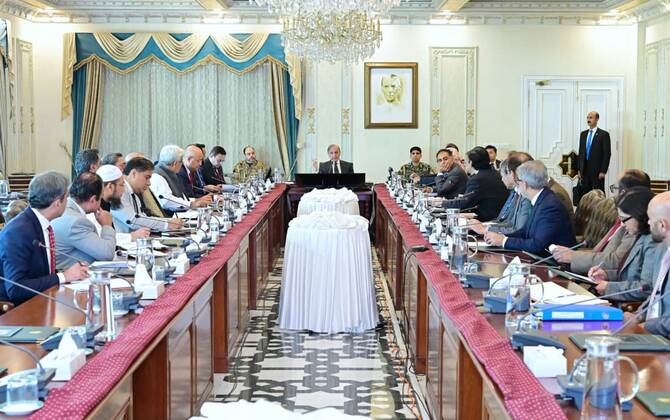
Pakistan Prime Minister Shehbaz Sharif speaks during a cabinet meeting in Islamabad on November 10, 2025. (Handout/PMO)
Short Url
Updated 10 November 2025
Follow

Pakistan to move welfare payments to digital wallets by month-end — PM

  • Pakistan launched 10 million digital wallets under flagship cash-transfer initiative for low-income households in August
  • A cashless economy will lead to improved governance and a significant reduction in corruption, says Shehbaz Sharif

ISLAMABAD: Pakistan’s government will activate digital wallets by the end of this month through which millions of beneficiaries will receive social protection payments, the Prime Minister’s Office (PMO) said in a statement on Monday as Islamabad accelerates its efforts to move toward a cashless economy.

Sharif launched 10 million digital wallets under the Benazir Income Support Programme (BISP), Pakistan’s flagship cash-transfer initiative for low-income households, in August. The Pakistani prime minister had termed the move as a “historic milestone” in the country’s journey toward transparency, financial inclusion and adopting a cashless economy.

Pakistan, which is a cash-dominated market especially considering the informal sector, has undertaken efforts in recent months to promote digital transactions. Officials have said promoting a cashless economy will promote accountability, curb corruption and prevent tax evasion.

Sharif chaired a review meeting of the government’s measures to promote cashless economy on Monday during which he was briefed on the status of the 10 million BISP digital wallets.

“[Participants] of the meeting were informed that these wallets will become fully functional by the end of this month, and the next tranche of payments to beneficiaries will be made through them,” the PMO said in a statement.

The prime minister was also informed that payment of electricity and gas bills are being made cashless through QR codes issued by instant digital payment platform Raast. The move would enable payment of bills worth billions of rupees digitally, the PMO said.

Sharif was briefed that the mobile application for obtaining government services in Islamabad has been linked with Raast to enable payments through it. The PMO added that issuing new business licenses in Islamabad has been made conditional on adopting digital payment systems, while all existing shops have been enabled to accept payments via Raast QR codes.

Sharif called for promoting awareness of the importance of a cashless economy in rural areas to fully eliminate informal economy.

“The entire world is rapidly moving toward a digital economy, and Pakistan must keep pace with global developments,” the prime minister said according to the PMO. “A cashless economy will lead to improved governance and a significant reduction in corruption.”


At least 42 civilians killed in Afghanistan in conflict with Pakistan, UN agency says

Updated 6 sec ago
Follow

At least 42 civilians killed in Afghanistan in conflict with Pakistan, UN agency says

  • Civilian ​casualties ‌include ⁠those ​caused by ⁠indirect fire, airstrikes, says UN Assistance Mission in Afghanistan
  • Conflict was sparked last Thursday after Afghan forces said were retaliation for Pakistani airstrikes earlier this month

KABUL/ISLAMABAD: At least 42 civilians have been killed and 104 wounded in Afghanistan in the fighting with Pakistan between February 26 and March 2, the United Nations Assistance Mission in Afghanistan (UNAMA) said on Tuesday, as the military conflict between the neighbors entered its sixth day.

Military tensions between the South Asian nations remained high on Tuesday, with Afghanistan saying it had captured another Pakistani post in the ‌Kandahar region and ‌the fighting between the allies-turned-foes was “still ongoing.”

“The civilian ​casualties ‌include ⁠those ​caused by ⁠indirect fire in cross-border clashes...as well as those caused by airstrikes,” the UN agency said, adding that the numbers were “preliminary.”

The conflict — the worst between the countries in years — was sparked last week by what Afghanistan’s Taliban rulers said were retaliatory strikes on Pakistani installations in response to Pakistan’s targeting of militants in Afghanistan.

Afghanistan says Pakistani forces targeted its civilians, a charge Islamabad denies.

Islamabad has ⁠launched air-to-ground missiles at Taliban military sites over the ‌last week, and even directly targeted the ‌Taliban government for the first time over ​allegations it harbors militants executing attacks on ‌Pakistan from its soil.

Pakistani forces destroyed a military base in ‌Nangarhar province of Afghanistan in a successful air operation, Pakistani security sources said on Tuesday.

UNAMA CALLS FOR HALT TO FIGHTING

Both sides have claimed to have killed scores of troops of the other and inflicted heavy damage on military facilities since the fighting ‌began.
Reuters has not been able to verify the numbers.

Pakistani President Asif Ali Zardari, while addressing a joint session ⁠of parliament ⁠on Monday, reiterated that Islamabad would not allow territory in its neighborhood to be used for attacks against it.

“The soil of Pakistan is sacred. We will not allow any entity — domestic or foreign — to use neighboring territory to destabilize our peace,” he said.

UNAMA called for a halt to the fighting and warned that the violence, which has displaced an estimated 16,400 households, has worsened the situation of Afghanistan’s people who were still recovering from successive earthquakes in August and September that killed more than 1,400 people.

“Restrictions on movements in the border area due to the active conflict have ​reduced the capacity of humanitarian agencies ​and partners to deliver life-saving and other assistance in the most-affected areas,” it said.