

Pakistan to conduct nationwide drive against measles, rubella and polio this month 

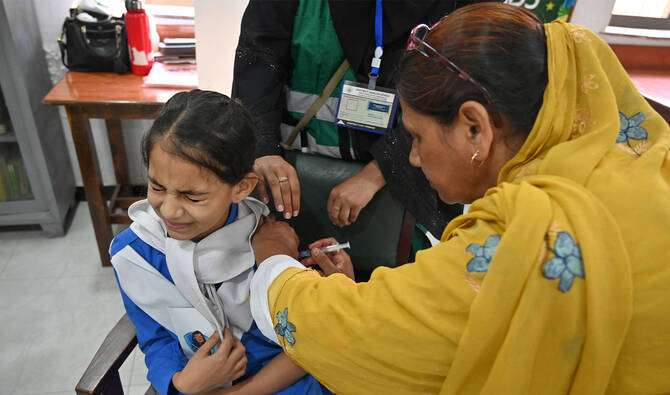
A health worker (R) administers human papillomavirus (HPV) vaccine to a school student in Islamabad on September 24, 2025. (AFP/File)
Short Url
Updated 10 November 2025
Follow

Pakistan to conduct nationwide drive against measles, rubella and polio this month 

  • All three diseases are highly contagious but can be prevented through vaccination
  • Pakistan has reported over 131,000 measles cases in past three years, official data states

KARACHI: Pakistan will launch a nationwide vaccination drive against measles, rubella and polio from Nov. 17 till Nov. 29, the National Emergency Operations Center (NEOC) announced on Sunday.

Measles, rubella, and polio are highly contagious diseases that continue to pose public health challenges in Pakistan, particularly among children. Measles and rubella spread through respiratory droplets and can cause pneumonia and encephalitis, while polio attacks the nervous system and can lead to irreversible paralysis. In the past three years, Pakistan has reported more than 131,000 measles cases, the NECO said. 

While all three diseases are preventable through vaccination, sporadic outbreaks in the past have highlight gaps in immunization coverage, misinformation and access to health care in remote areas in the South Asian country of over 241 million people. The NEOC said all children between the ages of 6 months and 5 years will be provided with free vaccines during the nationwide vaccination campaign.

“In specific high-risk districts, polio drops will be administered along with measles, rubella vaccine so that every child is protected,” it said in a statement.

“The vaccines will be provided free of charge at government health centers, schools, madrasas (religious seminaries) and temporary vaccination points.”

The measles-rubella (MR) vaccine will protect 35 million children aged 6 months to under five years nationwide, the NEOC said. 

Meanwhile, oral polio vaccination drops will be administered in 89 high-risk districts, reaching 22.9 million children under five to protect them from lifelong paralysis.

“Together, this nationwide effort will protect more than 36.4 million children across Balochistan, Sindh, Khyber Pakhtunkhwa, Punjab, Gilgit-Baltistan, Azad Jammu and Kashmir, and Islamabad,” the NEOC said. 

Last month, Pakistan ran a week-long, anti-polio immunization campaign, with vaccinators going door-to-door to inoculate over 45 million children nationwide despite multiple attacks.

Pakistan, one of the last two nations in the world along with Afghanistan where the disease remains endemic, has reported 30 polio cases so far this year.


Islamic military coalition, Pakistan to deepen cooperation to combat ‘terrorism’ — Pakistani military

Updated 02 February 2026
Follow

Islamic military coalition, Pakistan to deepen cooperation to combat ‘terrorism’ — Pakistani military

  • Islamic Military Counter Terrorism Coalition is a 43-member alliance that includes Pakistan, Saudi Arabia, Egypt, Jordan, UAE and other nations
  • The Pakistani military statement comes after a meeting between IMCTC secretary-general and the chief of Pakistani defense forces in Rawalpindi

ISLAMABAD: Pakistan and the Islamic Military Counter Terrorism Coalition (IMCTC) have reaffirmed their commitment to deepening cooperation, including intelligence sharing and capacity building, to jointly combat “terrorism” and “extremism,” the Pakistani military said on Monday.

The IMCTC is a 43-member military alliance that was formed on Saudi Arabia’s initiative in Dec. 2015 to consolidate Muslim countries’ efforts in countering “terrorism.”

A 17-member IMCTC delegation is visiting Pakistan from Feb. 2-6 to conduct a training at National University of Sciences and Technology on “Re-integration and Rehabilitation of Extremist Elements,” according to the Pakistani military.

On Monday, IMCTC Secretary-General Maj. Gen. Mohammed bin Saeed Al-Moghedi held a meeting with Chief of Pakistani Defense Forces Field Marshal Asim Munir to discuss cooperation among IMCTC member states.

“During the meeting, matters of mutual interest were discussed, with particular emphasis on regional security dynamics and enhanced cooperation in counter-terrorism efforts,” the Inter-Services Public Relations (ISPR), the Pakistani military’s media wing, said in a statement.

“Both sides reaffirmed their shared commitment to combating terrorism and extremism through collaborative strategies, intelligence sharing, and capacity building among member states.”

The IMCTC features Pakistan, Saudi Arabia, Türkiye, Afghanistan, Egypt, Jordan, Qatar, Palestine, UAE, Bangladesh and other nations. In 2017, Pakistan’s former army chief Gen. (retd) Raheel Sharif was appointed as the IMCTC commander-in-chief.

During discussions with Major General Al-Moghedi, Field Marshal Munir appreciated the role of IMCTC in fostering stability and promoting coordinated counterterrorism initiatives across the Islamic world, according to the ISPR.

The IMCTC secretary-general acknowledged Pakistan’s significant contributions and sacrifices in the fight against militancy and lauded the professionalism of Pakistan’s armed forces.

“The meeting underscored the resolve of both sides to further strengthen institutional collaboration for peace, stability, and security in the region,” the ISPR added.

Pakistan enjoys cordial ties with most Muslim countries around the world, particularly Gulf Cooperation Council countries. In Sept. 2025, Pakistan signed a landmark defense pact with Saudi Arabia according to which an act of aggression against one country will be treated as an act of aggression against both.