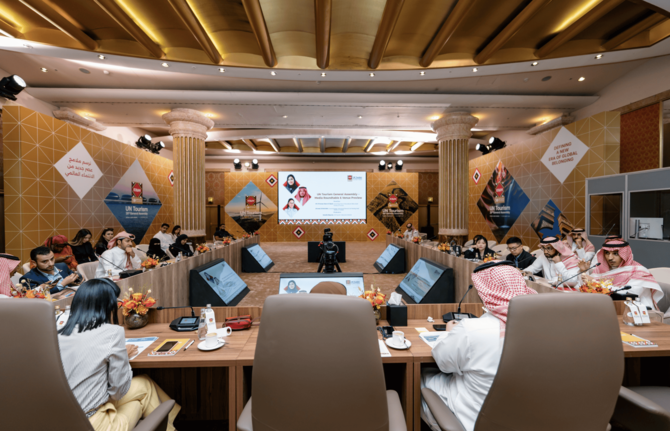

RIYADH: More than 160 delegates from across the world are in Riyadh for the 26th session of the UN Tourism General Assembly, with the opening ceremony and first plenary set to take place on Nov. 9.
For the first time, a Gulf Cooperation Council country is hosting a UN agency’s general assembly, underscoring the region’s important role in the tourism sector.
Over the coming days, delegates will participate in four plenary sessions, numerous meetings of seven specialized committees, and the 124th and 125th sessions of the Executive Council - the organization’s highest executive body.
Sunday’s agenda will see the General Assembly’s opening ceremony begin at 10am KSA time, followed by the first plenary meeting.
Ahead of the event, UN Tourism Secretary-General Zurab Pololikashvili said: “The UN Tourism General Assembly brings together tourism leaders from across the world to set the agenda and build a more innovative and inclusive sector.
“Over the next few days, first with the meeting of our diverse and dynamic Affiliate Members, and then with the sessions of our General Assembly, Riyadh will showcase the power of tourism, as a driver of transformation, modernisation and opportunity.
“Together, we can harness the power of technology to drive positive change, diversify our economies and create jobs for many millions of people everywhere.”
Saudi Minister of Tourism Ahmed Al Khateeb said the Kingdom is “proud” to welcome the world to the 26th UN Tourism General Assembly “as we celebrate 50 years of UN Tourism’s global cooperation and shared progress.”
He added: “This week marks a defining moment for our industry — a chance to shape how tourism grows in the decades ahead through stronger connectivity, greater sustainability, deeper investment in human capital, and innovation powered by AI.
“Tourism is one of the world’s most powerful forces for prosperity and understanding — creating jobs, supporting small businesses, and connecting cultures.
“Guided by Vision 2030, the Kingdom is committed to ensuring that this growth continues to drive opportunity and inclusion — and to welcoming the world with the spirit of Saudi hospitality that defines who we are.”
While the first public sessions of the gathering are set to take place on Sunday, work had already been going on behind closed doors in the days leading up to the opening ceremony, with 200 delegates, representing more than 100 affiliated entities, tackling issues facing the tourism sector.
According to UN Tourism, affiliate members met to advance public-private collaboration, with a dedicated segment of the session focused on the first UN Tourism Awards for Excellence in Sustainable Sports Tourism powered by FIA, a joint initiative between the Organization and the Affiliate Member Fédération Internationale de l'Automobile.
These awards will recognize outstanding projects that integrate sustainability, innovation, and community impact in the sports tourism sector.
Another key item on the agenda was the enhanced participation of affiliate members in the elaboration of the World Tourism Barometer.
Designated experts from the Affiliate Members network, who are now part of the Panel of Experts, are expected to contribute regularly with insights drawn from direct industry experience for this report published four times a year.
There was also the first meeting of the Executive Council’s Interinstitutional Working Group on Tourism and Climate Action.
Some 29 countries joined the session, with Brazil acting as chair, and Antigua and Barbuda, and Maldives as vice-chairs.
Speaking to Arab News, Maldives Minister of Tourism and Environment Thoriq Ibrahim highlighted the environmental impact of the industry on his country, and explained how his government is seeking to tackle the issue.
“Resorts are required to generate their own power,” he said, adding: “Under the current administration, one of the key pledges is that by 2028 the nation will produce 33 percent of its electricity from renewable energy.”