

UN genocide adviser warns ‘threshold about to be crossed’ in Sudan’s El-Fasher atrocities

The UN special adviser on the prevention of genocide on Friday said that Sudan may be nearing a tipping point for atrocities amid growing reports of widespread killings and attacks on civilians in El-Fasher. (AFP)
Short Url
Updated 07 November 2025
Follow

UN genocide adviser warns ‘threshold about to be crossed’ in Sudan’s El-Fasher atrocities

  • ‘Direct attacks on civilians’ highlight need for urgent action, Chaloka Beyani says
  • UN warns of worsening conditions in North Darfur, with hundreds of thousands facing acute shortages of food, water, medical care

NEW YORK: The UN special adviser on the prevention of genocide on Friday said that Sudan may be nearing a tipping point for atrocities amid growing reports of widespread killings and attacks on civilians in El-Fasher.

Warning that “a threshold is about to be crossed,” Chaloka Beyani said that “once our office sounds the alarm, (it) rings over and beyond ordinary violations of human rights or of international humanitarian law.”

He said the scale of atrocities shows “there has to be early action taken.”

Beyani said there had been “massive violations of international human rights law” and “direct attacks on civilians” by warring parties in Darfur.

Graphic reports and videos that surfaced late last month appeared to show atrocities carried out by the paramilitary Rapid Support Forces after they seized control of El-Fasher from government troops, ending a siege that had lasted more than 500 days.

UN Emergency Relief Coordinator Tom Fletcher told the Security Council recently that “the horror is continuing” in Darfur, warning that civilians remain trapped amid widespread violence.

Beyani’s office said several risk indicators for atrocities were now present in Sudan, though only an international court could determine whether genocide had occurred.

The International Criminal Court also expressed “profound alarm” earlier this week, saying it was gathering evidence of mass killings, rapes, and other atrocities allegedly committed in El-Fasher.

Meanwhile, reports indicate that the RSF has agreed to a “humanitarian ceasefire” proposed by the US, Saudi Arabia, and the UAE.

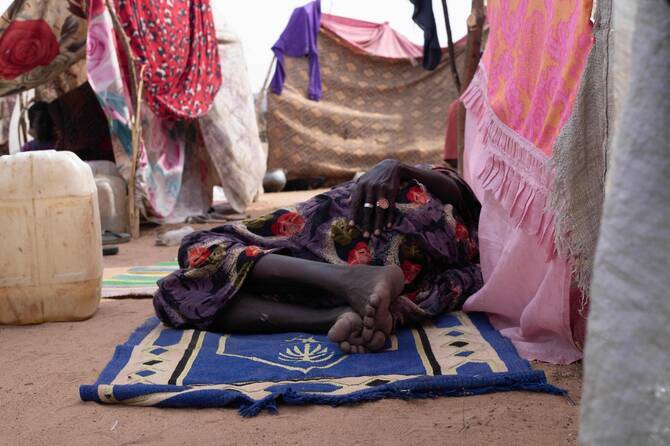
The UN has warned of deteriorating conditions in North Darfur, where hundreds of thousands displaced from El-Fasher face acute shortages of food, water, and medical care. Aid agencies are setting up new camps in Tawila and other nearby areas, but more than 650,000 people remain in desperate need of assistance.


Morocco to secure 60% of water needs from desalination

Nizar Baraka
Updated 14 sec ago
Follow

Morocco to secure 60% of water needs from desalination

  • Rabat boosts investment in facilities powered by renewable energy, minister tells Marrakech conference

MARRAKECH: Morocco, which has endured seven years of drought, plans to supply 60 percent of its drinking water from treated seawater by 2030, up from 25 percent, its water minister said, as Rabat accelerates investment in desalination plants powered by renewable energy.

The push is crucial to ensure a steady water supply and to maintain Morocco’s status as a key producer and exporter of fresh produce amid climate change, as droughts have dried up some of its main water reservoirs and depleted underground resources.

FASTFACT

The plant will have a capacity of 350 million cubic meters and will supply urban centers in Morocco’s food basket as well as farmlands.

The North African country plans to produce 1.7 billion cubic meters of desalinated water annually by 2030 from projects under construction and plants for which it will hold tenders starting next year, Nizar Baraka said on the sidelines of the World Water Congress in Marrakech.
The largest plant — with planned investment of about 10 billion dirhams ($1 billion) — will be located near Tiznit, 615 km south of the capital Rabat. 
It will have a capacity of 350 million cubic meters and will supply urban centers in the country’s food basket as well as farmlands, he said.
“Studies are underway as part of preparations for the plant’s tender, to be announced by mid next year,” Baraka said.
Besides the northern cities of Nador and Tangier, plants are also planned in Rabat in partnership with the French group Veolia, as well as in Tantan, where the government is considering building a port dedicated to green hydrogen and ammonia exports, Baraka said.
Morocco currently operates 17 desalination plants producing 345 million cubic meters annually. 
Four additional plants are under construction with a combined capacity of 540 million cubic meters, scheduled to be ready by 2027, including a major facility in Casablanca, the country’s most populous city.
“All new desalination plants will be powered by renewable energy,” Baraka said.
Morocco has also faced rising temperatures and worsening evaporation in dams. 
To counter this, it installed floating solar panels on a dam near Tangier to reduce evaporation, which accounts for 30 percent of the country’s surface water loss, according to the minister.
“The experiment will be expanded to include dams in the south and mountainous regions,” Baraka said.