‘Large numbers’ in Sudan’s El-Fasher facing death: MSF

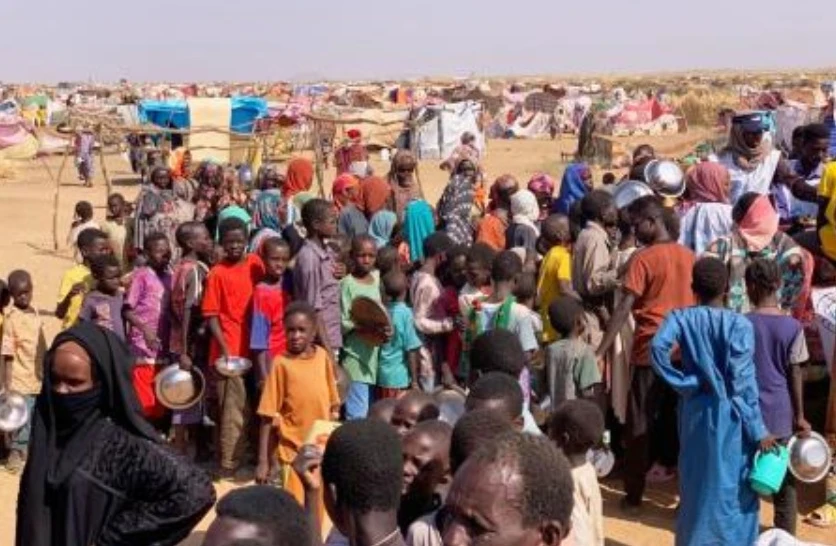
This photo released by the Norwegian Refugee Council, shows displaced families from el-Fasher at a displacement camp where they sought refuge from fighting between government forces and the RSF, in Tawila, Darfur region, Oct. 31, 2025. (AP)
Short Url
Updated 01 November 2025
Follow

‘Large numbers’ in Sudan’s El-Fasher facing death: MSF

  • MSF denounced the “horrendous mass atrocities and killings, both indiscriminate and ethnically-targeted,” that have occurred in and around El-Fasher this week
  • Survivors reported that people were separated based on their gender, age or presumed ethnic identity

GENEVA: Doctors Without Borders on Saturday said it feared an ongoing potentially fatal situation for “large numbers of people” in Sudan’s El-Fasher, which has been captured by the paramilitary Rapid Support Forces.
Thousands of people have fled from El-Fasher, which fell to the RSF on October 26 after an 18-month siege.
Since then, testimonies of bloody violence targeting civilians have proliferated.
In a statement, Doctors Without Borders (MSF) denounced the “horrendous mass atrocities and killings, both indiscriminate and ethnically-targeted,” that have occurred in and around El-Fasher this week.

“Large numbers of people remain in grave danger and are being prevented by the Rapid Support Forces and its allies from reaching safer areas, such as Tawila where we work,” the NGO added.
But the numbers of people arriving to Tawila, a nearby region, “don’t add up, while accounts of large-scale atrocities are mounting,” according to MSF’s head of emergencies Michel Olivier Lacharite.
“Where are all the missing people who have already survived months of famine and violence in El-Fasher?” he said.
“The most likely, albeit frightening, answer is that they are being killed, blocked, and hunted down when trying to flee.”
Humanitarian organizations fear ethnically motivated atrocities similar to those committed in the early 2000s in Darfur by the Arab Janjaweed militias, from which the RSF originated.
Several eyewitnesses told MSF that a group of 500 civilians, along with soldiers from the Sudanese Armed Forces and the army-allied Joint Forces, had attempted to flee on October 26, but most were killed or captured by the RSF and their allies.
Survivors reported that people were separated based on their gender, age or presumed ethnic identity, and that many are still being held for ransom. One survivor described “horrific scenes” where fighters crushed prisoners with their vehicles.
The war in Sudan has killed thousands of people, displaced millions more and triggered the world’s worst humanitarian crisis, according to the United Nations.
The conflict erupted in April 2023 with a power struggle between two former allies: General Abdel Fattah Al-Burhane, army chief and Sudan’s de facto leader since the 2021 coup, and RSF chief General Mohamed Dagalo.
UN’s development chief says living conditions in Gaza are worst he has ever seen

Updated 4 sec ago
Follow

UN’s development chief says living conditions in Gaza are worst he has ever seen

  • Alexander De Croo urges Israeli authorities to allow more access for removal of debris, provision of temporary housing, and efforts to restart the private sector
  • 90 percent of territory’s population living amid rubble in ‘extremely painful’ and dangerous circumstances, he says after 3-day visit to Gaza

NEW YORK CITY: The head of the UN Development Programme said on Tuesday that living conditions in Gaza are the worst he has witnessed in his career, as he urged Israeli authorities to grant more access for the removal of debris, the provision of temporary housing, and private-sector recovery efforts.
Speaking in East Jerusalem after a three-day visit to Gaza, Alexander De Croo said 90 percent of the territory’s population was living amid rubble in “extremely painful” and dangerous circumstances.
“I have been minister of development for six years in the past; this is the worst living conditions that I have ever seen,” he said.
Teams from his agency are focusing their recovery efforts in Gaza on three main areas, he explained: the removal of rubble and other solid waste, temporary housing, and restarting parts of the private sector.
UNDP has removed about 5 percent of the rubble from the war-ravaged enclave so far, De Croo said, but at the current pace clearing it all will take seven years.
“90 percent of the people of Gaza today live in the middle of that rubble, which is extremely dangerous,” he warned, adding that unexploded ordnance and other health risks pose additional ongoing dangers to residents.
Regarding housing, he said most people were living in what he described as very rudimentary tents. UNDP has built 500 “recovery housing” units and has a further 4,000 ready to go, but he estimated that between 100,000 and 203,000 units were needed to provide even the most basic improvements to shelter.
“This is definitely not reconstruction,” he said. “But it’s an improvement on what is available for the moment.”
His agency’s third area of focus is restoration of the private sector, which he said has been “in hibernation.” It aims to help businesses resume operations and provide income for residents through limited investments and cash-for-work programs, including the processing of food.
The main request his agency is making to Israeli authorities is greater access for the delivery of materials and equipment, De Croo said, including heavy machinery for the removal of debris, and components for temporary housing.
“We understand the security concerns of the Israeli authorities,” he said. “But that would not be a reason to not provide organizations such as UNDP, other UN organizations and international (nongovernmental organizations) the more access that is definitely needed to be able to help more people.”
Asked about Israel’s objections to the deployment of large bulldozers and the provision of additional housing units, De Croo said discussions with Israeli officials often centered on “dual-use” concerns over materials that could potentially have military as well as civilian applications.
“We are in continuous discussions with the Israeli authorities on what are the right conditions to have more access,” he said, adding that UNDP takes steps to ensure all materials are used solely for humanitarian purposes.
He reiterated his call for expanded access to enable support for humanitarian and recovery efforts, and said such assistance is an obligation on every state.
“We really have only one ask: Please provide organizations such as UNDP and the others the necessary access to be able to provide the humanitarian and recovery support,” he added.