

Pakistan president voices support for Indonesia after mosque blasts in Jakarta

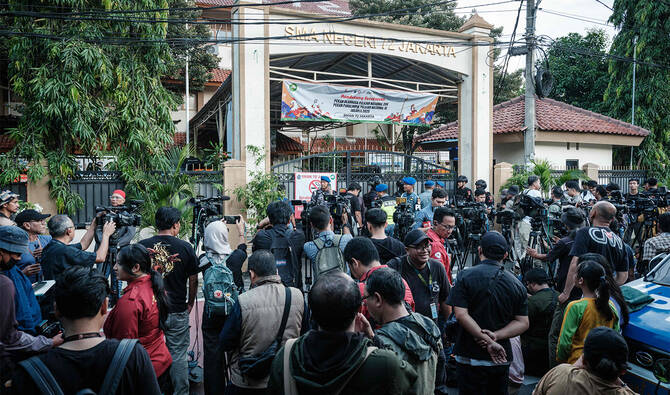
Journalists gather at the entrance of a school in Jakarta on November 7, 2025. A blast injured dozens of people near a school in Indonesia's capital on November 7, a senior police official said without disclosing the cause of the explosion. (AFP)
Short Url
Updated 07 November 2025
Follow

Pakistan president voices support for Indonesia after mosque blasts in Jakarta

  • Zardari reaffirms Pakistan’s commitment to combat militancy after 55 people injured in Jakarta blasts
  • Pakistan, Indonesia cooperate on counterterrorism through joint military exercises to fight extremism

ISLAMABAD: President Asif Ali Zardari reiterated Pakistan’s commitment to combat militancy in collaboration with the international community on Friday as he expressed support for Indonesian efforts against extremism after explosions in a mosque injured dozens during Friday prayers in Jakarta, his office said.

At least 55 people were hospitalized after the blasts, with Indonesian officials indicating the explosions may have been an attack after identifying a 17-year-old as a suspected perpetrator.

Videos from the scene showed police armed with assault rifles guarding the iron gates of the compound where the explosions occurred as emergency and armored vehicles lined the street.

“President Zardari reaffirmed Pakistan’s solidarity with Indonesia in the fight against terrorism and extremism, noting that Pakistan has itself suffered greatly and rendered immense sacrifices in this struggle,” the President’s Secretariat said in a statement.

“The President said that Pakistan stands shoulder to shoulder with Indonesia and the international community in its commitment to defeat terrorism in all its forms and manifestations.”

The statement added Zardari expressed “deep sorrow and concern” over the explosion, conveyed his sympathies to the Indonesian government and people and wished a swift recovery for the injured.

Pakistan and Indonesia have long cooperated on counterterrorism efforts and shared intelligence to combat extremist threats.

The two countries established a joint working group to combat militancy in 2005, following talks between former Indonesian and Pakistani Presidents Susilo Bambang Yudhoyono and Pervez Musharraf.

Last year, Pakistan and Indonesia participated in a week-long joint military exercise named Elang Strike-II to counter militancy.

This was the second exercise carried out by the two countries together in the counter-terrorism domain.

With input from Reuters


Historic Sikh prayer held at Lahore’s Aitchison College gurdwara after nearly 80 years

Updated 5 sec ago
Follow

Historic Sikh prayer held at Lahore’s Aitchison College gurdwara after nearly 80 years

  • Ceremony marks 140th anniversary of colonial-era institution
  • Shrine had remained closed since Partition due to absence of Sikh students

ISLAMABAD: A Sikh worship service was held today, Friday, at the historic gurdwara inside Lahore’s Aitchison College, reopening the shrine for prayer nearly eight decades after it fell out of regular use following the 1947 Partition.

Founded in 1886 to educate the sons of royalty and prominent families of undivided Punjab, Aitchison College once served students from Muslim, Hindu and Sikh backgrounds. After Partition, which created Pakistan and India and triggered mass migration along religious lines, Sikh enrollment ended and the gurdwara ceased functioning as an active place of worship, though the college continued to maintain the building.

Friday’s ceremony took place as part of events marking the elite school’s 140th anniversary.

“A historic and emotional Sikh worship service was held at the Gurdwara on the campus of Aitchison College,” the institution said in a statement announcing the ceremony.

The gurdwara was designed by renowned Sikh architect Ram Singh of the then Mayo School of Arts, now the National College of Arts. Its foundation stone was laid in 1910 by Maharaja Bhupinder Singh of Patiala, a former Aitchison student who studied there from 1904 to 1908, and the Patiala royal family supported fundraising for its construction. Completed shortly afterward, it served as a daily prayer space for Sikh pupils attending the school.

About 15 Sikh alumni of Aitchison College are currently living in India and have recalled attending evening prayers at the gurdwara, describing its black-and-white marble flooring and castle-like interior architecture.

The campus also houses other pre-Partition places of worship, including a mosque built in 1900 by the Nawab of Bahawalpur and a Hindu temple whose foundation stone was laid in 1910 by the Maharaja of Darbhanga.

Over the decades, Aitchison College has educated prominent figures from across pre-Partition Punjab and modern South Asia, including former Pakistani prime ministers Imran Khan, Mir Zafarullah Khan Jamali and Feroz Khan Noon, as well as Indian cricket captain Iftikhar Ali Khan Pataudi and members of princely families such as the Maharaja of Patiala.