World Food Programme may have to pause food aid in Congo due to record low funding

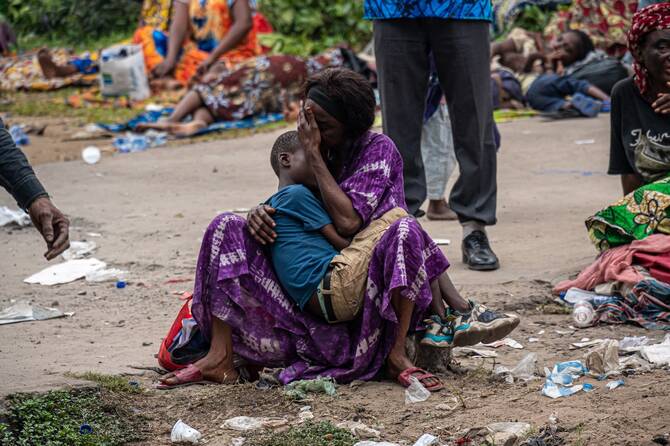
Victims of the April floods in the Tshangu district demonstrate in front of the residence of Democratic Republic of the Congo's President Felix Tshisekedi, in Kinshasa. (AFP)
Short Url
Updated 07 November 2025
Follow

World Food Programme may have to pause food aid in Congo due to record low funding

  • More than 3.2 million people are facing emergency levels of acute food insecurity in the eastern DRC

GENEVA:The UN World Food Programme warned on Friday it may have to pause food aid to help millions of malnourished people in eastern Democratic Republic of Congo by February due to a major funding crisis.
“We’re at historically low levels of funding. We’ve probably received about $150 million this year,” said Cynthia Jones, country director of the WFP for the DRC, pointing to a need for $350 million to help people in desperate need in the West African country.
More than 3.2 million people are facing emergency levels of acute food insecurity in the eastern DRC, characterised by large food gaps and high levels of acute malnutrition, according to a report by a global food monitor released on Tuesday.
The area has been rocked by more than a year of fighting. The Rwandan-backed M23 rebels staged a lightning offensive this year in South Kivu province that allowed them to seize more territory than ever before.
Rwanda has denied supporting the rebels. Both M23 and Congolese forces have been accused of carrying out atrocities.
Previously the WFP was reaching about 1 million people per month with food assistance, but has now had to reduce that number to 600,000 people per month amid dwindling funding.
“If we were to continue reaching 600,000 people per month, we would break completely by February, March. That’s the reality. That’s how dire the situation is,” Jones said.
In recent years the WFP had received up to $600 million in funding. In 2024 it received about $380 million.
UN agencies, including the WFP, have been hit by major cuts in US foreign aid as well as other major European donors reducing overseas aid budgets to increase defense spending. (Reporting by Olivia Le Poidevin, Editing by Miranda Murray and Alex Richardson)


Starvation fears as flood toll passes 900 in Indonesia

Updated 9 sec ago
Follow

Starvation fears as flood toll passes 900 in Indonesia

  • More than 1,790 people have been killed in natural disasters unfolding across Southeast Asia over the past week
  • Floods have swept away roads, smothered houses in silt, and cut off supplies in Indonesia's provinces of Aceh and North Sumatra

More than 1,790 people have been killed in natural disasters unfolding across Southeast Asia over the past week

Floods have swept away roads, smothered houses in silt, and cut off supplies in Indonesia's provinces of Aceh and North Sumatra

BANDA ACEH, Indonesia: Ruinous floods and landslides have killed more than 900 people on Indonesia’s island of Sumatra, the country’s disaster management agency said Saturday, with fears that starvation could send the toll even higher.
A chain of tropical storms and monsoonal rains has pummelled Southeast and South Asia, triggering landslides and flash floods from the Sumatran rainforest to the highland plantations of Sri Lanka.
More than 1,790 people have been killed in natural disasters unfolding across Indonesia, Sri Lanka, Malaysia, Thailand and Vietnam over the past week.
In Indonesia’s provinces of Aceh and North Sumatra, floods have swept away roads, smothered houses in silt, and cut off supplies.
Aceh governor Muzakir Manaf said response teams were still searching for bodies in “waist-deep” mud.
However, starvation was one of the gravest threats now hanging over remote and inaccessible villages.
“Many people need basic necessities. Many areas remain untouched in the remote areas of Aceh,” he told reporters.
“People are not dying from the flood, but from starvation. That’s how it is.”
Entire villages had been washed away in the rainforest-cloaked Aceh Tamiang region, Muzakir said.
“The Aceh Tamiang region is completely destroyed, from the top to the bottom, down to the roads and down to the sea.
“Many villages and sub-districts are now just names,” he said.
Aceh Tamiang flood victim Fachrul Rozi said he had spent the past week crammed into an old shop building with others who had fled the rising waters.
“We ate whatever was available, helping each other with the little supplies each resident had brought,” he told AFP.
“We slept crammed together.”
Aceh resident Munawar Liza Zainal said he felt “betrayed” by the Indonesian government, which has so far shrugged off pressure to declare a national disaster.
“This is an extraordinary disaster that must be faced with extraordinary measures,” he told AFP, echoing frustrations voiced by other flood victims.
“If national disaster status is only declared later, what’s the point?“
Declaring a national disaster would free up resources and help government agencies coordinate their response.
Analysts have suggested Indonesia could be reluctant to declare a disaster — and seek additional foreign aid — because it would show it was not up to the task.
Indonesia’s government this week insisted it could handle the fallout.

Climate calamity

The scale of devastation has only just become clear in other parts of Sumatra as engorged rivers shrink and floodwaters recede.
AFP photos showed muddy villagers salvaging silt-encrusted furniture from flooded houses in Aek Ngadol, North Sumatra.
Humanitarian groups worry that the scale of the calamity could be unprecedented, even for a nation prone to natural disasters.
Indonesia’s death toll rose to 908 on Saturday, according to the disaster management agency, with 410 people missing.
Sri Lanka’s death toll jumped on Friday to 607, as the government warned that fresh rains raised the risk of new landslides.
Thailand has reported 276 deaths and Malaysia two, while at least two people were killed in Vietnam after heavy rains triggered a series of landslides.
Seasonal monsoon rains are a feature of life in Southeast Asia, flooding rice fields and nourishing the growth of other key crops.
However, climate change is making the phenomenon more erratic, unpredictable and deadly throughout the region.
Environmentalists and Indonesia’s government have also suggested that logging and deforestation exacerbated landslides and flooding in Sumatra.