Pakistan, Afghanistan resume peace talks in Türkiye as Islamabad seeks end to cross-border attacks

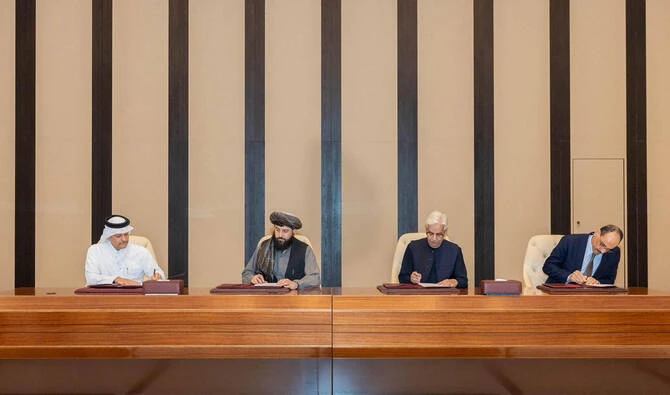
Afghan Defence Minister, Mullah Mohammad Yaqoob Mujahid and Pakistan's Defence Minister, Khawaja Muhammad Asif sign documents of a ceasefire agreement, during a negotations meeting mediated by Qatar and Turkey, in Doha, Qatar, on October 19, 2025. (REUTERS/File)
Short Url
Updated 06 November 2025
Follow

Pakistan, Afghanistan resume peace talks in Türkiye as Islamabad seeks end to cross-border attacks

  • Pakistan’s defense minister reaffirms talks with Afghanistan center on ending cross-border militant attacks
  • Both sides earlier extended the ceasefire and agreed to establish a monitoring and verification mechanism

ISLAMABAD: Pakistan’s negotiating team is in Istanbul to begin a new round of peace talks with Afghanistan on Thursday, Defense Minister Khawaja Asif said, reaffirming that Islamabad was seeking an end to cross-border militant attacks.

The two countries engaged in deadly border clashes last month that killed dozens of people on both sides before reaching a tenuous ceasefire amid peace talks mediated by Qatar and Türkiye.

Pakistan has long accused Afghanistan of sheltering militants who launch cross-border attacks while urging the authorities in Kabul not to let their land be used by armed factions. Afghanistan has frequently denied Islamabad’s allegation of any militant presence in the past, describing Pakistan’s security challenges as its internal matter.

However, the Taliban abandoned their traditional position more recently, with spokesperson Zabihullah Mujahid telling media Pakistan did not accept Kabul’s proposal “to expel individuals whom Islamabad considers a threat” from Afghanistan during the last round of negotiations, a claim dismissed by Pakistani authorities.

“The delegation left today and negotiations will start tomorrow,” the Pakistani minister told a group of journalists outside the parliament building on Wednesday, referring to his country’s negotiators and the talks with Afghanistan. “Let’s hope the Afghans also act with some prudence and peace can be restored in this region.”

The two countries had agreed to an extended ceasefire with a monitoring and verification mechanism developed with the help of the mediating nations at the end of the last round of negotiations.

The next round of talks was announced to be held in Istanbul on Nov. 6.

Asked about the prospects of a positive outcome, Asif said: “If there are chances of progress, dialogue is held. If there are no chances, it’s just a waste of time, right?”

He added that Pakistan had a single-point agenda that militant attacks should end from Afghan territory.

Pakistan challenged the Afghan version that Islamabad refused Kabul’s proposal to expel militants launching attacks against its people and security personnel earlier this month.

“Pakistan had demanded that terrorists in Afghanistan posing a threat to Pakistan be controlled or arrested,” the information ministry said in a social media post. “When the Afghan side said that they were Pakistani nationals, Pakistan immediately proposed that they be handed over through designated border posts, consistent with Pakistan’s long-standing position.”

It added that the Afghan narrative over the issue was both “false and misleading.”

The talks are taking place amid an atmosphere of distrust, with both sides accusing the other of not acting in good faith.

However, the two countries preferred to continue negotiations at the encouragement of the mediating nations after the last round hit a deadlock.

Islamabad dismisses claims about paying up to 8 percent interest on foreign loans as ‘misleading’

Updated 22 February 2026
Follow

Islamabad dismisses claims about paying up to 8 percent interest on foreign loans as ‘misleading’

  • Pakistan has long relied on external loans to help bridge persistent gaps in public finances and foreign exchange reserves
  • Pakistan’s total external debt, liabilities stand at $138 billion at an overall average cost of around 4 percent, ministry says

KARACHI: Pakistan’s finance ministry on Sunday dismissed as “misleading” claims that the country is paying up to 8 percent interest on external loans, saying the overall average cost of external public debt is approximately 4 percent.

Pakistan has long relied on external loans to help bridge persistent gaps in public finances and foreign exchange reserves, driven largely by a narrow tax base, chronic trade deficits, rising debt-servicing costs and repeated balance-of-payments pressures.

Over the decades, successive governments have turned to multilateral and bilateral lenders, including the International Monetary Fund, the World Bank and the Asian Development Bank, to support budgetary needs and shore up foreign exchange reserves.

The finance ministry on Sunday issued a clarification in response to a “recent press commentary” regarding the country’s external debt position and associated interest payments, and said the figures required contextual explanation to ensure accurate understanding of Pakistan’s external debt profile.

“Pakistan’s total external debt and liabilities currently stand at $138 billion. This figure, however, encompasses a broad range of obligations, including public and publicly guaranteed debt, debt of Public Sector Enterprises (both guaranteed and non-guaranteed), bank borrowings, private-sector external debt, and intercompany liabilities to direct investors. It is therefore important to distinguish this aggregate figure from External Public (Government) Debt, which amounts to approximately $92 billion,” it said.

“Of the total External Public Debt, nearly 75 percent comprises concessional and long-term financing obtained from multilateral institutions (excluding the IMF) and bilateral development partners. Only about 7 percent of this debt consists of commercial loans, while another 7 percent relates to long-term Eurobonds. In light of this composition, the claim that Pakistan is paying interest on external loans ‘up to 8 percent’ is misleading.

The overall average cost of External Public Debt is approximately 4 percent, reflecting the predominantly concessional nature of the borrowing portfolio.”

With respect to interest payments, public external debt interest outflows increased from $1.99 billion in Fiscal Year (FY) 2022 to $3.59 billion in FY2025, representing an increase of 80.4 percent, not 84 percent as reported. In absolute terms, interest payments rose by $1.60 billion over this period, not $1.67 billion, it said.

According to the State Bank of Pakistan’s records, Pakistan’s total debt servicing payments to specific creditors during the period under reference were as follows: the IMF received $1.50 billion, of which $580 million constituted interest; Naya Pakistan Certificates payments totaled $1.56 billion, including $94 million in interest; the Asian Development Bank received $1.54 billion, including $615 million in interest; the World Bank received $1.25 billion, including $419 million in interest; and external commercial loans amounted to nearly $3 billion, of which $327 million represented interest payments.

“While interest payments have increased in absolute terms, this rise cannot be attributed solely to an expansion in the debt stock,” the ministry said. “Although the overall debt stock has increased slightly since FY2022, the additional inflows have primarily originated from concessional multilateral sources and the IMF’s Extended Fund Facility (EFF) under the ongoing IMF-supported program.”

Pakistan secured a $7 billion IMF bailout in Sept. 2024 as part of Prime Minister Shehbaz Sharif’s efforts to stabilize the South Asian economy that narrowly averted a default in 2023. The government has since been making efforts to boost trade and bring in foreign investment to consolidate recovery.

“It is also important to note that the increase in interest payments reflects prevailing global interest rate dynamics. In response to the inflation surge of 2021–22, the US Federal Reserve raised the federal funds rate from 0.75-1.00 percent in May 2022 to 5.25–5.50 percent by July 2023. Although rates have since moderated to around 3.75 percent, they remain significantly higher than 2022 levels,” the finance ministry said.

“The government remains committed to prudent debt management, transparency, and the continued strengthening of Pakistan’s macroeconomic stability,” it added.