


WASHINGTON: In a parallel reality, Donald Trump reigns as king, fighter pilot, and Superman, and his political opponents are cast as criminals and laughingstocks — an unprecedented weaponization of AI imagery by a sitting American president.
Trump has ramped up his use of artificial intelligence-generated content on his Truth Social channel since starting his second White House term, making his administration the first to deploy hyper-realistic fake visuals as a core communications strategy.
Trump, no stranger to conspiracy theories and unfounded claims, has used the content in his breathless social media commentary to glorify himself and skewer his critics — particularly during moments of national outrage.
Last month, he posted a fake video showing himself wearing a crown and flying a fighter jet labeled “King Trump” that dumps what appears to be excrement on crowds of protesters.
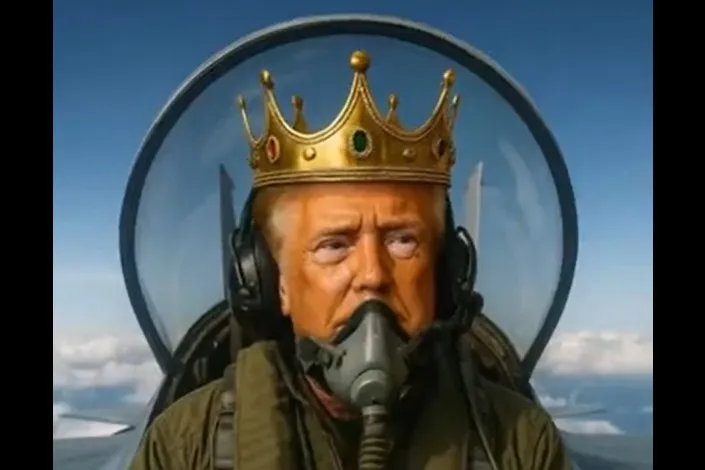
Meme of President Trump as "King Trump". (Truth Social)
The clip — accompanied by singer Kenny Loggins’s “Danger Zone” — was posted the same day as nationwide “No Kings” protests against what critics called his authoritarian behavior.
In another post, the White House depicted Trump as Superman amid fevered social media speculation about his health.
“THE SYMBOL OF HOPE,” the post said.
“SUPERMAN TRUMP.”
‘Distort reality’
Trump or the White House have similarly posted AI-made images showing the president dressed as the pope, roaring alongside a lion, and conducting an orchestra at the Kennedy Center, a venerable arts complex in the US capital.
The fabricated imagery has deceived social media users, some of whom questioned in comments whether they were authentic.
It was unclear whether the imagery was generated by Trump himself or his aides. The White House did not respond to AFP’s request for comment.
Wired magazine recently labeled Trump “America’s first generative AI president.”
“Trump peddles disinformation on and offline to boost his own image, attack his adversaries and control public discourse,” Nora Benavidez, senior counsel at the advocacy group Free Press, told AFP.
“For someone like him, unregulated generative AI is the perfect tool to capture people’s attention and distort reality.”
In September, the president triggered outrage after posting an apparent AI-generated video of himself promising every American access to all-healing “MedBed” hospitals.
MedBed, a widely debunked conspiracy theory popular among far-right circles, refers to an imaginary medical device equipped with futuristic technology. Adherents say it can cure any ailment, from asthma to cancer.
Trump’s phony clip — later deleted without any explanation — was styled as a Fox News segment and featured his daughter-in-law Lara Trump promoting a fictitious White House launch of the “historic new health care system.”
‘Campaigning through trolling’
“How do you bring people back to a shared reality when those in power keep stringing them along?” asked Noelle Cook, a researcher and author of “The Conspiracists: Women, Extremism, and the Lure of Belonging.”
Trump has reserved the most provocative AI posts for his rivals and critics, using them to rally his conservative base.
In July, he posted an AI video of former president Barack Obama being arrested in the Oval Office and appearing behind bars in an orange jumpsuit.
Later, he posted an AI clip of House minority leader Hakeem Jeffries — who is Black — wearing a fake mustache and a sombrero.
Jeffries slammed the image as racist.
“While it would in many ways be desirable for the president of the United States to stay above the fray and away from sharing AI images, Trump has repeatedly demonstrated that he sees his time in office as a non-stop political campaign,” Joshua Tucker, co-director of the New York University Center for Social Media and Politics, told AFP.
“I would see his behavior more as campaigning through trolling than actively trying to propagate the false belief that these images depict reality.”
Mirroring Trump’s strategy, California Governor Gavin Newsom on Tuesday posted an apparent AI video on X lampooning Republicans after Democrats swept key US elections.
The clip depicted wrestlers inside a ring with superimposed faces of Democratic leaders knocking down their Republican opponents, including Trump.
The post read: “Now that’s what we call a takedown.”


