

Tech giants sign pact against AI-made political deepfakes

1 / 2
An activist of Tehreek-e-Insaf (PTI) party listens to Pakistan's former Prime Minister Imran Khan's speech on a phone, in Zaman Park in Lahore on May 13, 2023. (AFP/File)
2 / 2
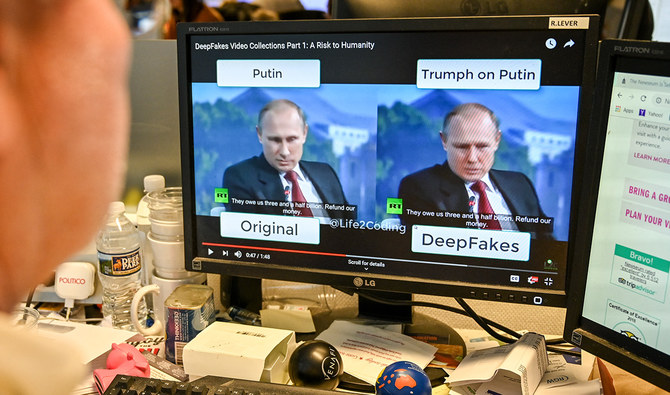
A AFP journalist views a video on January 25, 2019, manipulated with artificial intelligence to potentially deceive viewers, or "deepfake" at his newsdesk in Washington, DC. (AFP/File)
Short Url
Updated 17 February 2024
Follow

Tech giants sign pact against AI-made political deepfakes

  • In Pakistan, the party of former prime minister Imran Khan has used AI to generate speeches from their jailed leader
  • Last month, a robocall impersonation of President Biden urged people to not cast ballots in the New Hampshire primary

MUNICH: Tech giants including Meta, Microsoft and TikTok signed a pledge Friday to crack down on AI content intended to deceive voters ahead of crucial elections around the world this year.

The accord commits the companies including Google and OpenAI to develop ways to identify, label and control AI-generated images, videos and audio that aim to mislead voters.

“I think you need all the players from the source of the generation to the actual consumption by the user involved and that’s why I think having everybody, 20 companies sign up to this is so impactful,” Nick Clegg, president of global affairs at Meta, told AFP.

Among the 20 signatories of the deal, presented on the sidelines of the Munich Security Conference in Germany, were also X, formerly known as Twitter, as well as Snap, Adobe, LinkedIn, Amazon and IBM.

Under the agreement, AI-generated content could be given a watermark or tagged in the metadata at source, although the signatories acknowledged that “all such solutions have limitations.”

The tech companies also said they would also work together to develop ways to “detect and address” deceptive election material on their platforms.

Such content could, for example, be annotated to make it clear it is AI generated.

Meta, Google and OpenAI have already agreed to use a common watermarking standard that would tag images generated by their AI applications, such as OpenAI’s ChatGPT, Microsoft’s Copilot or Google’s Gemini (formerly Bard).

The pledge comes as big tech companies are under considerable pressure over fears that AI-powered applications could be misused in a pivotal election year.

The European Commission vice president for values and transparency, Vera Jourova, who attended the presentation in Munich, said she was pleased the tech companies “agree the technology can pose a risk to democracy.”

Governments “could not blame big tech for everything,” however, Jourova said.

“We also have some job to do on our side,” she said, with the EU preparing for elections to the European Parliament in June.

Recent examples of convincing AI deepfakes have only heightened worries about the easily accessible technology.

Last month, a robocall impersonation of US President Joe Biden pushed out to tens of thousands of voters urged people to not cast ballots in the New Hampshire primary.

In Pakistan, the party of former prime minister Imran Khan has used AI to generate speeches from their jailed leader.


Pakistan warns India-Canada uranium deal could widen nuclear imbalance in South Asia

Updated 5 sec ago
Follow

Pakistan warns India-Canada uranium deal could widen nuclear imbalance in South Asia

  • Islamabad says assured uranium supplies could free India’s domestic reserves for military use
  • Foreign office calls for non-discriminatory nuclear cooperation framework for non-NPT states

ISLAMABAD: Pakistan on Thursday voiced concern over a uranium supply agreement and nuclear technology cooperation between India and Canada, warning the arrangement could expand India’s nuclear arsenal and undermine the global non-proliferation framework.

The statement came after Ottawa and New Delhi concluded a long-term deal covering uranium supplies and potential cooperation in advanced nuclear technologies, including small modular reactors.

The agreement was announced earlier this week as part of efforts by the two countries to deepen energy and economic ties. Canada has previously supplied uranium to India under a civilian nuclear cooperation framework first agreed in 2010 and implemented in 2013, with commercial supply contracts signed in subsequent years.

“Assured external uranium supplies effectively release India’s domestic reserves for military use, enabling the expansion of its fissile material stockpiles, accelerating the growth of its nuclear arsenal, and deepening existing asymmetries in South Asia’s strategic balance,” foreign office spokesperson Tahir Andrabi said in a statement while responding to media queries.

“The arrangement also undermines Canada’s commitment to the international non-proliferation regime and its corresponding obligations under that framework,” he added.

Andrabi said the agreement represents another country-specific exception in civilian nuclear cooperation, noting that India’s 1974 nuclear test — conducted using plutonium produced in a Canadian-supplied research reactor — led to the creation of the Nuclear Suppliers Group (NSG).

“A state whose actions necessitated the establishment of global export controls is now being granted preferential access under selective arrangements,” he added.

The foreign office spokesperson said India has not placed all of its civilian nuclear facilities under International Atomic Energy Agency safeguards and has not made binding commitments under the new arrangement to do so.

He also pointed out it was unclear what concrete non-proliferation assurances accompanied the agreement.

“Pakistan reiterates that civil nuclear cooperation must be governed by a non-discriminatory, criteria-based approach applicable equally to states that are not parties to the Nuclear Non-Proliferation Treaty (NPT),” Andrabi said.

“Selective exceptions diminish the credibility of the global non-proliferation framework and risk further destabilizing regional and global peace & security.”