World leaders to rally climate fight ahead of Amazon summit

Brazil's President Luiz Inacio Lula da Silva poses with Sidi Ould Tah, president of the African Development Bank, under a giant tree in the Amazon in Belem, Brazil, on November 5, 2025, ahead of the United Nations COP 30 event. (REUTERS)
Short Url
Updated 06 November 2025
Follow

World leaders to rally climate fight ahead of Amazon summit

  • About 50 heads of state are expected in the rainforest city of Belem for a summit ahead of next week's COP30 climate negotiations
  • Almost every nation is participating, but the US is sending nobody, with President Donald Trump having branded climate science a “con job”

BELÉM, Brazil: World leaders meet Thursday in the Brazilian Amazon in an effort to show that climate change remains a top global priority despite broken promises and the United States shunning the gathering.
About 50 heads of state and government are expected in the rainforest city of Belem for a summit on Thursday and Friday ahead of the annual UN Conference of Parties (COP) climate negotiations that open next week.
Almost every nation is participating, but Washington is sending nobody, with President Donald Trump having branded climate science a “con job.”
UK Prime Minister Keir Starmer and French President Emmanuel Macron are expected in Belem but other major economies, including China and India, are sending deputies or climate ministers.
The choice of Belem, a city of 1.4 million people, half of whom live in working-class neighborhoods known as favelas, has been controversial due to its limited infrastructure, with sky-high hotel fees complicating the participation of small delegations and NGOs.
Authorities have invested in new buildings and renovations, but with fewer than 24 hours to go to the leaders’ summit opening, media teams and delegation scouts arrived at the COP venue Wednesday to find building works still very much underway.
Nonetheless, Karol Farias, 34, a makeup artist who came to shop at the newly spruced up Ver-o-Peso market told AFP: “The COP is bringing Belem the recognition it deserves.”

Uphill battle 

Brazil is not seeking to land a big deal at COP30, but rather to send a clear signal in an uncertain time that nations still back the climate fight.
The US absence will linger awkwardly during the summit, as will Brazil’s recent approval of oil drilling near the mouth of the Amazon River.
So, too, will the unanswered call for a wave of ambitious new climate pledges ahead of COP30, and the stark acknowledgement from UN chief Antonio Guterres that the target of limiting global warming to 1.5 degrees Celsius from pre-Industrial levels will be missed.
Host Brazil is also still scrambling to find affordable rooms in Belem for cash-strapped countries.
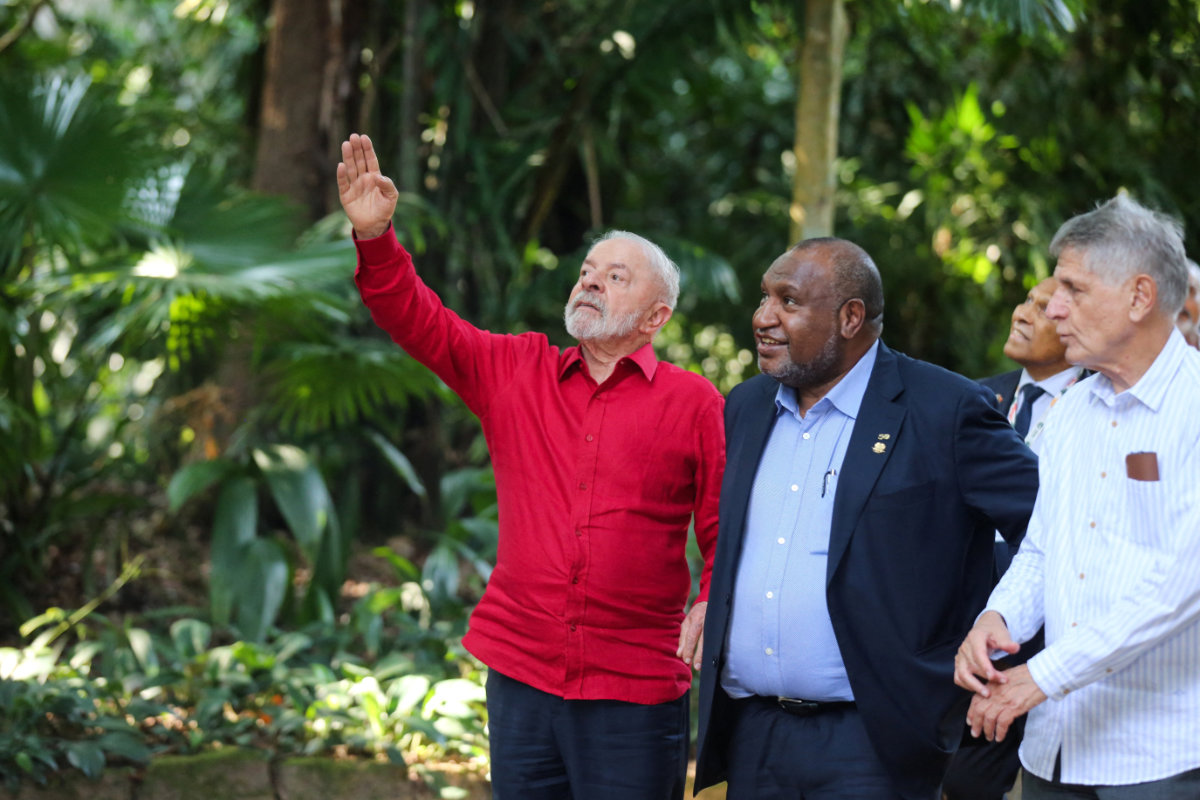


Brazil's President Luiz Inacio Lula da Silva gestures next to James Marape, prime minister of Papua New Guinea, ahead of the COP 30, in Belem, Brazil, on November 5, 2025. (REUTERS)

The COP30 presidency on Tuesday said it had secured outside funding to provide three free cabins aboard cruise ships for delegations from low-income countries.
Brazil has acknowledged the uphill battle it faces rallying climate action at a time of wars and tariff disputes, tight budgets, and a populist backlash against green policies.
In a sobering reminder of the task at hand, a closely watched vote last month to reduce pollution from global shipping was rejected under intense pressure from the United States.
Leaders gathered in Belem “need to deliver a clear mandate to the COP to be ambitious and to close the gap and to address the issues that are burning,” Greenpeace Brazil executive director Carolina Pasquali told AFP from aboard the organization’s Rainbow Warrior flagship, docked at the city’s port.

 ‘Enough talk’ 

Rather than producing a slew of new commitments, Brazil has cast the summit as an opportunity for accountability.
“Enough talking, now we have to implement what we’ve already discussed,” Brazil’s President Luiz Inacio Lula da Silva said this week.
Brazil is putting diplomatic muscle into pitching a global fund that would reward tropical countries for protecting rainforests.
It has also put a particular emphasis on adaptation, a key demand of countries pushing for more help to build defenses against rising seas and climate disasters.
“This is not a charity, but a necessity,” Evans Njewa, a Malawian diplomat and chair of the Least Developed Countries bloc, told AFP.
These countries want concrete detail on how climate finance can be substantially boosted to $1.3 trillion a year by 2035 — the estimated need in the developing world.
The hosts are also under pressure to marshal a response to the collective failure to limit warming to 1.5C as agreed in the landmark Paris accord a decade ago.
Even if all commitments are enacted in full, global warming is still set to reach 2.5C by century’s end.
“For many of our countries, we won’t be able to adapt our way out of something that overshoots over two degrees,” Ilana Seid, a diplomat from Palau and chair of the Alliance of Small Island States, told AFP in October.
They, among others, want to tackle fossil fuels and push for deeper cuts to greenhouse gas emissions.
Lula said Brazil wants to “propose a roadmap for reducing fossil fuels” but conceded it was a difficult conversation.


Italian fashion designer Valentino dead at 93

Updated 10 min 30 sec ago
Follow

Italian fashion designer Valentino dead at 93

ROME: Valentino Garavani, the jet-set Italian designer whose high-glamor gowns — often in his trademark shade of “Valentino red” — were fashion show staples for nearly half a century, has died at home in Rome, his foundation announced Monday. He was 93.
“Valentino Garavani was not only a constant guide and inspiration for all of us, but a true source of light, creativity and vision,″ the foundation said in a statement posted on social media.
His body will repose at the foundation’s headquarters in Rome on Wednesday and Thursday. The funeral will be held Friday at the Basilica Santa Maria degli Angeli e dei Martiri in Rome’s Piazza della Repubblica.
Universally known by his first name, Valentino was adored by generations of royals, first ladies and movie stars, from Jackie Kennedy Onassis to Julia Roberts and Queen Rania of Jordan, who swore the designer always made them look and feel their best.
“I know what women want,” he once remarked. “They want to be beautiful.”
Never one for edginess or statement dressing, Valentino made precious few fashion faux-pas throughout his nearly half-century-long career, which stretched from his early days in Rome in the 1960s through to his retirement in 2008.
His fail-safe designs made Valentino the king of the red carpet, the go-to man for A-listers’ awards ceremony needs. His sumptuous gowns have graced countless Academy Awards, notably in 2001, when Roberts wore a vintage black and white column to accept her best actress statue. Cate Blanchett also wore Valentino — a one-shouldered number in butter-yellow silk — when she won the Oscar for best supporting actress in 2004.
Valentino was also behind the long-sleeved lace dress Jacqueline Kennedy wore for her wedding to Greek shipping magnate Aristotle Onassis in 1968. Kennedy and Valentino were close friends for decades, and for a spell the one-time US first lady wore almost exclusively Valentino.
He was also close to Diana, Princess of Wales, who often donned his sumptuous gowns.
Beyond his signature orange-tinged shade of red, other Valentino trademarks included bows, ruffles, lace and embroidery; in short, feminine, flirty embellishments that added to the dresses’ beauty and hence to that of the wearers.
Perpetually tanned and always impeccably dressed, Valentino shared the lifestyle of his jet-set patrons. In addition to his 152-foot (46-meter) yacht and an art collection including works by Picasso and Miro, the couturier owned a 17th-century chateau near Paris with a garden said to boast more than a million roses.
Valentino and his longtime partner Giancarlo Giammetti flitted among their homes — which also included places in New York, London, Rome, Capri and Gstaad, Switzerland — traveling with their pack of pugs. The pair regularly received A-list friends and patrons, including Madonna and Gwyneth Paltrow.
“When I see somebody and unfortunately she’s relaxed and running around in jogging trousers and without any makeup ... I feel very sorry,” the designer told RTL television in a 2007 interview. “For me, woman is like a beautiful, beautiful flower bouquet. She has always to be sensational, always to please, always to be perfect, always to please the husband, the lover, everybody. Because we are born to show ourselves always at our best.”
Valentino was born into a well-off family in the northern Italian town of Voghera on May 11, 1932. He said it was his childhood love of cinema that set him down the fashion path.
“I was crazy for silver screen, I was crazy for beauty, to see all those movie stars being sensation, well dressed, being always perfect,” he explained in the 2007 television interview.
After studying fashion in Milan and Paris, he spent much of the 1950s working for established Paris-based designer Jean Desses and later Guy Laroche before striking out on his own. He founded the house of Valentino on Rome’s Via Condotti in 1959.
From the beginning, Giammetti was by his side, handling the business aspect while Valentino used his natural charm to build a client base among the world’s rich and fabulous.
After some early financial setbacks — Valentino’s tastes were always lavish, and the company spent with abandon — the brand took off.
Early fans included Italian screen sirens Gina Lollobrigida and Sophia Loren, as well as Hollywood stars Elizabeth Taylor and Audrey Hepburn. Legendary American Vogue editor-in-chief Diana Vreeland also took the young designer under her wing.
Over the years, Valentino’s empire expanded as the designer added ready-to-wear, menswear and accessories lines to his stable. Valentino and Giammetti sold the label to an Italian holding company for an estimated $300 million in 1998. Valentino would remain in a design role for another decade.
In 2007, the couturier feted his 45th anniversary in fashion with a 3-day-long blowout in Rome, capped with a grand ball in the Villa Borghese gallery.
Valentino retired in 2008 and was briefly replaced by fellow Italian Alessandra Facchinetti, who had stepped into Tom Ford’s shoes at Gucci before being sacked after two seasons.
Facchinetti’s tenure at Valentino proved equally short. As early as her first show for the label, rumors swirled that she was already on her way out, and just about one year after she was hired, Facchinetti was indeed replaced by two longtime accessories designers at the brand, Maria Grazia Chiuri and Pier Paolo Piccioli.
Chiuri left to helm Dior in 2016, and Piccioli continued to lead the house through a golden period that drew on the launch of the Rockstud pump with Chiuri and his own signature color, a shade of fuchsia called Pink PP. He left the house in 2024, later joining Balenciaga, and has been replaced by Alessandro Michele, who revived Gucci’s stars with romantic, genderless styles.
Valentino is owned by Qatar’s Mayhoola, which controls a 70 percent stake, and the French luxury conglomerate Kering, which owns 30 percent with an option to take full control in 2028 or 2029. Richard Bellini was named CEO last September.
Valentino has been the subject of several retrospectives, including one at the Musee des Arts Decoratifs, which is housed in a wing of Paris’ Louvre Museum. He was also the subject of a hit 2008 documentary, “Valentino: The Last Emperor,” that chronicled the end of his career in fashion.
In 2011, Valentino and Giammetti launched what they called a “virtual museum,” a free desktop application that allows viewers to feast their eyes on about 300 of the designer’s iconic pieces.