



ISLAMABAD: In a modest Islamabad workshop thick with the scent of enamel paint, artist Muhammad Ejaz Ullah Mughal carefully guided his brush across the curved body of a vintage Vespa scooter, covering the metal in blooming florals, intricate foliage and portraits of Saudi Arabia’s King Salman and Crown Prince Mohammed bin Salman as well as landmarks from the Kingdom.
Mughal, 48, is collaborating with fellow painter Ghulam Shabbir, 65, on the hand-decorated scooter, which will be shipped later this month to a restaurant in Al Khobar, Saudi Arabia, owned by a Pakistani expat. The display, alongside other examples of Pakistani truck art, is intended as a cultural bridge between the two countries.
Pakistan and Saudi Arabia maintain close economic, political and security relations, underpinned by shared religious and cultural connections. The two countries have recently expanded cooperation through agreements on defense and economic coordination.
The connection also runs through personal experience. Both Mughal and Shabbir have previously worked in the Kingdom and say the project carries deeper meaning.
“When I was in Saudi Arabia, I used to write ‘Pak-Saudi Friendship’ [on different things] and gift them to people,” Mughal told Arab News as he painted a floral motif on the Vespa.
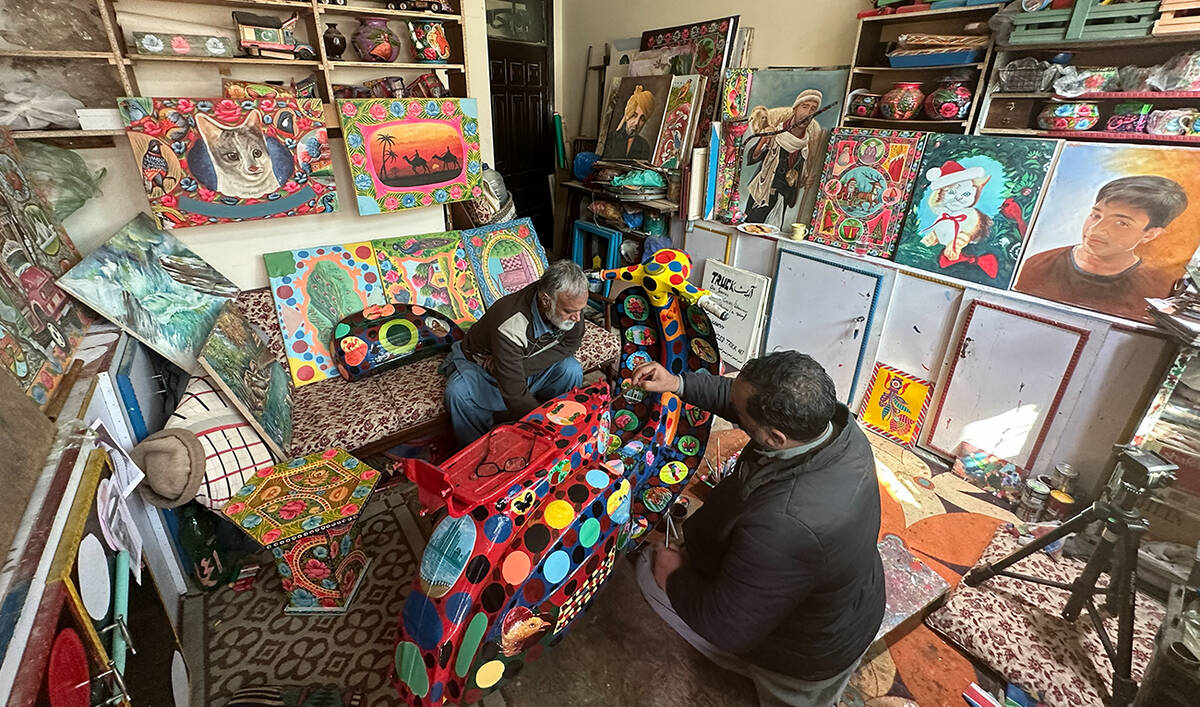
Two artists paint a vintage Italian Vespa in Islamabad, Pakistan, on February 17, 2026. (AN)
“They would ask me what I had written in Urdu, in Nastaliq [style]. When it was explained to them in Arabic, they would embrace me warmly.”
For Mughal, choosing the vintage Vespa symbolized pairing two fading traditions: the classic Italian scooter and Pakistan’s hand-painted truck art.
“Now because of [this] truck art, I will need not say anything, because it will itself be speaking: ‘Long live Pak-Saudi Friendship’,” he said.
Pakistani truck art is a distinctive folk aesthetic known for vivid colors, poetic calligraphy and elaborate imagery. Originating from decorations on cargo vehicles, the style has gained international recognition and appeared in exhibitions and public installations abroad.
The project is being mentored by Sofia Akhtar, an income tax lawyer-turned-artist who runs a studio supporting traditional craftsmen.
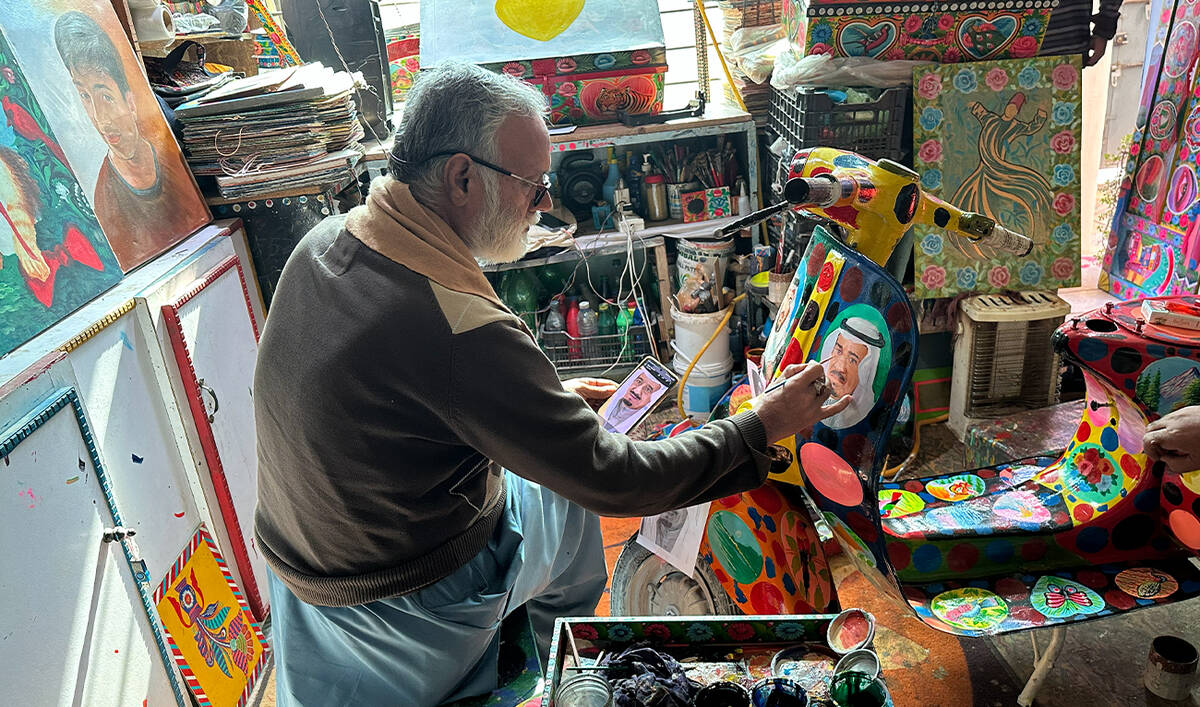
The artist, Ghulam Shabir, paints a portrait of Saudi King Salman on a Vespa in Islamabad, Pakistan, on February 17, 2026. (AN)
“Before this, our work began to be recognized in Europe, when in the UK a bus was adorned with truck art,” Akhtar said. “Now after Europe, at this time our diversion has started toward the Arab countries.”
She expects the Saudi reception to be strong as the Kingdom expands cultural initiatives.
“I feel as if their [artists] work will explode like a volcano and spread all over Arab countries,” she said.
While Mughal focuses on design, the detailed execution relies on Shabbir, a veteran artist who previously painted large cinema hoardings before digital printing replaced the craft.
He worked in Saudi Arabia from 2009 to 2022, including on the Makkah Hotel in Jeddah.
“I know that when this goes there to Saudi
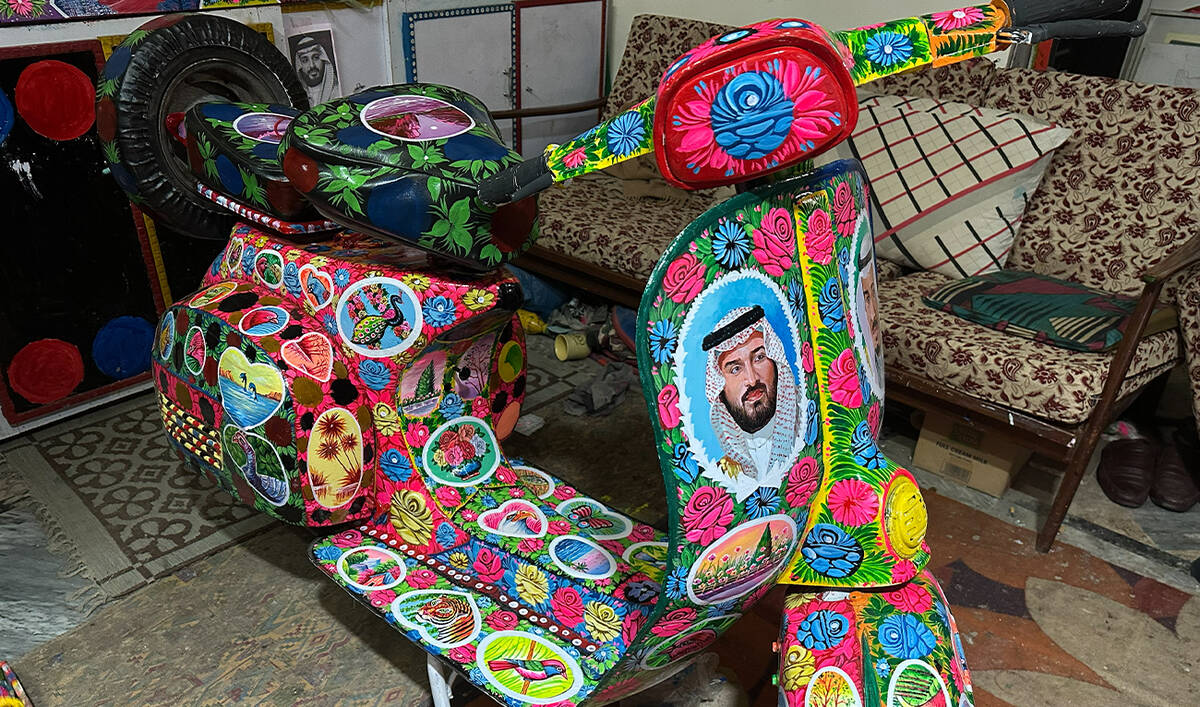
A vintage Vespa displays Pakistan’s iconic truck art, featuring portraits of the Saudi King and Crown Prince, in Islamabad, Pakistan, on February 17, 2026. (AN)
Arabia, a fair will gather around it,” Shabbir said. “Those people are very devoted to their Kings. They love King Salman and [Crown Prince] Mohammed bin Salman very much. They love them a lot. When they see this portrait, it is a new style, new work for them.”
He noted that although the imagery was familiar in Pakistan, the level of hand-painted detail was unusual in the Gulf.
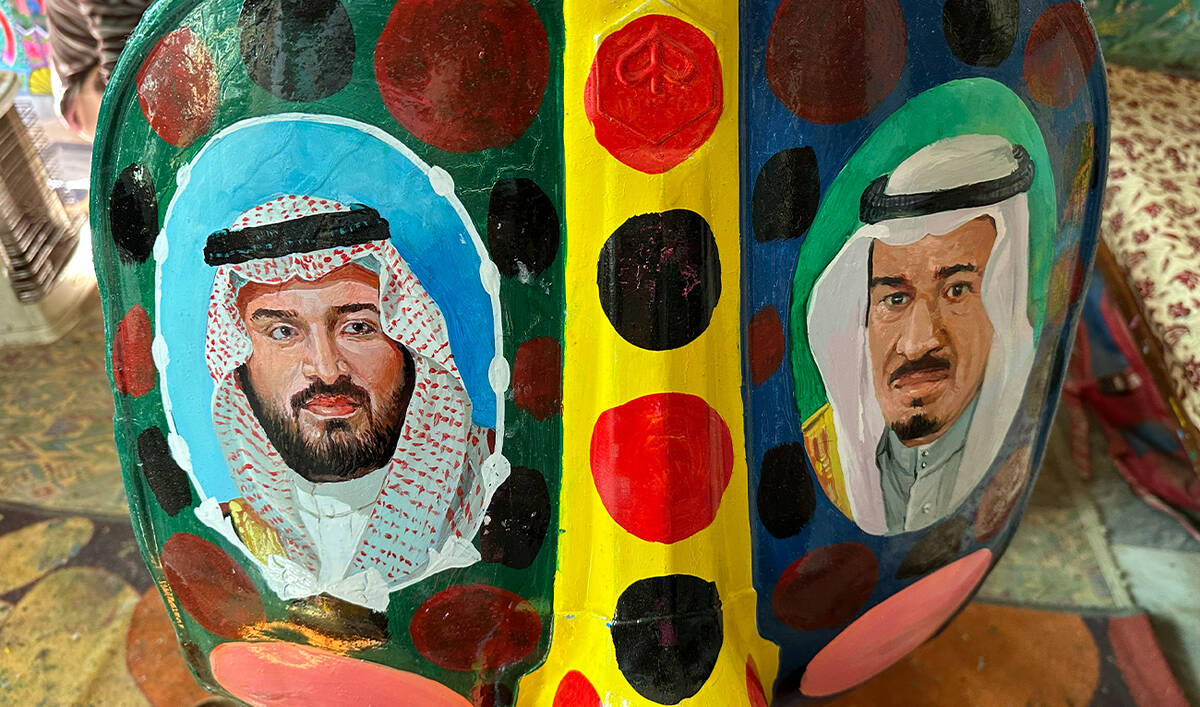
Portraits of the Saudi King (right) and Crown Prince (left) are painted on a Vespa by Pakistani artists in Islamabad, Pakistan, on February 17, 2026. (AN)
“It involves a lot of small, detailed work. Every single thing is observed carefully, trees, leaves, animals, birds, their perspective,” he explained, highlighting the border of a portrait with his brush. “We have to work while considering all of that.”
For Shabbir, the decorated scooter represents more than an artistic commission.
“They love Pakistanis very much. And Pakistanis also consider Saudi Arabia as a second home,” he said. “When it goes there, god willing, it will create waves. People will come in crowds to see it.”


