

Death toll in Louisville UPS plane crash rises to 9

The death toll from the crash of a UPS cargo plane that erupted into a fireball moments after takeoff in Louisville, Kentucky on Tuesday has risen to nine, city and state officials said Wednesday. (X/@CoffindafferFBI)
Short Url
Updated 05 November 2025
Follow

Death toll in Louisville UPS plane crash rises to 9

  • Investigators from the National Transportation Safety Board will be on site later Wednesday morning to begin the process of finding out what went wrong
  • Louisville Mayor Craig Greenberg said nine dead people had been found at the scene of the crash

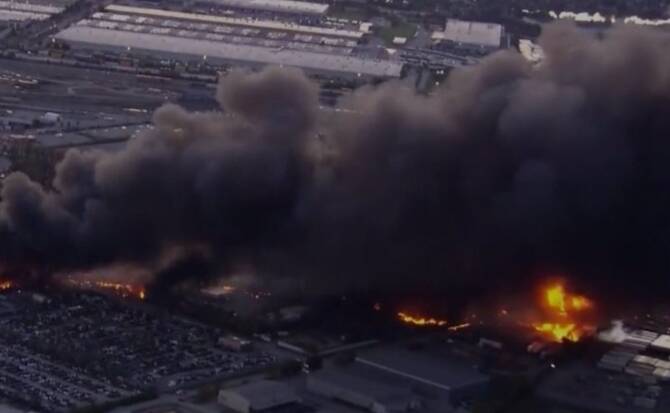
KENTUCKY, USA: The death toll from the crash of a UPS cargo plane that erupted into a fireball moments after takeoff in Louisville, Kentucky on Tuesday has risen to nine, city and state officials said Wednesday.
Investigators from the National Transportation Safety Board will be on site later Wednesday morning to begin the process of finding out what went wrong when the 34-year-old MD-11 cargo plane caught fire around 5:13 p.m. ET Tuesday and then crashed.
Louisville Mayor Craig Greenberg said nine dead people had been found at the scene of the crash. Kentucky Governor Andy Beshear said on social media it was possible there would be more fatalities. The plane had a crew of three according to UPS and officials said none of the crew survived.

Several buildings in an industrial area beyond the runway were on fire after the crash, with thick, black smoke seen rising into the evening sky.
Officials said 11 victims had been taken to hospitals on Tuesday.
A government official told Reuters at least 10 others remain unaccounted for. Beshear told CNN that two people remain in critical condition and added it could have been much worse.
“This plane barely missed a restaurant bar. It was very close to a very large Ford plant with hundreds, if not a thousand plus workers,” Beshear said. ” It was very close to our convention center that’s having a big livestock show that people were arriving for.” The international airport in Louisville reopened to air traffic early on Wednesday, though the runway where the accident happened is expected to remain closed for another 10 days, officials said.
UPS said Wednesday it canceled a parcel sorting shift that usually begins in the midmorning at its facility at the airport after it had halted package sorting operations Tuesday.
US aviation safety expert Anthony Brickhouse said on Wednesday he has not seen any evidence of a link between the accident and a 36-day US government shutdown that has strained air traffic control.
NTSB investigators will be looking to retrieve the flight data recorder and cockpit voice recorder that will shed light on the crash.
Brickhouse said investigators are expected to focus on the number one engine which was seen on video to be ignited, and appeared to have separated from the aircraft. “It is designed to fly if you lose one engine, but we need to see the effect of losing that engine on the rest of the aircraft,” Brickhouse said.
The triple-engine plane was fueled for an 8-1/2 hour flight to Honolulu.
It was the first UPS cargo plane to crash since August 2013, when an Airbus aircraft went down on a landing approach to the international airport in Birmingham, Alabama, killing both crew.


Ukraine accuses Hungary, Slovakia of ‘blackmail’ over threats to cut electricity

Updated 3 sec ago
Follow

Ukraine accuses Hungary, Slovakia of ‘blackmail’ over threats to cut electricity

KYIV: Ukraine’s Foreign Ministry condemned what it described as “ultimatums and blackmail” by the governments of Hungary and Slovakia on Saturday, after they threatened to stop electricity supplies to ​Ukraine unless Kyiv restarts flows of Russian oil.
Shipments of Russian oil to Hungary and Slovakia have been cut off since January 27, when Kyiv says a Russian drone strike hit pipeline equipment in Western Ukraine. Slovakia and Hungary say Ukraine is to blame for the prolonged outage.
Slovakia’s Prime Minister Robert Fico said on Saturday that he would cut off emergency electricity supplies to Ukraine within two days unless Kyiv resumes Russian oil transit to Slovakia over Ukraine’s ‌territory. Hungary’s Viktor ‌Orban made a similar threat days earlier.
The issue ​has ‌become ⁠one of ​the ⁠angriest disputes yet between Ukraine and two neighbors that are members of the EU and NATO but whose leaders have bucked the largely pro-Ukrainian consensus in Europe to cultivate warm ties with Moscow.
Slovakia and Hungary are the only two EU countries that still rely on significant amounts of Russian oil shipped via the Soviet-era Druzhba pipeline over Ukraine.
“Ukraine rejects and condemns the ultimatums and blackmail by the ⁠governments of Hungary and the Slovak Republic regarding energy supplies ‌between our countries,” the Ukrainian Foreign Ministry said ‌in a statement. “Ultimatums should be sent to the Kremlin, ​and certainly not to Kyiv.”

HUNGARY, ‌SLOVAKIA ARE KEY FOR UKRAINE’S ELECTRICITY IMPORTS
Between them, Hungary and Slovakia ‌have been providing around half of European emergency electricity exports to Ukraine, which Kyiv increasingly relies on as Russian attacks have damaged its grid.
“If oil supplies to Slovakia are not resumed on Monday, I will ask SEPS, the state-owned joint-stock company, to stop emergency electricity ‌supplies to Ukraine,” Fico said in a post on X.
Kyiv said that such actions were “provocative, irresponsible, and threaten the energy ⁠security of ⁠the entire region.”
Throughout the war that began with the full-scale Russian invasion whose fourth anniversary falls on Tuesday, Ukraine has allowed its territory to be used for Russian energy exports to Europe, which have been sharply curtailed but not halted.
Ukraine has proposed alternative transit routes to ship oil to Europe while emergency pipeline repair works are under way.
In a letter seen by Reuters, the Ukrainian mission to the EU proposed shipments through Ukraine’s oil transportation system or a maritime route, potentially including the Odesa-Brody pipeline linking Ukraine’s main Black Sea port to the EU.
Since October last year, Russia has intensified its drone and ​missile attacks on the Ukrainian ​energy system, knocking out electricity and heat and plunging millions of Ukrainians into long blackouts during bitterly cold winter temperatures.