LONDON: Uproar over the alleged abuse of a Palestinian detainee held by the Israel Defense Forces has been directed not at the soldiers filmed carrying out the assault but at the military’s top lawyer, who officials have criticized for releasing the footage.
Captured on surveillance cameras in July 2024 at Israel’s Sde Teiman military base in the Negev desert, the graphic footage was released to Israeli news outlets a month later by Yifat Tomer-Yerushalmi, the IDF’s military advocate-general.
Tomer-Yerushalmi resigned on Oct. 31, arguing she had approved the video’s release “in an attempt to counter false propaganda against army law enforcement bodies,” amid right-wing claims the allegations against the soldiers had been faked.

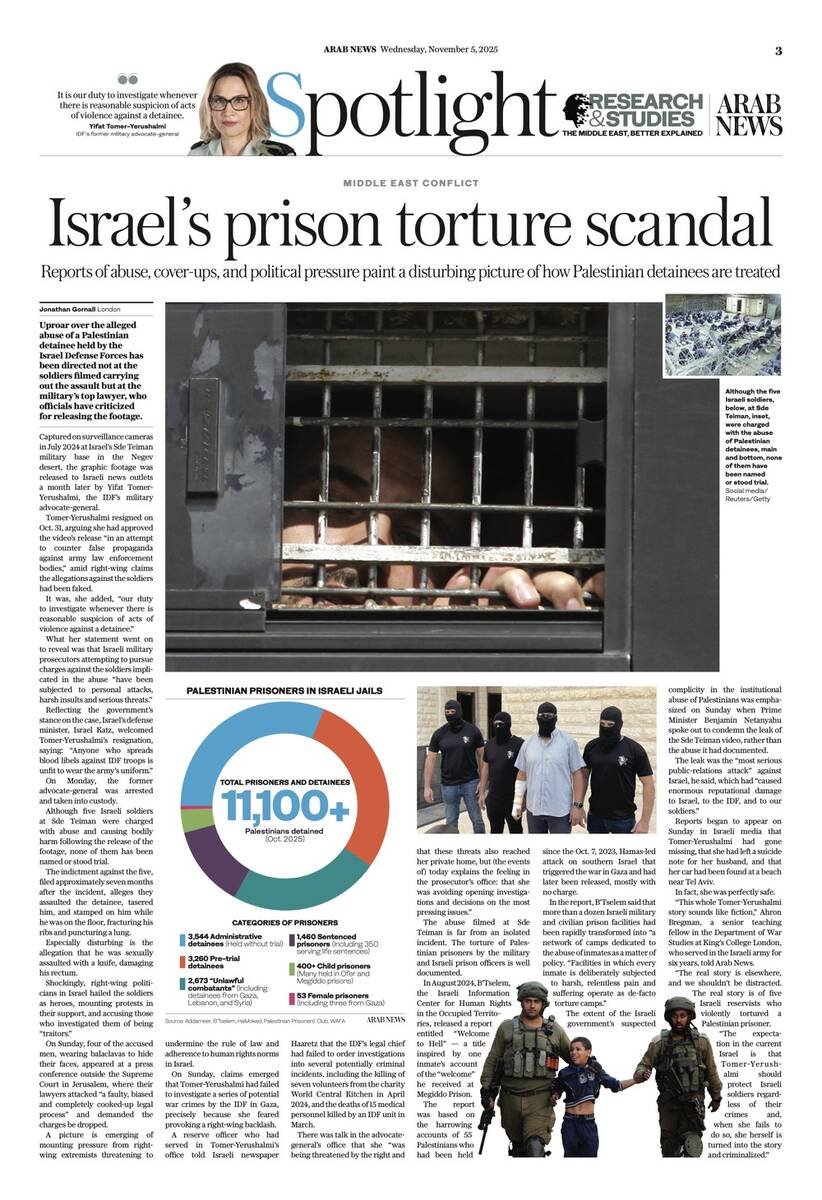
Palestinian men who had been detained by Israeli forces speak to well-wishers and reporters after their release. (AFP)
It was, she added, “our duty to investigate whenever there is reasonable suspicion of acts of violence against a detainee.”
What her statement went on to reveal was that Israeli military prosecutors attempting to pursue charges against the soldiers implicated in the abuse “have been subjected to personal attacks, harsh insults and serious threats.”
Reflecting the government’s stance on the case, Israel’s defense minister, Israel Katz, welcomed Tomer-Yerushalmi’s resignation, saying: “Anyone who spreads blood libels against IDF troops is unfit to wear the army’s uniform.”
On Monday, the former advocate-general was arrested and taken into custody.
When the footage was first shown on an Israeli news channel in August last year, observers drew comparisons with the abuse of Iraqi prisoners by American guards at Abu Ghraib in Iraq, which came to light in 2004.
Despite the international outcry over Abu Ghraib, most of the 12 US soldiers responsible received only minor sentences, and no-one was charged over the death during torture of one of the detainees, or the deaths of dozens of other prisoners at the facility.
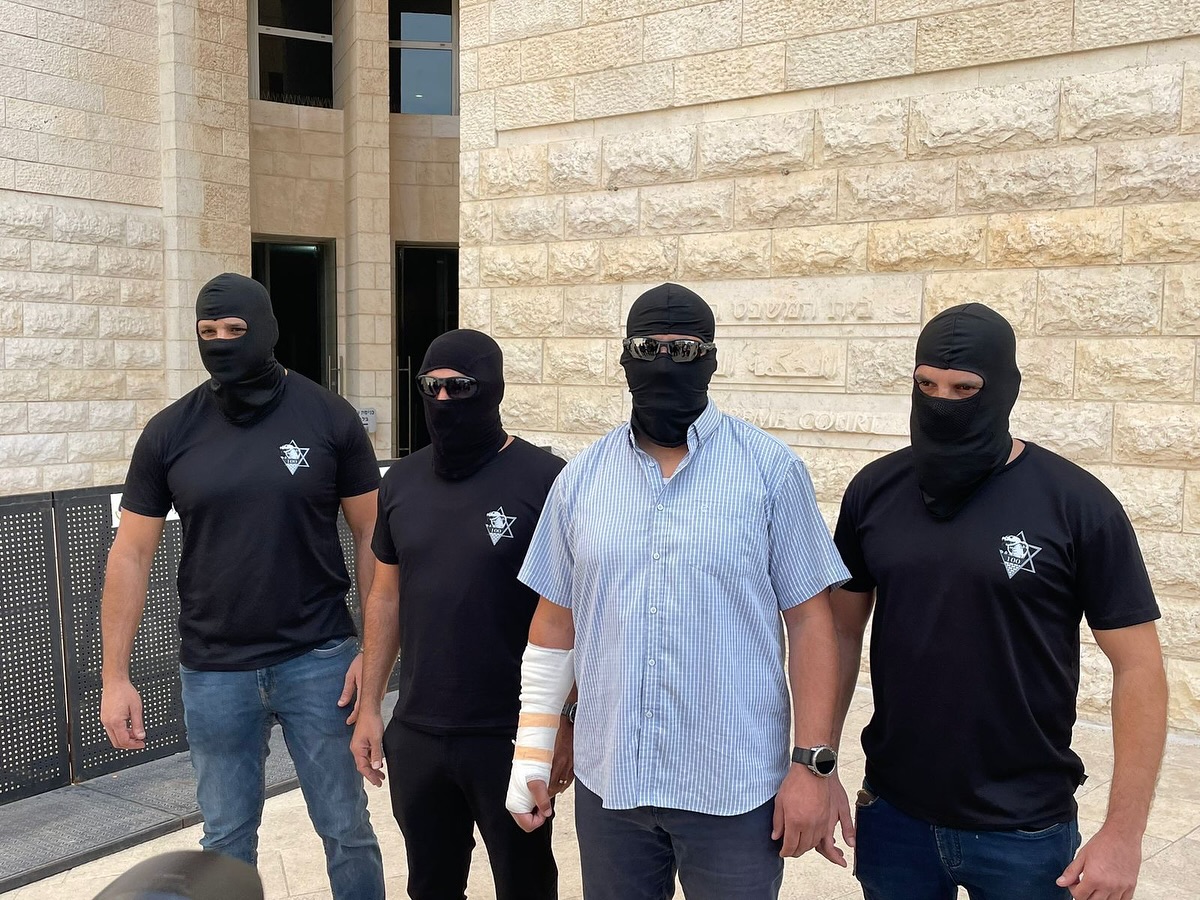
Israeli occupation soldiers who committed the sexual and physical assault against a Palestinian prisoner in Sde Teiman prison appeared at a press conference. (Supplied)
Similarly, although five Israeli soldiers at Sde Teiman were charged with abuse and causing bodily harm following the release of the footage, none of them has been named or stood trial.
The indictment against the five, filed approximately seven months after the incident, alleges they assaulted the detainee, tasered him, and stamped on him while he was on the floor, fracturing his ribs and puncturing a lung.
Especially disturbing is the allegation that he was sexually assaulted with a knife, damaging his rectum.
Shockingly, right-wing politicians in Israel hailed the soldiers as heroes, mounting protests in their support, and accusing those who investigated them of being “traitors.”
On Sunday, four of the accused men, wearing balaclavas to hide their faces, appeared at a press conference outside the Supreme Court in Jerusalem, where their lawyers attacked “a faulty, biased and completely cooked-up legal process” and demanded the charges be dropped.
A picture is emerging of mounting pressure from right-wing extremists threatening to undermine the rule of law and adherence to human rights norms in Israel.
On Sunday, claims emerged that Tomer-Yerushalmi had failed to investigate a series of potential war crimes by the IDF in Gaza, precisely because she feared provoking a right-wing backlash.
A reserve officer who had served in Tomer-Yerushalmi’s office told Israeli newspaper Haaretz that the IDF’s legal chief had failed to order investigations into several potentially criminal incidents, including the killing of seven volunteers from the charity World Central Kitchen in April 2024, and the deaths of 15 medical personnel killed by an IDF unit in March.

Muazzaz Khalil Abayat, a 37-year-old Palestinian from Bethlehem, lies in a hospital bed following his release. (AFP)
There was talk in the advocate-general’s office that she “was being threatened by the right and that these threats also reached her private home, but (the events of) today explains the feeling in the prosecutor’s office: that she was avoiding opening investigations and decisions on the most pressing issues.”
The abuse filmed at Sde Teiman is far from an isolated incident. The torture of Palestinian prisoners by the military and Israeli prison officers is well documented.
“According to the Israeli NGO HaMoked, as of November 2025, 9,204 Palestinians are being held by the Israeli authorities,” Budour Hassan, a researcher for Amnesty International on Israel and the Occupied Palestinian Territory, told Arab News.
“These include 4,573 people held without charge or trial either under administrative detention (3,368) or under the Unlawful Combatants Law (1,205) who are languishing behind bars in indefinite arbitrary detention denied even the semblance of due process.
“Israel has consistently used arbitrary detention as a primary tool to perpetuate its cruel system of apartheid against Palestinians.
“Amnesty International has documented how Israeli authorities have routinely subjected Palestinian prisoners and detainees to torture or other ill-treatment while in custody, including starvation, physical and sexual violence, and denied them access to independent monitors and humanitarian organizations.
“Prisoner’s families are also denied the fundamental right to visit their loved ones and many detainees are forcibly disappeared leaving their families in agonizing uncertainty about their fate and whereabouts.”
In August 2024, B’Tselem, the Israeli Information Center for Human Rights in the Occupied Territories, released a report entitled “Welcome to Hell” — a title inspired by one inmate’s account of the “welcome” he received at Megiddo Prison.

Palestinians who were detained by Israeli forces arrive in an ambulance for a checkup. (AFP)
The report was based on the harrowing accounts of 55 Palestinians who had been held since the Oct. 7, 2023, Hamas-led attack on southern Israel that triggered the war in Gaza and had later been released, mostly with no charge.
In the report, B’Tselem said that more than a dozen Israeli military and civilian prison facilities had been rapidly transformed into “a network of camps dedicated to the abuse of inmates as a matter of policy.
“Facilities in which every inmate is deliberately subjected to harsh, relentless pain and suffering operate as de-facto torture camps.”
Among the harrowing accounts was the testimony of Hadil a-Dahduh Zaza, a 24-year-old woman from Gaza who was held in Damon Prison.
“I was put in a pit in the ground,” she told B’Tselem. “When I was in it, with all the other detainees, the soldiers ordered me to take off my hijab. One of them told me: ‘I killed your husband, and I want to bury you alive. Let the dogs eat you’.”
Sari Huriyyah, a 53-year-old real-estate lawyer, father of four and an Israeli citizen, was arrested in his office in Haifa and taken to Megiddo Prison, where he witnessed the sustained abuse of other prisoners and endured beatings several times a day.
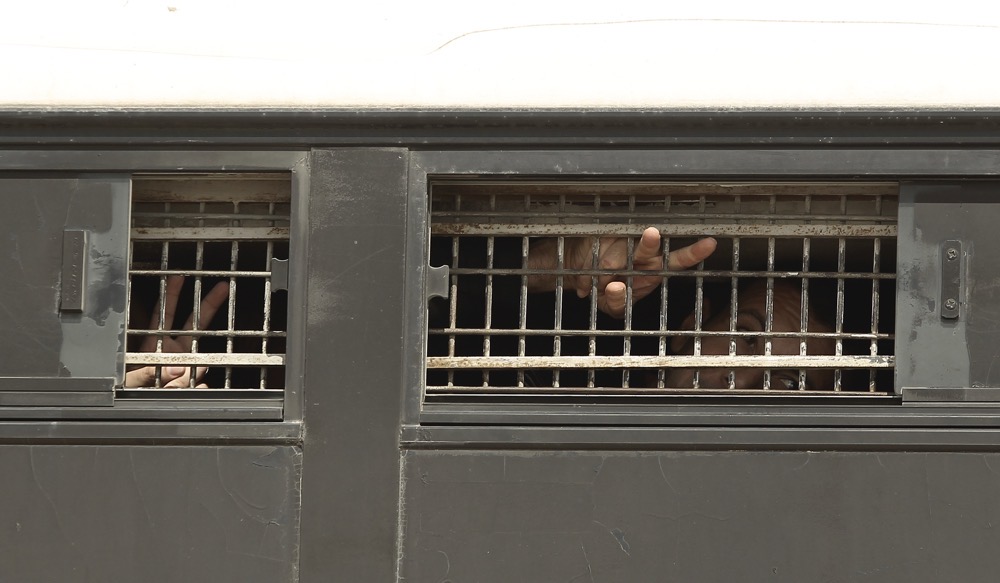
Palestinian prisoners gesture from the window of a bus as it leaves Nafha Prison. (Reuters)
“I didn’t understand how this was happening to me at my age,” he recalled. “It was very difficult to see the degradation of those around me.”
Sleep was impossible. “We heard detainees crying and shouting while guards beat them. The guards yelled out demands that they bark like dogs.”
The ordeal of Musa ‘Aasi, a 58-year-old from Beit Liqya in the West Bank, who was held in a series of different prisons, began when soldiers came to his house, punched him in the face and then beat his 24-year-old son with their rifles.
In prison, he said, “they beat detainees … brutally and at random. I recognized well-known people, including politicians and journalists. They deliberately humiliated them.”
On one of several occasions when he was abused, “prison staff beat us brutally with rifles and clubs and punched and kicked us. The worst was when they let their dogs attack us. The dogs were muzzled, but it was very frightening, and they scratched our hands and faces with their claws.”
But “the real suffering,” he said, began when he was transferred to Ketziot prison in the Negev. “The detention was prolonged torture,” he said. “Abuse, humiliation, and degradation like I’ve never experienced in my life.”
On Tuesday, the Palestinian author Nasser Abu Srour, who was freed in October under the US-brokered Gaza ceasefire deal after spending more than 32 years in Israeli prisons, described how the abuse of prisoners had escalated over the past two years.
In a phone call from Egypt, where he has been exiled, he told the Guardian that after Oct. 7, prison guards “started acting like they were in a war and this was another front, and they started beating, torturing, killing like warriors.”
After the Gaza war began, he said, the treatment of long-term Palestinian prisoners deteriorated alarmingly, with a marked increase in beatings and the withholding of food and heating.

“Any place where there are no cameras was a place for brutality,” he said. “They would tie our hands behind our heads and throw us on the floor and then they would start trampling on us with their feet.”
Abu Srour’s memoir of his three decades in prison, “Tale of a Wall: Reflections on Hope and Freedom,” has been shortlisted for the annual literature prize awarded by the Institute of the Arab World in Paris.
One Palestinian human rights lawyer, who did not want to be identified as they are themselves currently facing trial, described their own harrowing experience inside Israeli detention centers since the start of the Gaza war.
“Following the war on Gaza, the detention experience was harsh on all levels, particularly amid a complete absence of communication with the outside world,” she said, adding that this “granted the Israeli Prison Service great latitude to isolate and abuse the detainees.”
According to her testimony, “the conduct of the prison guards made it clear that they possessed absolute authority to humiliate, torture and assault the detainees.”
“We felt as if we were entombed alive,” she said. “Death was a threat to us at every moment and in any means, while everyone beyond the prison walls remained oblivious.”
She said detainees were subjected to “malnutrition, deliberate medical neglect, physical assault or constant oppression,” and that “numerous cases” of sexual assault had been reported, “particularly against detained men, some of which amounted to rape — either directly or through the use of tools or dogs.”
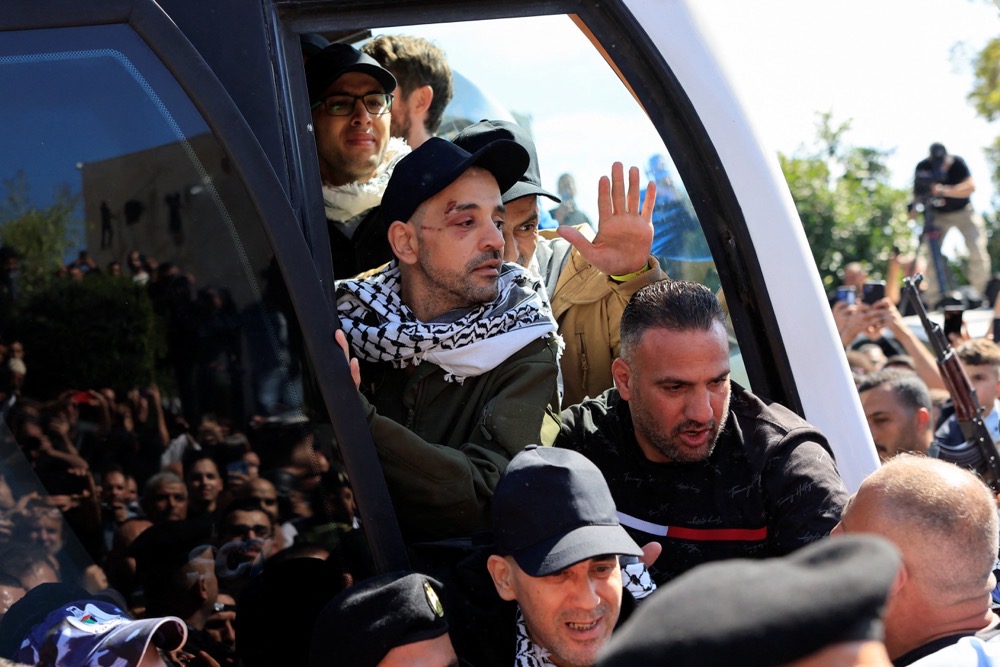
Freed Palestinian prisoners look on in a bus after being released from an Israeli jail as part of a hostages-prisoners swap and a ceasefire deal in Gaza between Hamas and Israel. (Reuters)
“These assaults were not limited to men but also targeted female detainees,” she said, adding that many women “were subjected to harassment by members of the prison administration, the army forces, and the Nachshon unit responsible for transporting detainees between prisons and courts.”
She said the detainees’ “body integrity was further violated” during strip searches that “frequently involved overt harassment.”
Describing systemic deprivation, the lawyer said Israeli authorities had stripped detainees of “all concessions secured by the detainees’ movement through a long struggle.”
These included “deliberate medical neglect, starvation policy, deprivation of basic necessities,” and bans on family visits or communication with the outside world.
She also cited “frequent cell searches, prohibition of cultural or educational activities, repeated raids on cells, collective and individual punishments without justification, and the use of tear gas and different weapons against prisoners inside the prisons.”
International aid agencies have consistently raised concerns about the treatment of Palestinian detainees held in Israeli prisons.
“ICRC is concerned by reports circulating on the treatment of Palestinian detainees while in Israeli places of detention,” a spokesperson for the International Committee of the Red Cross told Arab News.
“We are continuing discussions on our access to Palestinians in Israeli places of detention and stand ready to resume these at any moment.
“Wherever and whoever they may be, detainees need to be treated with humanity and dignity at all times. This is an international legal requirement applicable to all detaining authorities in Israel and the occupied territories.

Palestinians who were detained by Israeli forces talk to medics. (AFP)
“Committed to its mandate and responsibilities, the ICRC will continue stressing the relevant authorities of their legal obligations — which include humane treatment, as well as for notifying and providing ICRC access to detainees — for as long as it is necessary.”
Alleged ill-treatment in Israeli prisons is not confined to adult detainees. Human rights monitors have documented multiple cases of abuses perpetrated against children.
“As a child rights organization, we have documented ill-treatment and torture from the hands of Israeli forces against Palestinian child detainees for decades,” Miranda Cleland, advocacy officer at Defense for Children International — Palestine, told Arab News.
“In that time, the data and testimony from child after child is remarkably consistent: Israeli forces arrest children in the middle of the night from their homes, blindfold them and bind their hands behind their back, and subject them to incredibly stressful, coercive interrogations designed to extract confessions.
“Since Oct. 7, 2023, Israeli forces have intensified their torture of Palestinian children and deliberately deteriorated the conditions inside prisons.
“Children report brutal beatings, rotten food, denial of access to the shower and toilet, and outbreaks of scabies, lice, and communicable diseases that thrive in overcrowded, unsanitary environments.”
The extent of the Israeli government’s suspected complicity in the institutional abuse of Palestinians was emphasized on Sunday when Prime Minister Benjamin Netanyahu spoke out to condemn the leak of the Sde Teiman video, rather than the abuse it had documented.
The leak was the “most serious public-relations attack” against Israel, he said, which had “caused enormous reputational damage to Israel, to the IDF, and to our soldiers.”
Reports began to appear on Sunday in Israeli media that Tomer-Yerushalmi had gone missing, that she had left a suicide note for her husband, and that her car had been found at a beach near Tel Aviv. Her phone, it was reported, had “disappeared.”

Palestinian men who had been detained by Israeli forces arrive after their release for a check-up. (AFP)
In fact, she was perfectly safe.
“This whole Tomer-Yerushalmi story sounds like fiction,” Ahron Bregman, a senior teaching fellow in the Department of War Studies at King’s College London, who served in the Israeli army for six years, told Arab News.
“The real story is elsewhere, and we shouldn’t be distracted. The real story is of five Israeli reservists who violently tortured a Palestinian prisoner.
“The expectation in the current Israel is that Tomer-Yerushalmi should protect Israeli soldiers regardless of their crimes and, when she fails to do so, she herself is turned into the story and criminalized.”