

Pakistan minister voices optimism ahead of Istanbul talks with Kabul over militancy

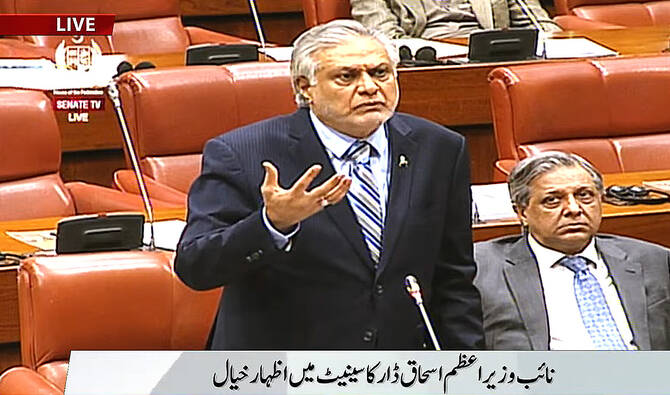
Pakistan’s deputy prime minister and foreign minister Ishaq Dar, gestures while addressing the upper house of parliament in Islamabad, on November 6, 2025. (PTV News/ YT)
Short Url
Updated 04 November 2025
Follow

Pakistan minister voices optimism ahead of Istanbul talks with Kabul over militancy

  • Tensions between Pakistan and Afghanistan have been high in recent months following an uptick in attacks in Pakistan’s western provinces
  • The two countries engaged in fierce fighting last month and are due to meet in Istanbul on Nov. 6 to firm up a ceasefire reached in Doha

ISLAMABAD: Pakistan’s foreign minister on Tuesday expressed optimism ahead of talks with Afghanistan in Istanbul that the two neighbors could work together to address cross-border militancy and strengthen bilateral cooperation.

Tensions between Pakistan and Afghanistan have been high in recent months following an uptick in attacks in Pakistan’s western provinces that border Afghanistan. Islamabad has repeatedly accused the Afghan Taliban of allowing the use of their soil for these attacks, an allegation Kabul denies.

The two countries engaged in fierce fighting last month after Pakistan hit what it called TTP-affiliated targets in Afghanistan. Both sides reached a ceasefire in Doha on Oct. 19 and are due to meet in Istanbul on Nov. 6 to finalize a mechanism to keep militancy along their 2,600-kilometer border in check.

Addressing the upper house of parliament, FM Ishaq Dar said he “received six calls” from his Afghan counterpart Amir Khan Muttaqi on Monday and told him that he supported Afghanistan as a neighboring Muslim country, but the rise in cross-border militancy had left him in a difficult position.

“I am among those who want to move forward positively with Afghanistan, Iran and all our neighboring countries. This is my responsibility on behalf of Pakistan,” Dar said, briefing Senate members about Pakistan’s talks with Afghanistan.

“My wish and prayer is that these matters be resolved and that we help one another.”

The TTP is responsible for some of the bloodiest attacks in Pakistan, including on churches, schools and the shooting of Malala Yousafzai, who survived the 2012 attack after she was targeted for her campaign against the Taliban’s efforts to deny women education. The group has stepped up its attacks against Pakistani security forces and law enforcement agencies in recent years.

Pakistani forces were able to effectively dismantle the TTP and kill most of its top leaders in a string of military operations from 2014 onwards in the country’s northwestern tribal areas, driving most of the fighters into neighboring Afghanistan.

Without naming anyone, Dar blamed the former government of Prime Minister Imran Khan for holding talks with the TTP and providing space to its fighters to regroup in the region.

“That was the biggest mistake. I am not against any person or any government, but this is a fact,” he said. “We must pull ourselves together so that such mistakes are not repeated, whether it’s our government or any other.”


Pakistan opposition continues sit-in outside parliament over ex-PM Khan’s eye treatment

Updated 5 sec ago
Follow

Pakistan opposition continues sit-in outside parliament over ex-PM Khan’s eye treatment

  • Opposition leader says the protest will continue until Imran Khan, currently at Adiala prison, is admitted to Shifa Hospital
  • The government says Khan’s medical report will be compiled again, promising no negligence in the matter under judicial oversight

ISLAMABAD: Pakistan’s opposition alliance is continuing its sit-in outside the Parliament House in Islamabad for the second day on Saturday, seeking shifting of jailed former prime minister Imran Khan to a private hospital for treatment of his worsening eye condition.

The protest follows a rare prison visit earlier this week by Barrister Salman Safdar, appointed as amicus curiae by the Supreme Court to assess Khan’s health and living conditions at Rawalpindi’s Adiala jail. In his report, Safdar highlighted “seriousness” of Khan’s ocular condition and recommended an independent examination.

On Friday evening, opposition members gathered outside the parliament building in Islamabad to stage a sit-in, with the police locking its gates and cordoning off surrounding roads to prevent protesters from gathering in front of the building, witnesses and opposition leaders said.

Mehmood Khan Achakzai, the head of the Tehreek-e-Tahafuz-e-Ayeen-e-Pakistan opposition alliance, criticized the authorities for the measures to prevent opposition members from reaching the sit-in venue in Islamabad.

“We are not the ones who make threats, but if you continue with this attitude, after two or three days every roundabout in Pakistan will be closed,” Achakzai said on X late Friday. “Then we will not even be able to handle the people.”

In an earlier post on X, the alliance said its leadership would continue the sit-in “until Imran Khan is admitted to Al-Shifa Hospital.”

“We have staged a sit-in for the earliest medical check-up of Imran Khan, which would take just ten minutes,” Achakzai told reporters on Friday evening. “If it is conducted, we will end our protest.”

According to a Feb. 6 medical report from the Pakistan Institute of Medical Sciences (PIMS) cited in Safdar’s filing, Khan was diagnosed with “right central retinal vein occlusion” after reporting reduced vision in his right eye. He underwent an intravitreal injection at PIMS and was discharged with follow-up advice.

In his interaction with Safdar, Khan said he had suffered “rapid and substantial loss of vision over the preceding three months” and claimed his complaints had not been addressed promptly in custody. He further said he had been left with “only 15 percent vision in his right eye.”

Safdar’s report noted that the 73-year-old former premier appeared “visibly perturbed and deeply distressed” over the loss of vision, though it also recorded that he expressed satisfaction with his safety, basic amenities and food provisions in prison.

Responding to the controversy, Parliamentary Affairs Minister Tariq Fazal Chaudhry rejected PTI’s claims that Khan had been suffering from an eye issue since October last year, noting that the ex-premier was visited by his sister on Dec. 2 but she did not mention the medical issue.

“Medical report will be compiled again, the chief justice of the Supreme Court is himself monitoring this case,” he said. “Wherever it will be requested, Imran Khan’s eye will be examined at.”

Chaudhry vowed there would be no negligence.

Khan has been in custody since August 2023 in connection with multiple cases that he and his party describe as politically motivated. The government denies the allegation.

Concerns over his health resurfaced after authorities confirmed he had briefly been taken from prison to a hospital in Islamabad for an eye procedure. While the government said his condition was stable, Khan’s family and PTI leaders alleged they were not informed in advance and that he was being denied timely and independent medical access.
