

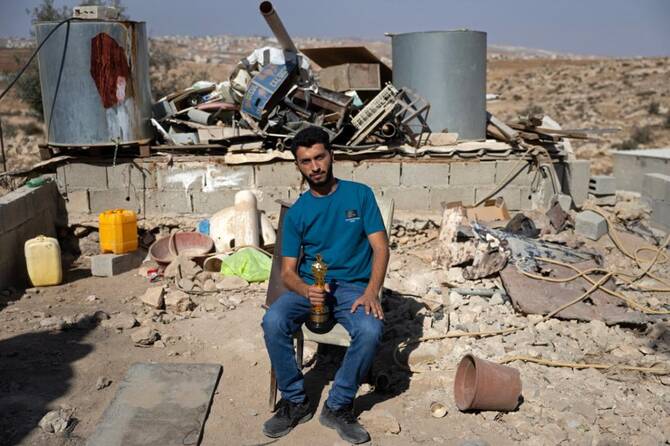

AT TUWANI, Palestinian Territories: Armed with his camera, Oscar-winning Palestinian filmmaker Basel Adra has spent years in the occupied West Bank documenting what he describes as the impunity Israelis enjoy in their mistreatment of Palestinians.
From his terrace, he points to the nearby Israeli settlement of Maon, just a short distance away. The view appears calm, but he said incidents involving settlers and Israeli soldiers take place almost daily.
The situation has only worsened since the start of the war in Gaza in October 2023, said Adra, the co-director of “No Other Land,” a documentary he made with Israeli filmmaker Yuval Abraham that this year won an Academy award.
“The world allows Israelis — and gives them the impunity — to commit crimes,” the 29-year-old filmmaker told AFP at his home in the village of At Tuwani.
In the nine months after accepting his Oscar in Hollywood, Adra has given score of interviews and captured hundreds of videos capturing settler violence allegedly carried out under army protection.
“Dozens of Palestinian communities, villagers fled from their homes in this time due to the settler and occupation forces violence and attacks and killings,” Adra said.
Taking a team of AFP journalists on a tour to illustrate the difficulties of life for Palestinians in the West Bank, Adra headed to the nearby Bedouin village of Umm Al-Khair.
To reach it, one must pass an Israeli settlement.
On a wall, an inscription in Arabic warns: “No future for Palestine.”
Since the war in Gaza began with Hamas’s October 2023 attack on Israel, settler and army attacks in the West Bank have killed around 1,000 Palestinians, according to the Palestinian health ministry in Ramallah.
During the same period, Palestinian attacks in the same region have killed at least 43 Israelis, including soldiers, according to official Israeli figures.
- Targeted -
Even the presence of international and Israeli activists, intended to deter violence, has done little to change reality for Palestinians in the West Bank.
Adra recalled the killing of a close friend, fellow activist Awdah Hathaleen, on July 28.
Hathaleen, he said, was filming “settlers with a bulldozer going through his family land, destroying their olive trees and fence.”
His death, widely filmed by other activists and reported in the media, prompted Israeli police to open an investigation, though they did not classify it as murder.
“A couple of days after this criminal settler committed these crimes, he was allowed to come again to the same place, to continue digging the same land,” Adra said.
The young filmmaker, who displayed the Oscar statue, has also been targeted.
“I’ve been arrested several times by the army,” Adra said.
“Once, settlers came onto our land, they started pushing us, throwing stones. They had sticks, and one of them had a gun. Two of my brothers were slightly injured.”
“We called the police. They arrived, but the attack continued while they watched.”
The military said it had received reports that “several terrorists” had hurled rocks at Israeli civilians near At Tuwani injuring two of them.
“Upon receiving the report, the security forces were dispatched to the scene, conducted searches in the area and questioned suspects,” the military told AFP.
Adra said that in Masafer Yatta, the cluster of villages that includes At Tuwani, settler activity is unrelenting.
“They keep building settlements and illegal outposts 24 hours a day, seven days a week,” he said.
After a long legal battle, the Supreme Court ruled in favor of the army in 2022, paving the way for the eviction of residents from eight Palestinian villages in the area.
- ‘We will stay’ -
In the village of Umm Al-Khair, a few concrete houses are surrounded by settler structures — mobile homes flying Israeli flags and permanent structures encircling the Bedouins.
At his desk, community leader Khalil Hathaleen — brother of the slain activist — spreads out 14 demolition orders received on October 28.
According to army documents in Hebrew and Arabic, residents have 14 days to appeal.
“Even if the entire village is demolished, we will stay on this land and we will not leave,” Hathaleen said.
“Because there is nowhere else to go.”
Like other communities in the area, the approximately 200 residents of Umm Al-Khair are descendants of Bedouins expelled from the Negev desert in southern Israel in the early 1950s.
About three million Palestinians live in the West Bank, which Israel has occupied since 1967. Some 500,000 Israelis live there in settlements deemed illegal under international law.
At the end of October, the Israeli parliament voted to advance two far-right-backed bills calling for annexation of the territory.
“Growing up, I believed very much in international law,” Adra said.
“I believe that the materials that I’m filming, the documentation, when they are seen abroad, somebody is going to do something.”


