

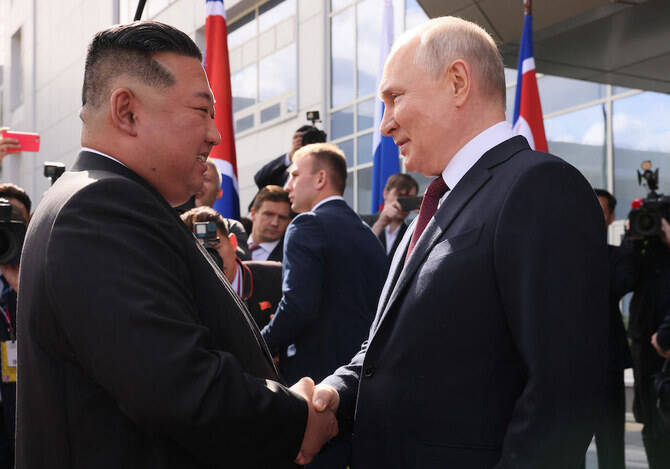
North Korea sends 5,000 construction troops to Russia: Seoul

North Korea has sent about 5,000 construction troops to Russia since September to help with "infrastructure reconstruction", a South Korean lawmaker said Tuesday after a briefing by Seoul's spy agency. (AFP/File)
Short Url
Updated 04 November 2025
Follow

North Korea sends 5,000 construction troops to Russia: Seoul

  • North Korean leader Kim Jong Un has been emboldened by the war in Ukraine
  • South Korean lawmaker Lee Seong-kweun told reporters that “around 5,000 North Korean construction troops have been moving to Russia in phases since September

SEOUL: North Korea has sent about 5,000 construction troops to Russia since September to help with “infrastructure reconstruction,” a South Korean lawmaker said Tuesday after a briefing by Seoul’s spy agency.
North Korean leader Kim Jong Un has been emboldened by the war in Ukraine, securing critical support from Moscow after sending thousands of troops to fight alongside Russian forces.
South Korean lawmaker Lee Seong-kweun told reporters that “around 5,000 North Korean construction troops have been moving to Russia in phases since September and are expected to be mobilized for infrastructure reconstruction.”
He added that “continued signs of training and personnel selection in preparation for additional troop deployments have been detected.”
The spy agency told lawmakers that about 10,000 North Korean troops were estimated to be currently deployed near the Russia-Ukraine border, according to Lee.
At least 600 North Korean soldiers have died in the Ukraine war and thousands more sustained injuries, according to South Korean estimates.
Analysts say North Korea is receiving financial aid, military technology, and food and energy supplies from Russia in return for sending troops.
That has allowed it to sidestep tough international sanctions imposed over its nuclear and missile programs that were once a crucial bargaining chip for the United States.

- US talks -

Since Kim’s 2019 summit with US President Donald Trump collapsed over the scope of denuclearization and sanctions relief, Pyongyang has repeatedly declared itself an “irreversible” nuclear state.
Pyongyang did not respond to Trump’s offer to meet with Kim last week, and instead its Foreign Minister Choe Son Hui headed to Moscow, where she and Russian President Vladimir Putin agreed to strengthen bilateral ties.
Lee said Seoul’s spy agency believes Kim was open to talks with Washington “and will seek contact when the conditions are in place.”
Although the proposed meeting with Trump did not materialize, “multiple signs suggest” that Pyongyang “had been preparing behind the scenes for possible talks with the US,” said the lawmaker.
In September, Kim appeared alongside Xi Jinping and Russia’s Vladimir Putin at an elaborate military parade in Beijing — a striking display of his new, elevated status in global politics.
An international sanctions monitoring group, the Multilateral Sanctions Monitoring Team, said in a report last month that North Korea was planning to send “40,000 laborers to Russia, including several delegations of IT workers.”
Under UN sanctions, North Korean workers are prohibited from earning money abroad.


Australia hits Afghan Taliban officials with sanctions, travel bans

Updated 6 sec ago
Follow

Australia hits Afghan Taliban officials with sanctions, travel bans

  • The Taliban has said it respects women’s rights, in line with its interpretation of Islamic law and local custom
  • The measures were part of a new Australian government framework that enabled it to “directly impose its own sanctions and travel bans to increase pressure on the Taliban, targeting the oppression of the Afghan people,” Wong said

SYDNEY: Australia on Saturday imposed financial sanctions and travel bans on four officials in Afghanistan’s Taliban government over what it said was a deteriorating human rights situation in the country, especially for women and girls.
Australia’s Foreign Minister Penny Wong said the officials were involved “in the oppression of women and girls and in undermining good governance or the rule of law” in the Taliban-run country.
Australia was one of several nations which in August 2021 pulled troops out of Afghanistan, after being part of a NATO-led international force that trained Afghan security forces and fought the Taliban for two decades after Western-backed forces ousted the Islamist militants from power.
The Taliban, since regaining power in Afghanistan, has been criticized for deeply restricting the rights and freedoms of women and girls through bans on education and work.
The Taliban has said it respects women’s rights, in line with its interpretation of Islamic law and local custom.
Wong said in a statement the sanctions targeted three Taliban ministers and the group’s chief justice, accusing them of restricting access for girls and women “to education, employment, freedom of movement and the ability to participate in public life.”
The measures were part of a new Australian government framework that enabled it to “directly impose its own sanctions and travel bans to increase pressure on the Taliban, targeting the oppression of the Afghan people,” Wong said.
Australia took in thousands of evacuees, mostly women and children, from Afghanistan after the Taliban retook power in the war-shattered South Asian country, where much of the population now relies on humanitarian aid to survive.