

Syrian probe debunks kidnap allegations

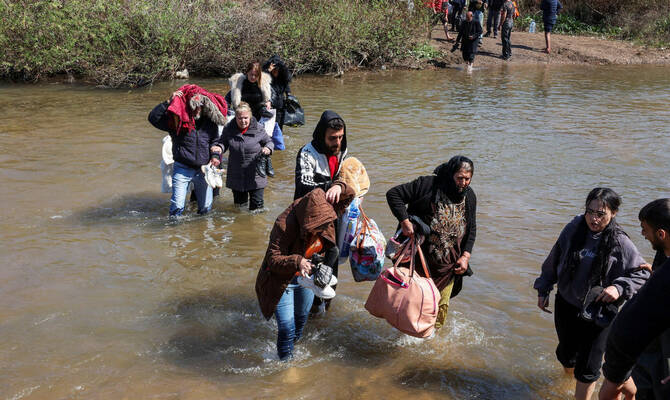
Alawite Syrians, who fled the violence in western Syria, walk in the water of the Nahr El Kabir River, after the reported mass killings of Alawite minority members, in Akkar, Lebanon March 11, 2025. (Reuters)
Short Url
Updated 02 November 2025
Follow

Syrian probe debunks kidnap allegations

  • The violence began after armed groups aligned with former Syrian President Bashar Assad attacked government security forces

DAMASCUS: A Syrian government-led committee has found that most allegations of kidnapping of women from the Alawite religious minority were false, the findings of the monthslong probe released on Sunday show.

Syria’s Interior Ministry spokesperson Noureddine Al-Baba announced the outcome of the inquiry into 42 allegations of violence against women and girls during the violence in March along Syria’s coastal provinces.

Al-Baba said the committee, which was set up in July, spoke to affected women and girls and concluded that only one case was a kidnapping.

“In the one confirmed kidnapping case, the girl was safely returned after security agencies investigated the matter,” Al-Baba told a news conference. 

“The search continues to identify the perpetrators.”

President Ahmad Al-Sharaa’s government has been trying to bring back calm and economic recovery to the war-torn country.

“We urge citizens, civil society, and human rights organizations to first report any such incidents or suspicions to the Interior Ministry,” Al-Baba said.

The Syrian inquiry concluded that of the remaining 41 cases it examined, 12 involved women fleeing with romantic partners, nine were “temporary absences” with relatives or friends, six were instances of fleeing domestic violence, six were false allegations on social media, four were victims of extortion or prostitution, and four were perpetrators of criminal offenses who security agencies apprehended.

The violence began after armed groups aligned with former Syrian President Bashar Assad attacked government security forces. 

The counterinsurgency spiraled into sectarian revenge attacks and massacres that killed hundreds of civilians.

Amnesty International said in July it had received credible reports of several dozen women and girls being kidnapped across the provinces of Latakia, Tartus, Homs, and Hama.


After wins abroad, Syria leader must gain trust at home

Updated 2 sec ago
Follow

After wins abroad, Syria leader must gain trust at home

BEIRUT: One year after ousting Bashar Assad, Ahmed Al-Sharaa has restored Syria’s international standing and won sanctions relief.
But analysts warn the former jihadist still needs to secure trust on the home front.
Sectarian bloodshed in the country’s Alawite and Druze minority heartlands — alongside ongoing Israeli military operations — have shaken Syria as President Sharaa tries to lead the country out of 14 years of war.
“Syria has opened a new chapter that many once thought impossible,” said Nanar Hawach, senior Syria analyst at the International Crisis Group, citing relaunched diplomatic ties and foreign investment.
But he added: “International rehabilitation means little if all Syrians don’t feel safe walking their own streets.”
US President Donald Trump has taken a particular shining to the 43-year-old, a surprise political victory for a former militant who once had a US bounty on his head due to his ties to Al-Qaeda.
Sharaa has toured capitals from the Gulf to Europe to Washington since his Islamist alliance toppled Assad on December 8 last year, ending more than half a century of the family’s iron-fisted rule.
Washington and the UN Security Council have removed him from their respective “terrorism” and sanctions lists, and a delegation from the world body visited Damascus for the first time this week.
The United States, the European Union and Britain have lifted major economic sanctions on Syria, and Damascus has announced investment deals for infrastructure, transport and energy.
Sharaa has even visited Russia, whose military pounded his forces during the war and which is now home to an exiled Assad.
“Sharaa won abroad, but the real verdict comes at home,” Hawach said.

- ‘Real accountability’ -

Critics say Syria’s temporary constitution fails to reflect the country’s ethnic and religious diversity and concentrates power in the hands of a president appointed for a five-year transition.
The new authorities have disbanded armed factions, including Islamist and militant fighters, but absorbed most into the new-look army and security forces, including some foreign fighters.
And some government forces or their allies have been implicated in outbreaks of sectarian violence.
The Alawite community massacres in March, killed more than 1,700 people, according to the Syrian Observatory for Human Rights.
And clashes in July in south Syria’s Druze-majority Sweida province left more than 2,000 dead, including hundreds of Druze civilians.
Authorities have announced investigations into the bloodshed and have arrested and put some suspects on trial.
Nicholas Heras, from the New Lines Institute, said Sharaa “has twice failed as a leader of national reconciliation” — during the violence against the Alawites and the Druze.
Heras told AFP questions remain over “the extent to which he personally wants to rein in the militant Islamist militias that played the strongest role in bringing him to power in Damascus.”
Sharaa’s position, he said, remains precarious “because he does not command a unified security apparatus that can enforce the rules made by his government.”

- ‘Terrifying’ -

Gamal Mansour, a researcher at the University of Toronto, said “factional leaders who are essentially warlords” have taken up official roles, contributing to a “crisis of trust” among minorities.
However, “most Syrians believe Sharaa is the only option that provides guarantees,” he said, calling the prospect of a power vacuum “terrifying.”
Just keeping the country together is a major task, with some on the coast and in Sweida urging succession and the Kurds seeking decentralization, which Damascus has rejected.
A Kurdish administration in the northeast has agreed to integrate its institutions into the central government by year-end but progress has stalled.
Adding to pressures is neighboring Israel, which has repeatedly bombed Syria and wants to impose a demilitarised zone in the south.
Israel’s forces remain in a UN-patrolled buffer zone on the occupied Golan Heights and conduct regular incursions deeper into Syria despite the two sides holding direct talks.
On Monday, Trump told Israel to avoid destabilising Syria and its new leadership.
In October, committees selected new members of parliament, but the process excluded areas outside government control and Sharaa is still to appoint 70 of the 210 representatives.
lar/lg/dc