

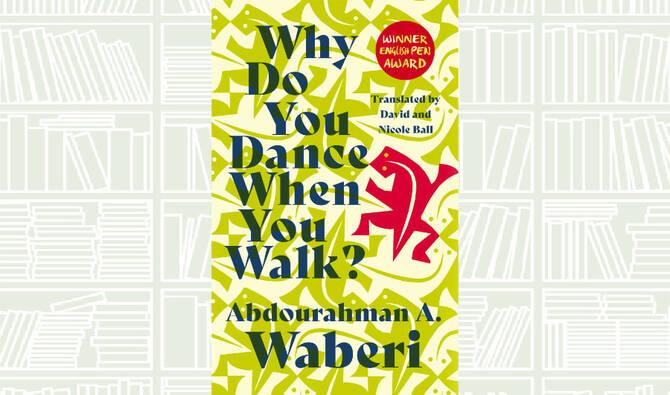

Author Abdourahman A. Waberi’s “Why Do You Dance When You Walk?” novel begins in Paris one early morning before school with a simple question from Aden’s 8-year-old daughter, Bea: “Papa, why do you dance when you walk?”
The question might have been innocent, but the answer was serious.
Originally published in French in 2019 and translated into English in 2022 by David and Nicole Ball for Cassava Republic Press, the poetic prose reads like a song. Waberi’s sentences carries the texture of melodic memory — dusty streets, salt air, family laughter and the echoing ache of distance. It was dizzyingly beautiful.
It is fictional, but so grounded in raw emotion that I found myself questioning how much of it was drawn from Waberi’s own truth.
Born in Djibouti in 1965, Waberi is evidently one of his country’s best-known literary voices. Like his narrator, he had polio as a child and was forced to walk with a limp — a detail that gives the novel its name and soul.
Some of what he shared, at least to me, felt too intimate to tell a child who didn’t reach double digits in age yet — even if she seemed mature. He spoke about the good, the bad and the very ugly reality of living with a disability. Yet that honesty made their exchange even more powerful.
I found myself wishing more fathers confided in their daughters in this most special way. By narrating his life story, customized for her ears, the story morphed from a history and geography lesson about their motherland and its people, to him as an individual, her father, and then to how it applied to her life, by extension.
Aden snaked silkily between the paths he took in his own childhood in a land far, far away from France; back to his roots in his native Djibouti, from his aloof mother and the shanty roofs of his neighborhood, to that pivotal ailment that turned his entire life around — quite literally.
In vivid and fleeting bursts, he talked of his childhood in Djibouti, on the cusp of independence; his transfixed gaze on the French-from-France expats and then on himself, a lonely, confused sick boy finding solace in books and dreams.
Perhaps the reciting and recollecting the story of his life’s journey was cathartic for him. Often, it seemed, that the ripple effects of our past traumas — which may unknowingly jilt our movements — are out of our hands. Or in this case, out, or off, of his feet.
While I have never been to Djibouti, the book seemed to move to an African rhythm all its own. The father’s storytelling to his daughter carried that musical cadence — part lullaby, part confession; full of bombastic heartbeats.
At just over a hundred pages in the English version, “Why Do You Dance When You Walk?” lingers like a song.
It is a reminder that storytelling can turn personal pain into something graceful, and when told to an attentive and captivated audience, even joyful.


