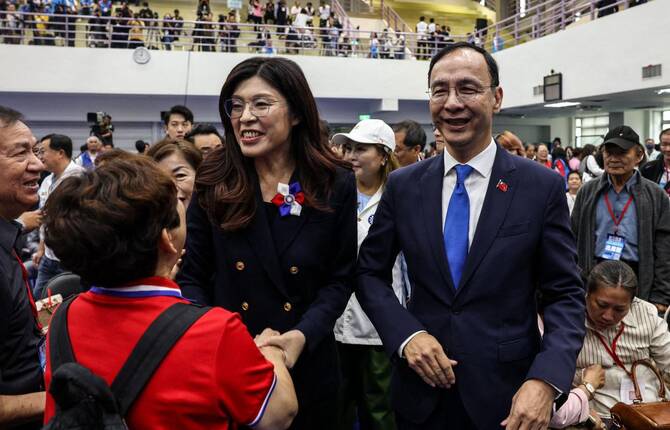
TAIPEI: Taiwan’s new opposition leader took office on Saturday, warning of the risk of war with China and pledging to open a new era of peace with Beijing.
Former lawmaker Cheng Li-wun takes the reins of the largest opposition party, the Kuomintang (KMT), at a time of rising military and political tension with Beijing, which views the democratically-governed island as its own territory.
“This is the worst of times. The Taiwan Strait faces grave military danger and the world is watching closely,” she told party members in a speech at an indoor high school stadium in Taipei. “Taiwan’s security faces the constant threat of war.”
While the KMT traditionally espouses close relations with Beijing, Taiwan’s government, led by the Democratic Progressive Party (DPP), strongly objects to China’s sovereignty claims.
Cheng, 55, has already signalled a swing toward even closer ties with Beijing than her urbane, internationalist-minded predecessor Eric Chu, who did not visit China during his term as chairman that began in 2021.
Chinese President Xi Jinping swiftly sent congratulations after her election last month, calling for efforts to advance “reunification” in a message to her.
Some Chinese Internet users refer to Cheng as the “reunification goddess,” though she said this week she had been given many monikers online, adding, “If they are wrong or untrue, just laugh it off.”
The KMT’s new Deputy Chairman Hsiao Hsu-tsen visited China this week and met Song Tao, head of China’s Taiwan Affairs Office.
Cheng did not give any details of her policy toward China in her maiden speech as party leader, nor say whether she would visit, instead saying she would work for peace.
“The KMT will definitely be the party that opens a new era of cross-Strait peace and leads Taiwan forward,” she said.
Cheng also opposes higher defense spending, a key policy of President Lai Ching-te’s administration. The spending has strong US backing.
While the KMT lost the presidential election last year, the party and its ally the small Taiwan People’s Party together hold the most seats in parliament, creating a headache for the ruling DPP in trying to pass the budget and other legislation.
One of Cheng’s first tasks will be preparing for mayoral and local elections late next year. While mostly focusing on domestic issues, these will provide an important gauge of support ahead of the 2028 presidential vote.

Taiwan’s new opposition leader takes over, warning against risk of China war
https://arab.news/bhvca
Taiwan’s new opposition leader takes over, warning against risk of China war
- Opposition leader takes over amid rising tension with China
- Taiwan’s government rejects Beijing’s sovereignty claims
Cambodia shuts Thailand border crossings over deadly fighting
- Thai Prime Minister Anutin Charnvirakul said Trump “didn’t mention whether we should make a ceasefire” during their Friday phone call
- Across the border, a Cambodian evacuee said she was “sad” the fighting hadn’t stopped despite Trump’s intervention
BANGKOK: Cambodia shut its border crossings with Thailand on Saturday, after Bangkok denied US President Donald Trump’s claim that a truce had been agreed to end days of deadly fighting.
Violence between the Southeast Asian neighbors, which stems from a long-running dispute over the colonial-era demarcation of their 800-kilometer (500-mile) border, has displaced around half a million people on both sides.
At least 25 people have died this week, including four Thai soldiers the defense ministry said were killed in the border area on Saturday.
The latest fatalities were followed by Phnom Penh announcing it would immediately “suspend all entry and exit movements at all Cambodia-Thailand border crossings,” the interior ministry said.
Each side blamed the other for reigniting the conflict, before Trump said a truce had been agreed.
Thai Prime Minister Anutin Charnvirakul said Trump “didn’t mention whether we should make a ceasefire” during their Friday phone call.
The two leaders “didn’t discuss” the issue, Anutin told journalists on Saturday.
Trump had hailed his “very good conversation” with Anutin and Cambodian Prime Minister Hun Manet on Friday.
“They have agreed to CEASE all shooting effective this evening, and go back to the original Peace Accord” agreed in July, Trump wrote on his Truth Social platform.
The United States, China and Malaysia, as chair of the regional bloc ASEAN, brokered a ceasefire in July after an initial five-day spate of violence.
In October, Trump backed a follow-on joint declaration between Thailand and Cambodia, touting new trade deals after they agreed to prolong their truce.
But Thailand suspended the agreement the following month after Thai soldiers were wounded by land mines at the border.
In Thailand, evacuee Kanyapat Saopria said she doesn’t “trust Cambodia anymore.”
“The last round of peace efforts didn’t work out... I don’t know if this one will either,” the 39-year-old told AFP.
Across the border, a Cambodian evacuee said she was “sad” the fighting hadn’t stopped despite Trump’s intervention.
“I am not happy with brutal acts,” said Vy Rina, 43.
- Trading blame over civilians -
Bangkok and Phnom Penh have traded accusations of attacks against civilians, with the Thai army reporting six wounded on Saturday by Cambodian rockets.
Cambodia’s information minister, Neth Pheaktra, meanwhile said Thai forces had “expanded their attacks to include civilian infrastructure and Cambodian civilians.”
A Thai navy spokesman said the air force “successfully destroyed” two Cambodian bridges used to transport weapons to the conflict zone.
Malaysian Prime Minister Anwar Ibrahim on Saturday urged both sides to “cease all forms of hostilities and refrain from any further military actions.”
Thailand has reported 14 soldiers killed and seven civilian deaths, while Cambodia said four civilians were killed earlier this week.
At a camp in Thailand’s Buriram, AFP journalists saw displaced residents calling relatives near the border who reported that fighting was ongoing.
Thailand’s prime minister has vowed to “continue to perform military actions until we feel no more harm and threats to our land and people.”
After the call with Trump, Anutin said “the one who violated the agreement needs to fix (the situation).”
Cambodia’s Hun Manet, meanwhile, said his country “has always been adhering to peaceful means for dispute resolutions.”


