Taiwan does not want China’s ‘one country, two systems’, president says

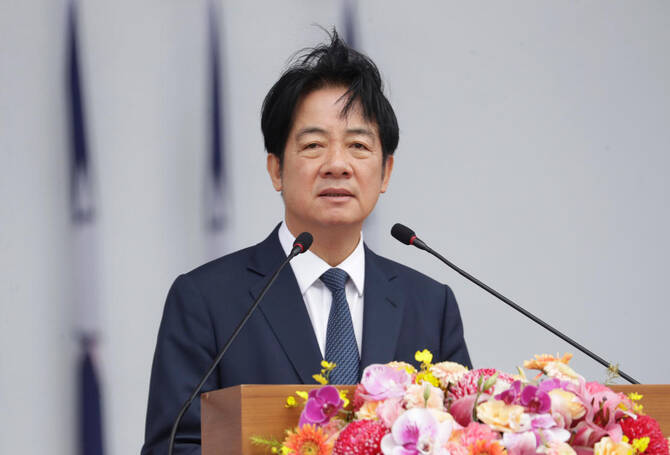
President Lai Ching-te said that “Taiwan’s sovereignty cannot be violated or annexed” and its future can only be decided by its people. (AP)
Short Url
Updated 31 October 2025
Follow

Taiwan does not want China’s ‘one country, two systems’, president says

  • Taiwan will defend its freedom and democracy, president says
  • China making a renewed push for Taiwan to accept its autonomy offer

HUKOU, Taiwan: Taiwan does not want China’s “one country, two systems” and must uphold its freedom and democracy, and resolve to defend itself, President Lai Ching-te said on Friday, rejecting Beijing’s latest push to get the island to come under Chinese control.
China said this week it “absolutely will not” rule out using force over Taiwan, striking a much tougher tone than a series of articles in state media that pledged benign rule if the island comes over to Beijing under a system of autonomy it uses for Hong Kong and Macau.
Lai, whom China views as a “separatist,” told soldiers at a military base in northern Taiwan’s Hukou that only strength can bring true peace.
“Accepting the aggressor’s claims and abandoning sovereignty certainly cannot achieve peace. Therefore, we must maintain the status quo with dignity and resolve, firmly opposing annexation, aggression, and the forced advancement of unification,” he said.
“We reject ‘one country, two systems’ because we will forever uphold our free and democratic constitutional system,” Lai added.
China’s Taiwan Affairs Office did not immediately respond to a request for comment.
No support for China’s proposal
No major political party in Taiwan supports China’s “one country, two systems” idea.
Lai said that the Republic of China – Taiwan’s formal name – and the People’s Republic of China are “not subordinate” to each other and that “Taiwan’s sovereignty cannot be violated or annexed” and its future can only be decided by its people.
“The Taiwanese people safeguarding their sovereignty and preserving their democratic and free way of life should not be viewed as provocation. Investing in national defense is investing in peace.”
Lai has pledged to increase military spending to 5 percent of GDP by 2030, strengthening the island’s defenses in the face of a rising threat from its giant neighbor China.
Lai was in Hukou for a commissioning ceremony for Taiwan’s first battalion of M1A2T Abrams tanks, made by General Dynamics Land Systems, a unit of US firm General Dynamics.
Taiwan has so far received 80 of the 108 M1A2T tanks it ordered from the United States, the island’s most important international backer and arms supplier despite the lack of formal diplomatic ties.
The M1A2T tank can fire high explosive anti-tank warheads and kinetic energy ammunition, such as armor-piercing fin-stabilized discarding sabot.
The US is bound by law to provide Taiwan with the means to defend itself, though President Donald Trump has yet to approve any new arms sales since he took office earlier this year.
US Defense Secretary Pete Hegseth, meeting Chinese Defense Minister Dong Jun in Kuala Lumpur on Friday, said he had emphasized US concerns about China’s activities around Taiwan, as well as in the contested South China Sea.
Dong said China-Taiwan “reunification” was an irreversible historical trend and the US should take a clear stance in opposition to the island’s independence, his ministry said in a statement.


India rolls out strictest anti-pollution curbs as toxic smog engulfs Delhi

Demonstrator wearing an oxygen mask and holding oxygen tanks takes part in protest.
Updated 14 December 2025
Follow

India rolls out strictest anti-pollution curbs as toxic smog engulfs Delhi

  • Private monitors in several parts of northern Delhi recorded AQI spikes between 550 and 700s
  • Authorities invoked stage four of the capital region’s emergency pollution-control framework

NEW DELHI: India’s capital choked under a thick blanket of smog on Sunday, with the government imposing anti-pollution curbs after monitoring stations in some areas recorded extremely hazardous air quality.

Home to 30 million people, Delhi has not recorded a single “clean air” day in 2025, with Air Quality Index readings hitting high above the 50 score throughout the year.

On the AQI scale from 0 to 500, good air quality is represented by levels below 50, while levels above 300 are dangerous.

Worsening since late October, official records over the weekend were in the severe to severe-plus range of 400–500, but as 24-hour averages, they did not capture the peaks. Private monitors in several parts of North and North West Delhi recorded AQI spikes above 550 and even into the 700s in real-time.

On Saturday evening, the Ministry of Environment’s Commission for Air Quality Management invoked stage four — the highest level — of the Graded Response Action Plan for Delhi and surrounding areas.

To “prevent further deterioration of air quality in the region,” the commission suspended all non-essential construction, shut stone crushers and mining operations, stopped entry of trucks into the capital region, and ordered schools to shift to hybrid classes or online, where possible.

While authorities blamed the pollution on “adverse meteorological conditions,” residents have been demanding more government action.

“The situation is so bad in Delhi that we don’t have any option but to force kids to do online classes. The government has failed us; it has not done anything to address the issue,” said Nabanita Nayak, who decided for her teenage children to attend school online only, despite concerns over their screen addiction.

“If the kids are too much in front of laptops, that’s also an issue. As a mother, I am worried.” 

Delhi’s pollution has been worsening since Diwali in late October, when the average AQI has been above 370, or “very poor.” Since mid-November, it has been over 400, which means “severe” air quality, with certain areas recording 500 and above, which is classified as a “hazardous” level.

“I don’t feel proud living in Delhi. It’s the capital city of the country … We talk about being a developed nation by 2047 — we have deadlines,” said Jagriti Arora, who is keeping her 7-year-old daughter at home to prevent allergy flare-ups caused by air pollution.

“The government has to do something … China had a big problem with pollution, but now they’ve managed to bring it down.”

Delhi’s air quality deteriorates in winter due to local emissions and seasonal weather conditions. Cold temperatures and low wind speeds result in a temperature inversion, which traps pollutants close to the ground instead of letting them disperse. This allows emissions from millions of vehicles, ongoing construction, and nearby industrial activity to accumulate in the air. Urban waste burning and dust from construction sites further add to it.

“This is not a new thing. This has been happening now for over 10 years,” Arora said. “You can see it. You don’t need to actually look at an AQI meter to see how bad the pollution is these days.”