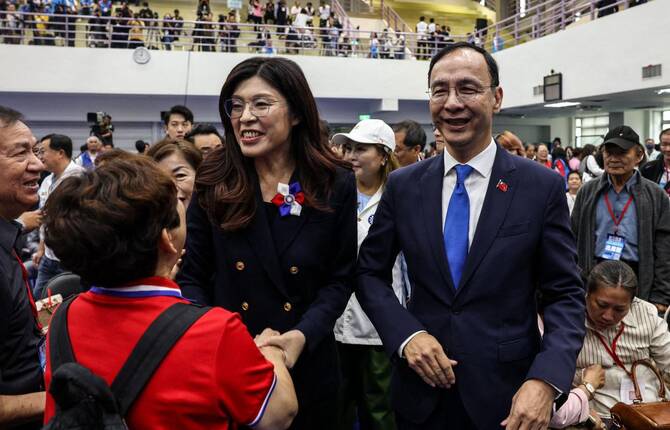
TAIPEI: Taiwan’s new opposition leader took office on Saturday, warning of the risk of war with China and pledging to open a new era of peace with Beijing.
Former lawmaker Cheng Li-wun takes the reins of the largest opposition party, the Kuomintang (KMT), at a time of rising military and political tension with Beijing, which views the democratically-governed island as its own territory.
“This is the worst of times. The Taiwan Strait faces grave military danger and the world is watching closely,” she told party members in a speech at an indoor high school stadium in Taipei. “Taiwan’s security faces the constant threat of war.”
While the KMT traditionally espouses close relations with Beijing, Taiwan’s government, led by the Democratic Progressive Party (DPP), strongly objects to China’s sovereignty claims.
Cheng, 55, has already signalled a swing toward even closer ties with Beijing than her urbane, internationalist-minded predecessor Eric Chu, who did not visit China during his term as chairman that began in 2021.
Chinese President Xi Jinping swiftly sent congratulations after her election last month, calling for efforts to advance “reunification” in a message to her.
Some Chinese Internet users refer to Cheng as the “reunification goddess,” though she said this week she had been given many monikers online, adding, “If they are wrong or untrue, just laugh it off.”
The KMT’s new Deputy Chairman Hsiao Hsu-tsen visited China this week and met Song Tao, head of China’s Taiwan Affairs Office.
Cheng did not give any details of her policy toward China in her maiden speech as party leader, nor say whether she would visit, instead saying she would work for peace.
“The KMT will definitely be the party that opens a new era of cross-Strait peace and leads Taiwan forward,” she said.
Cheng also opposes higher defense spending, a key policy of President Lai Ching-te’s administration. The spending has strong US backing.
While the KMT lost the presidential election last year, the party and its ally the small Taiwan People’s Party together hold the most seats in parliament, creating a headache for the ruling DPP in trying to pass the budget and other legislation.
One of Cheng’s first tasks will be preparing for mayoral and local elections late next year. While mostly focusing on domestic issues, these will provide an important gauge of support ahead of the 2028 presidential vote.

Taiwan’s new opposition leader takes over, warning against risk of China war
https://arab.news/bhvca
Taiwan’s new opposition leader takes over, warning against risk of China war
- Opposition leader takes over amid rising tension with China
- Taiwan’s government rejects Beijing’s sovereignty claims
About 400 immigrant children were detained longer than the recommended limit, ICE admits
- A Dec. 1 report from ICE indicated that about 400 immigrant children were held in custody for more than the 20-day limit during the reporting period from August to September
- Advocates documented injuries suffered by children and a lack of access to sufficient medical care
TEXAS, USA: Hundreds of immigrant children across the nation were detained for longer than the legal limit this summer, US Immigration and Customs Enforcement has admitted in a court filing, alarming legal advocates who say the government is failing to safeguard children.
In a court filing Monday evening, attorneys for detainees highlighted the government’s own admissions to longer custody times for immigrant children, unsanitary conditions reported by families and monitors at federal facilities, and a renewed reliance on hotels for detention.
The reports were filed as part of an ongoing civil lawsuit launched in 1985 that led to the creation of the 1990s cornerstone policy known as the Flores Settlement Agreement, which limits the time children can spend in federal custody and requires them to be kept in safe and sanitary conditions. The Trump administration is attempting to end the agreement.
A Dec. 1 report from ICE indicated that about 400 immigrant children were held in custody for more than the 20-day limit during the reporting period from August to September. They also told the court the problem was widespread and not specific to a region or facility. The primary factors that prolonged their release were categorized into three groups: transportation delays, medical needs, and legal processing.
Legal advocates for the children contended those reasons do not prove lawful justifications for the delays in their release. They also cited examples that far exceeded the 20-day limit, including five children who were held for 168 days earlier this year.
ICE did not immediately respond to a request for comment Tuesday.
Hotel use for temporary detention is allowed by the federal court for up to 72 hours, but attorneys questioned the government’s data, which they believe did not fully explain why children were held longer than three days in hotel rooms.
Conditions at the detention facilities continued to be an ongoing concern since the family detention site in Dilley, Texas, reopened this year.
Advocates documented injuries suffered by children and a lack of access to sufficient medical care. One child bleeding from an eye injury wasn’t seen by medical staff for two days. Another child’s foot was broken when a member of the staff dropped a volleyball net pole, according to the court filing. “Medical staff told one family whose child got food poisoning to only return if the child vomited eight times,” the advocates wrote in their response.
“Children get diarrhea, heartburn, stomach aches, and they give them food that literally has worms in it,” one person with a family staying at the facility in Dilley wrote in a declaration submitted to the court.
Chief US District Judge Dolly Gee of the Central District of California is scheduled to have a hearing on the reports next week, where she could decide if the court needs to intervene.


