

Ukraine sends special forces to embattled eastern city

1 / 2
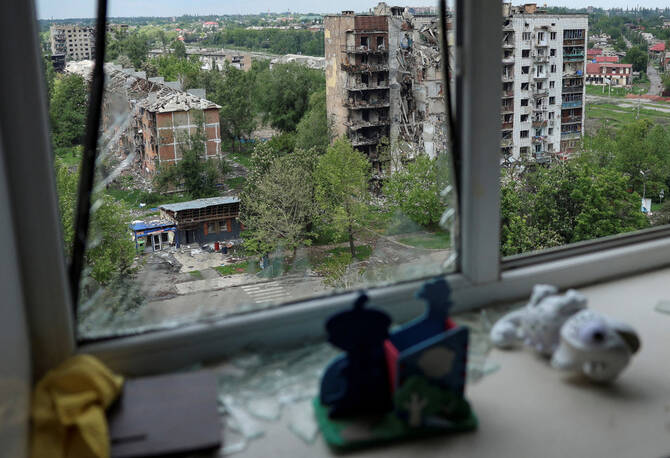
A view shows apartment buildings hit by Russian military strikes in the front line town of Pokrovsk in Donetsk region on May 21, 2025. (REUTERS/File Photo)
2 / 2
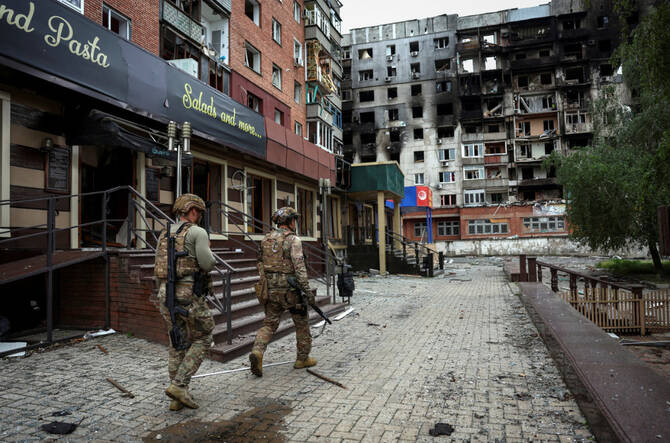
Members of the White Angel unit of Ukrainian police officers who evacuate people from the frontline towns and villages, check an area for residents in the frontline town of Pokrovsk in Donetsk region on May 21, 2025. (REUTERS/File Photo)
Short Url
Updated 01 November 2025
Follow

Ukraine sends special forces to embattled eastern city

  • The city’s capture would provide a major propaganda boost for the Kremlin
  • “A comprehensive operation to destroy and displace enemy forces from Pokrovsk is under way,” Ukrainian commander-in-chief Oleksandr Syrsky said

KYIV: Ukraine has deployed special forces to the eastern city of Pokrovsk, where it is under pressure from an intense Russian assault involving thousands of troops, Kyiv’s top commander said Saturday.
Pokrovsk, in Ukraine’s Donetsk region, lies on a major supply route for the Ukrainian army and has been in Moscow’s sights for over a year.
Hundreds of Russian soldiers have infiltrated the logistics hub, Kyiv said earlier this week. Others are closing in on its outskirts in a pincer-shaped movement, according to battlefield maps published by the Institute for the Study of War.
The city’s capture would provide a major propaganda boost for the Kremlin, which has rebuffed US calls to halt its nearly-four year invasion and instead pushed forward with its ground assault.
“A comprehensive operation to destroy and displace enemy forces from Pokrovsk is under way,” Ukrainian commander-in-chief Oleksandr Syrsky said in a post on Facebook.
“By my order, consolidated groups of Special Operations Forces are operating in the city,” he added, without elaborating.
Videos published on social media purported to show helicopters flying over Pokrovsk, while another purportedly taken by a Russian drone showed figures scrambling from a helicopter that had landed in a field.
Special forces are a branch of the military trained to carry out covert operations, often through unconventional warfare such as sabotage and diversion.
Syrsky said Pokrovsk was under pressure from an “enemy group thousands strong,” but denied reports that Moscow had encircled the logistics hub, saying there was “no blockade.”
“We are doing everything to implement logistics,” he said.
Pokrovsk city, home to 60,000 people before the war, is now a largely deserted wasteland devastated by fighting.
Moscow has been grinding forward on the front line for over a year in costly, meter-for-meter battles that Kyiv and its allies say have little strategic value.
Russia currently occupies a fifth of Ukraine, including the Crimean peninsula, which it seized in 2014.

- Missiles record -

Kyiv’s announcement came as data showed Russia fired more missiles at Ukraine in overnight attacks during October than in any month since at least the start of 2023.
The strikes, which have targeted Ukraine’s fragile energy grid for the fourth winter running, have cut power to hundreds of thousands of people.
It is part of what Kyiv and its backers say is a deliberate and cynical strategy to wear down Ukraine’s civilian population — a charge Russia denies.
Russia’s army fired 270 missiles over October, up 46 percent on the previous month, according to an AFP analysis of daily data published by Ukraine’s air force.
That was the highest one-month tally since Kyiv started routinely publishing statistics at the beginning of 2023.
As in previous winters, the authorities have introduced rolling blackouts in every region of the country, including Kyiv, to deal with shortfalls in power.
Russia also fired 5,298 long-range drones at Ukraine in October, the same data showed — down by around six percent on the number it fired in September but still close to record highs.
Russian President Vladimir Putin ordered the full-scale invasion of Ukraine in February 2022, describing it as a “special military operation” to demilitarise the country and prevent the expansion of NATO.
Kyiv and its European allies say the war, the largest and deadliest on European soil since World War II, is an unprovoked and illegal land grab that has resulted in a tidal wave of violence and destruction.
Tens of thousands of civilians and military personnel have been killed since the invasion began while millions of Ukrainians have been forced to their leave homes.
Russian drone and missile attacks on Ukraine killed at least two people earlier Saturday, according to Ukrainian officials.


Report highlights role of British Muslim charitable giving in supporting UK public services

Updated 05 December 2025
Follow

Report highlights role of British Muslim charitable giving in supporting UK public services

  • The study, “Building Britain: British Muslims Giving Back,” finds that donations from British Muslims are helping to bolster overstretched service

LONDON: British Muslim charitable giving is playing an increasingly significant role in supporting frontline public services across the UK, according to a new report by policy and research organization Equi.

The study, “Building Britain: British Muslims Giving Back,” finds that donations from British Muslims are helping to bolster overstretched services, including local councils, the NHS and welfare systems, at a time of growing financial pressure.

The report estimates that Muslim donors contribute around £2.2 billion ($2.9 billion) annually, making them the UK’s most generous community.

This figure is around four times the national giving average and rises to almost 10 times the average among higher earners.

According to the findings, Muslim-led charities are providing a wide range of support, including housing assistance, emergency cash grants, food provision and mental health services, easing demand on statutory services.

Equi points to evidence from 2023 showing that housing support delivered by the National Zakat Foundation helped prevent evictions that would have cost councils an estimated £28.8 million, with every £1 of charitable spending generating £73 in public sector savings.

The report also highlights a generational shift, with younger British Muslims increasingly directing their donations toward domestic causes such as homelessness, child poverty and mental health challenges.

Despite their growing impact, Muslim charities face a number of barriers, including de-banking, restrictive funding rules, securitization measures and what the report describes as limited recognition from government. Equi argues that these challenges are constraining the sector’s ability to maximize its contribution.

“British Muslim giving is not just generosity but a lifeline for public services that needs recognizing,” said Equi Managing Director Prof. Javed Khan.

“From preventing evictions to supporting mental health, these donations are saving millions for the taxpayer and strengthening communities across Britain. The evidence is clear that Muslim-led action is delivering frontline support where the state is struggling,” he added.

Equi is calling on policymakers to engage more closely with Muslim-led charities and to move beyond what it describes as symbolic recognition.

The report recommends measures such as UK-based match-funding schemes and greater faith literacy within policymaking, which it says could unlock billions of pounds in additional domestic spending while maintaining the UK’s global humanitarian commitments.

The study concluded that with greater collaboration between government and Muslim charities, charitable giving could play an even more transformative role in strengthening public services and social cohesion across the country.