CAIRO: Groups of gunmen who reportedly killed at least 460 people at a hospital in Sudan attacked in several waves, abducting doctors and nurses, then gunning down staff, patients and people sheltering there, the World Health Organization said Friday.
The attack Tuesday in the country’s Darfur region was part of a reported rampage by the Rapid Support Forces, a powerful paramilitary group, as it captured the key city of el-Fasher after besieging it for 18 months.
Witnesses have reported fighters going house-to-house, killing civilians and committing sexual assaults.
Many details of the hospital attack and other violence in the city have been slow to emerge, and the total death toll remains unknown.
The fall of el-Fasher heralds a new phase of the brutal, two-year war between the RSF and the military in Africa’s third-largest country.
The war has killed more than 40,000 people, according to UN figures, but aid groups say that is an undercount and the true number could be many times higher. The war has displaced more than 14 million people and fueled outbreaks of diseases believed to have killed thousands. Famine has been declared in parts of Darfur, a region the size of Spain, and other parts of the country.
Escaping El-Fasher
Communications are down in el-Fasher, located deep in a semi-desert region some 800 kilometers (500 miles) southwest of Khartoum, the capital. Aid groups that had been operating there have largely been forced out.
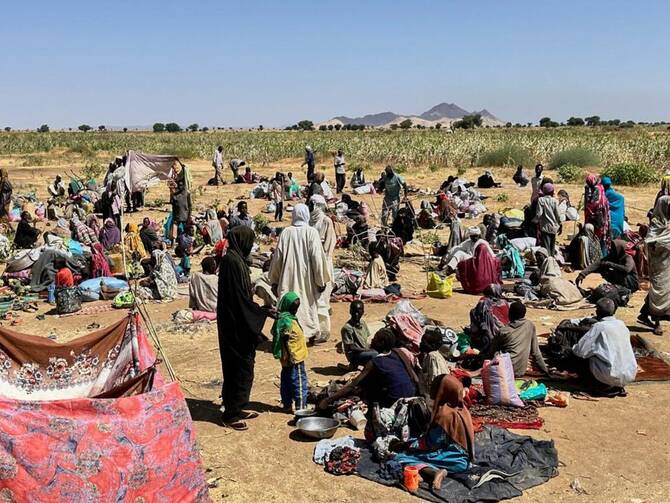
Some survivors have staggered into a refugee camp about 40 miles away in the town of Tawila.
More than 62,000 people are believed to have fled el-Fasher between Sunday and Wednesday, the UN migration agency said. But far fewer have made it to Tawila. The Norwegian Refugee Council, which manages the camp, put the number at around 5,000 people, raising fears over the fate of tens of thousands.
Fatima Abdulrahim, 70, fled el-Fasher with her grandchildren a few days before it was captured to escape the siege. She described to The Associated Press a harrowing five-day journey to reach Tawila, hiding in trenches, dodging bullets and gunmen behind walls and empty buildings.
“We ran on the streets, hiding for ten minutes behind the berm, then charging out, running until we made it out,” she said, adding that she kept falling and getting up amid gunfire and shelling. Her companions carried her at times, she said.
“Thirst almost killed us,” she said, describing picking grass to eat from the side of the road.
Along the way, she said she also witnessed militiamen shoot and kill young men trying to bring food into the city.
“The people dead on the streets were countless,” she said. “I kept covering the eyes of the little ones so they don’t see. Some were injured and beaten and could not move. We pulled some to the paved road, hoping a car would come and take them.”
She said some fighters stopped her, and the group she was traveling with, and took all their belongings and beat the children.
At least 450 people have been admitted to the hospital in Tawila, some suffering from severe malnutrition and sexual violence, said Adam Rojal, spokesperson for a local group that works with displaced people in Darfur.
The Norwegian Refugee Council said people were arriving at the camp with broken limbs and other wounds, and some with injuries sustained months ago. Many children arrived at the camp who had lost their parents in the fighting.
Hospital attack
Christian Lindmeier, a WHO spokesman, provided new details about the killings at el-Fasher’s Saudi Hospital, which had been the only hospital in the city still providing limited services during the siege.
Gunmen returned to the facility at least three times, Lindmeier told a UN press briefing in Geneva. At first, the fighters came and abducted a number of doctors and nurses, and at least six are still being held, he said. They later returned and “started killing,” he said.
They came a third time and “finished off what was still standing, including other people sheltering in the hospital,” Lindmeier said, without specifying who the attackers were.
A number of grisly videos from the hospital have circulated online showing bodies and at least one fighter shooting a man. The Associated Press has not been able to independently verify the details of the assault.
The RSF denied committing killings at the hospital. On Thursday, it posted on social media a video filmed at the hospital, showing what it said were some patients at the facility. A person speaking in the video said RSF fighters were caring for the patients, offering them change of wounds and food. At least one wounded man spoke to the reporter.
It was not immediately clear when the video was filmed, although a timestamp stated it was Thursday.
Dr. Teresa Zakaria, WHO’s unit head for humanitarian operations, told the briefing that the hospital was offering “limited service” now. But he said that since el-Fasher’s seizure on Sunday, “there is no longer any humanitarian health presence in the city, and access has remained blocked.”
Militia accused of repeated mass killings
El-Fasher was the Sudanese military’s last stronghold in Darfur, and its fall secures the RSF’s hold over most of the large western region. That raises fears of a new split in Sudan, with the military holding Khartoum and the country’s north and east.
The RSF and its allied militias have been accused of repeated mass killings and rapes when it controlled the capital Khartoum, and as it has seized towns across Darfur and further south over the past two years – mostly targeting civilians of Central and East African ethnicities.
The RSF is largely made up of fighters from the Arab Janjaweed militia, which is accused of carrying out a government-backed genocidal campaign in Darfur in the 2000s in which some 300,000 people were killed.
The Janjaweed were initially recruited by the military to fight Darfur insurgents, who were rebelling against power concentrated in the north. The militia later were reorganized into the RSF as an official force.
The military and the RSF were briefly allied in ruling Sudan following popular protests that ousted longtime leader Omar Al-Bashir. They had a falling out in 2023 in a struggle for power.

Militia attack on hospital in Darfur came in waves: WHO
Short Url
https://arab.news/gxrqh
Militia attack on hospital in Darfur came in waves: WHO
- Gunmen returned to the facility at least three times, Lindmeier told a UN press briefing in Geneva
- At first, fighters came and abducted a number of doctors and nurses, and at least six still being held, he said
US raid allegedly killed Syrian undercover agent instead of Daesh group official
- Neither US nor Syrian government officials have commented on the death, an indication that neither side wants the incident to derail improving ties
- Weeks after the raid, interim President Ahmad Al-Sharaa visited Washington and announced Syria would join the global coalition against Daesh
DUMAYR, Syria: A raid by US forces and a local Syrian group aiming to capture an Daesh (IS) group official instead killed a man who had been working undercover gathering intelligence on the extremists, family members and Syrian officials have told The Associated Press.
The killing in October underscores the complex political and security landscape as the United States begins working with interim Syrian President Ahmad Al-Sharaa in the fight against remnants of IS.
According to relatives, Khaled Al-Masoud had been spying on IS for years on behalf of the insurgents led by Al-Sharaa and then for Al-Sharaa’s interim government, established after the fall of former President Bashar Assad a year ago. Al-Sharaa’s insurgents were mainly Islamists, some connected to Al-Qaeda, but enemies of IS who often clashed with it over the past decade.
Neither US nor Syrian government officials have commented on Al-Masoud’s death, an indication that neither side wants the incident to derail improving ties. Weeks after the Oct. 19 raid, Al-Sharaa visited Washington and announced Syria would join the global coalition against IS.
Still, Al-Masoud’s death could be “quite a setback” for efforts to combat IS, said Wassim Nasr, a senior research fellow with the Soufan Center, a New York-based think tank focused on security issues.
Al-Masoud had been infiltrating IS in the southern deserts of Syria known as the Badiya, one of the places where remnants of the extremist group have remained active, Nasr said.
The raid targeting him was a result of “the lack of coordination between the coalition and Damascus,” Nasr said.
In the latest sign of the increasing cooperation, the US Central Command said Sunday that American troops and forces from Syria’s Interior Ministry had located and destroyed 15 IS weapons caches in the south.
Confusion around the raid
The raid occurred in Dumayr, a town east of Damascus on the edge of the desert. At around 3 a.m., residents woke to the sound of heavy vehicles and planes.
Residents said US troops conducted the raid alongside the Syrian Free Army, a US-trained opposition faction that had fought against Assad. The SFA now officially reports to the Syrian Defense Ministry.
Al-Masoud’s cousin, Abdel Kareem Masoud, said he opened his door and saw Humvees with US flags on them.
“There was someone on top of one of them who spoke broken Arabic, who pointed a machine gun at us and a green laser light and told us to go back inside,” he said.
Khaled Al-Masoud’s mother, Sabah Al-Sheikh Al-Kilani, said the forces then surrounded her son’s house next door, where he was with his wife and five daughters, and banged on the door.
Al-Masoud told them that he was with General Security, a force under Syria’s Interior Ministry, but they broke down the door and shot him, Al-Kilani said.
They took him away, wounded, Al-Kilani said. Later, government security officials told the family he had been released but was in the hospital. The family was then called to pick up his body. It was unclear when he had died.
“How did he die? We don’t know,” his mother said. “I want the people who took him from his children to be held accountable.”
Faulty intelligence
Al-Masoud’s family believes he was targeted based on faulty intelligence provided by members of the Syrian Free Army.
Representatives of the SFA did not respond to requests for comment.
Al-Masoud had worked with Al-Sharaa’s insurgent group, Hayat Tahrir Al-Sham, in its northwestern enclave of Idlib before Assad’s fall, his cousin said. Then he returned to Dumayr and worked with the security services of Al-Sharaa’s government.
Two Syrian security officials and one political official, who spoke on condition of anonymity because they were not authorized to comment publicly, confirmed that Al-Masoud had been working with Syria’s interim government in a security role. Two of the officials said he had worked on combating IS.
Initial media reports on the raid said it had captured an IS official. But US Central Command, which typically issues statements when a US operation kills or captures a member of the extremist group in Syria, made no announcement.
A US defense official, when asked for more information about the raid and its target and whether it had been coordinated with Syria’s government, said, “We are aware of these reports but do not have any information to provide.” The official spoke on condition of anonymity in accordance with regulations.
Representatives of Syria’s defense and interior ministries, and of US envoy to Syria Tom Barrack, declined to comment.
Increased coordination could prevent mistakes
At its peak in 2015, IS controlled a swath of territory across Iraq and Syria half the size of the United Kingdom. It was notorious for its brutality against religious minorities as well as Muslims not adhering to the group’s extreme interpretation of Islam.
After years of fighting, the US-led coalition broke the group’s last hold on territory in late 2019. Since then, US troops in Syria have been working to ensure IS does not regain a foothold. The US estimates IS still has about 2,500 members in Syria and Iraq. US Central Command last month said the number of IS attacks there had fallen to 375 for the year so far, compared to 1,038 last year.
Fewer than 1,000 US troops are believed to be operating in Syria, carrying out airstrikes and conducting raids against IS cells. They work mainly alongside the Kurdish-led Syrian Democratic Forces in the northeast and the Syrian Free Army in the south.
Now the US has another partner: the security forces of the new Syrian government.
Airwars, a London-based conflict monitor, has reported 52 incidents in which civilians were harmed or killed in coalition operations in Syria since 2020.
The group classified Al-Masoud as a civilian.
Airwars director Emily Tripp said the group has seen “multiple instances of what the US call ‘mistakes,’” including a 2023 case in which the US military announced it had killed an Al-Qaeda leader in a drone strike. The target later turned out to be a civilian farmer.
It was unclear if the Oct. 19 raid went wrong due to faulty intelligence or if someone deliberately fed the coalition false information. Nasr said that in the past, feuding groups have sometimes used the coalition to settle scores.
“That’s the whole point of having a hotline with Damascus, in order to see who’s who on the ground,” he said.
The killing in October underscores the complex political and security landscape as the United States begins working with interim Syrian President Ahmad Al-Sharaa in the fight against remnants of IS.
According to relatives, Khaled Al-Masoud had been spying on IS for years on behalf of the insurgents led by Al-Sharaa and then for Al-Sharaa’s interim government, established after the fall of former President Bashar Assad a year ago. Al-Sharaa’s insurgents were mainly Islamists, some connected to Al-Qaeda, but enemies of IS who often clashed with it over the past decade.
Neither US nor Syrian government officials have commented on Al-Masoud’s death, an indication that neither side wants the incident to derail improving ties. Weeks after the Oct. 19 raid, Al-Sharaa visited Washington and announced Syria would join the global coalition against IS.
Still, Al-Masoud’s death could be “quite a setback” for efforts to combat IS, said Wassim Nasr, a senior research fellow with the Soufan Center, a New York-based think tank focused on security issues.
Al-Masoud had been infiltrating IS in the southern deserts of Syria known as the Badiya, one of the places where remnants of the extremist group have remained active, Nasr said.
The raid targeting him was a result of “the lack of coordination between the coalition and Damascus,” Nasr said.
In the latest sign of the increasing cooperation, the US Central Command said Sunday that American troops and forces from Syria’s Interior Ministry had located and destroyed 15 IS weapons caches in the south.
Confusion around the raid
The raid occurred in Dumayr, a town east of Damascus on the edge of the desert. At around 3 a.m., residents woke to the sound of heavy vehicles and planes.
Residents said US troops conducted the raid alongside the Syrian Free Army, a US-trained opposition faction that had fought against Assad. The SFA now officially reports to the Syrian Defense Ministry.
Al-Masoud’s cousin, Abdel Kareem Masoud, said he opened his door and saw Humvees with US flags on them.
“There was someone on top of one of them who spoke broken Arabic, who pointed a machine gun at us and a green laser light and told us to go back inside,” he said.
Khaled Al-Masoud’s mother, Sabah Al-Sheikh Al-Kilani, said the forces then surrounded her son’s house next door, where he was with his wife and five daughters, and banged on the door.
Al-Masoud told them that he was with General Security, a force under Syria’s Interior Ministry, but they broke down the door and shot him, Al-Kilani said.
They took him away, wounded, Al-Kilani said. Later, government security officials told the family he had been released but was in the hospital. The family was then called to pick up his body. It was unclear when he had died.
“How did he die? We don’t know,” his mother said. “I want the people who took him from his children to be held accountable.”
Faulty intelligence
Al-Masoud’s family believes he was targeted based on faulty intelligence provided by members of the Syrian Free Army.
Representatives of the SFA did not respond to requests for comment.
Al-Masoud had worked with Al-Sharaa’s insurgent group, Hayat Tahrir Al-Sham, in its northwestern enclave of Idlib before Assad’s fall, his cousin said. Then he returned to Dumayr and worked with the security services of Al-Sharaa’s government.
Two Syrian security officials and one political official, who spoke on condition of anonymity because they were not authorized to comment publicly, confirmed that Al-Masoud had been working with Syria’s interim government in a security role. Two of the officials said he had worked on combating IS.
Initial media reports on the raid said it had captured an IS official. But US Central Command, which typically issues statements when a US operation kills or captures a member of the extremist group in Syria, made no announcement.
A US defense official, when asked for more information about the raid and its target and whether it had been coordinated with Syria’s government, said, “We are aware of these reports but do not have any information to provide.” The official spoke on condition of anonymity in accordance with regulations.
Representatives of Syria’s defense and interior ministries, and of US envoy to Syria Tom Barrack, declined to comment.
Increased coordination could prevent mistakes
At its peak in 2015, IS controlled a swath of territory across Iraq and Syria half the size of the United Kingdom. It was notorious for its brutality against religious minorities as well as Muslims not adhering to the group’s extreme interpretation of Islam.
After years of fighting, the US-led coalition broke the group’s last hold on territory in late 2019. Since then, US troops in Syria have been working to ensure IS does not regain a foothold. The US estimates IS still has about 2,500 members in Syria and Iraq. US Central Command last month said the number of IS attacks there had fallen to 375 for the year so far, compared to 1,038 last year.
Fewer than 1,000 US troops are believed to be operating in Syria, carrying out airstrikes and conducting raids against IS cells. They work mainly alongside the Kurdish-led Syrian Democratic Forces in the northeast and the Syrian Free Army in the south.
Now the US has another partner: the security forces of the new Syrian government.
Airwars, a London-based conflict monitor, has reported 52 incidents in which civilians were harmed or killed in coalition operations in Syria since 2020.
The group classified Al-Masoud as a civilian.
Airwars director Emily Tripp said the group has seen “multiple instances of what the US call ‘mistakes,’” including a 2023 case in which the US military announced it had killed an Al-Qaeda leader in a drone strike. The target later turned out to be a civilian farmer.
It was unclear if the Oct. 19 raid went wrong due to faulty intelligence or if someone deliberately fed the coalition false information. Nasr said that in the past, feuding groups have sometimes used the coalition to settle scores.
“That’s the whole point of having a hotline with Damascus, in order to see who’s who on the ground,” he said.
© 2025 SAUDI RESEARCH & PUBLISHING COMPANY, All Rights Reserved And subject to Terms of Use Agreement.


