NAIROBI: Tanzania’s governing party has been in charge for 64 years, for much of that time without any serious opposition.
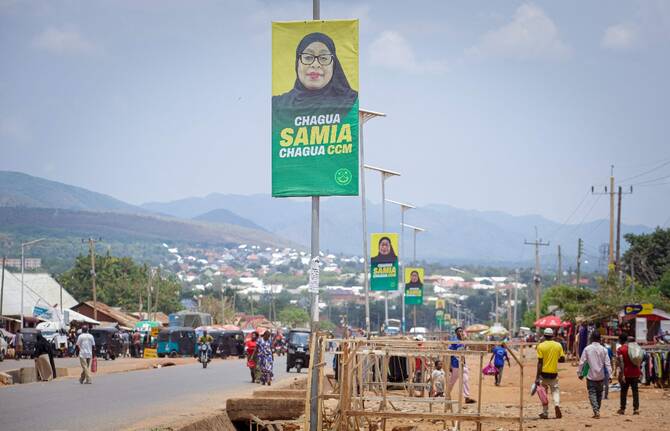
That looks set to be extended when Tanzanians go to the polls Wednesday in an election widely expected to be won by President Samia Suluhu Hassan, a former vice president who rose automatically to the presidency in 2021 after the death of her predecessor.
Although Tanzania is a multiparty democracy, a version of one party — Hassan’s Chama cha Mapinduzi, or Party of the Revolution — has been in power since the country’s independence from Britain in 1961.
The country, with annual per capita income of roughly $1,200, is an outlier in a region where liberation parties have been going out of fashion and young people fill the ranks of feisty opposition groups seeking political change.
Authorities in the country of 68 million people have cracked down on opposition leaders, civic groups, journalists and others in what Amnesty International has described as a “climate of fear” ahead of general elections to choose a president, lawmakers and other local leaders.
Hassan, Tanzania’s sixth president and its first female leader, defied early expectations that she would not follow the repressive style of former President John Pombe Magufuli, an authoritarian who did not permit opposition groups to campaign when elections were not due.
Many voters are disenchanted by the deepening of authoritarianism under Hassan. Some critics point out that the opposition parties allowed to appear on the ballot have not been campaigning much, with some opposition candidates even appearing to endorse Hassan’s election bid.
Virtually unchallenged
Voters will choose between Hassan and 16 other contenders. Two of Hassan’s main opponents, Tundu Lissu of Chadema and Luhaga Mpina of ACT-Wazalendo, are barred from seeking Tanzania’s presidency.
Lissu is a charismatic leader of the opposition to Hassan in recent years after his European exile, following an assassination attempt on him in 2017. He is now jailed on charges of treason he says are politically motivated. Police have since arrested John Heche, deputy leader of Chadema, who was taken into custody while attending Lissu’s treason trial.
While her major opponents are jailed, Hassan has been touring the country in a campaign that promises stability and prosperity for many who work in agriculture. With “work and dignity,” her campaign says, the country can move forward.
Her party CCM, which maintains ties with the Communist Party of China, has a loyal following in parts of the country, though the party’s share of the popular vote has been declining as opposition groups make their case for change.
Still, CCM heads to the polls virtually unchallenged, said Nicodemus Minde, a Tanzanian researcher with the Institute for Security Studies, a think tank based in South Africa.
Voter turnout, which has been declining since 2010, is predicted to be low, especially as a CCM victory is taken for granted, he wrote in an analysis for his group. “Voter apathy could be high due to the impact of the disqualification of the two main opposition parties,” he said.
He warned that Tanzania’s election presents “a significant risk of strengthening authoritarian practices rather than advancing democratic governance.”
The opposition has called for protests on election day.
Fears of unrest
Chadema, the opposition group disqualified from taking part in the election, insists there can be no popular vote without the reforms it says are necessary to have a free and fair election.
Some voters who spoke to The Associated Press said they were worried about the threat to peace stemming from elections, after authorities said they would not tolerate any disruptions by possible demonstrations.
Many say they have been left feeling disappointed by repressive tactics that include arbitrary arrests and abductions by unknown people. Some worry that the government plans to shut the Internet down ahead of voting.
“Peace must prevail for the election to run smoothly,” said Joshua Gerald, a resident of the commercial capital of Dar es Salaam, requesting not to give his last name because of safety fears. “Because, without peace, there can be chaos or fear, and people may fail to exercise their democratic rights.”
Noel Johnson, another young voter in the city, said “the government needs to protect our constitutional rights, especially the right to go for demonstrations because we are not satisfied by the ongoing electoral processes.”
Hassan has urged voters to show up in large numbers, saying peace would prevail, but concern over possible turmoil remains.
Richard Mbunda, a political scientist with the University of Dar es Salaam, told The Associated Press that public discontent could push the country toward instability. “There are clear signs of unrest,” Mbunda said.
Even a seemingly stable country like Tanzania risks sliding into turmoil if authorities appear aloof, he warned.
“The tone of reconciliation being spoken about during campaigns should be genuine,” he said. “Dialogue is needed. The election is legally valid but lacks political legitimacy.”


![]()
Tanzania goes to vote in elections set to keep the same party in power for 7 decades

Short Url
https://arab.news/rmyue
Tanzania goes to vote in elections set to keep the same party in power for 7 decades
- Although Tanzania is a multiparty democracy, a version of one party, Hassan’s Chama cha Mapinduzi, or Party of the Revolution, has been in power since the country’s independence from Britain in 1961


Latest updates


© 2026 SAUDI RESEARCH & PUBLISHING COMPANY, All Rights Reserved And subject to Terms of Use Agreement.