

African elections often lack a crucial component: an opposition

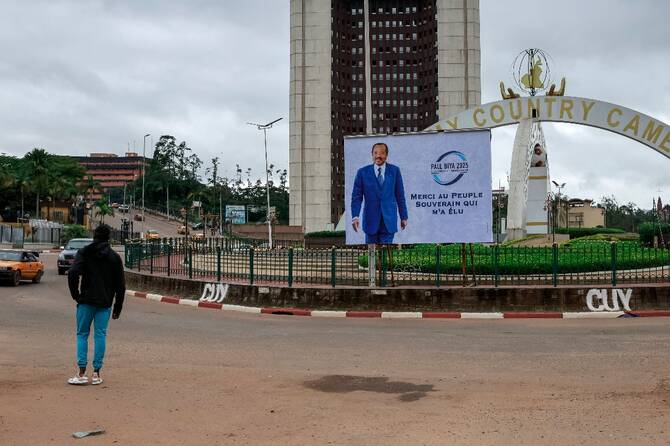
A pedestrian walks past a billboard of Cameroon's President Paul Biya reading: "I thank the sovereign people for electing me" on a street in Yaounde. (AFP)
Short Url
Updated 31 October 2025
Follow

African elections often lack a crucial component: an opposition

  • Behind the scenes are political and business elites that want to ensure their interests are not challenged, but are now spooked by a young generation demanding better governance and jobs

NAIROBI: Multiple African presidents are finding ways to block opposition candidates from running against them, turning elections into foregone conclusions that risk provoking violent unrest and undermining faith in democracy.
Tanzania’s elections descended into violence on Wednesday as voters rebelled against the lack of choice, with the two serious rivals to President Samia Suluhu Hassan either jailed or barred from running.
A day earlier, Ivory Coast President Alassane Ouattara won a fourth term with almost 90 percent of the vote after his two main opponents were similarly excluded.
In Cameroon, 92-year-old Paul Biya, the world’s oldest head of state, secured re-election for an eighth term this month, helped by the fact that his strongest challenger was barred from standing by the constitutional court.
There has been a decline in democracy worldwide in recent decades, with authoritarians finding inventive ways to block opponents everywhere from Asia to Europe to the Americas.
But it has been a striking trend in sub-Saharan Africa, showing “a crisis of democratic governance on the continent,” said Heritier Brilland Ndakpanga, of the Center for Humanitarian Dialogue.
2024 was considered a banner year for African democracy, with opposition parties winning power in Ghana, Botswana, Mauritius and Senegal.
But those were always among the continent’s most democratic countries, and the results may have encouraged other governments to take no chances at the ballot box.
Supposedly independent electoral bodies are often weaponized against the opposition, say analysts.
The running of elections is “in the hands not just of the government... but its most intransigent parts,” said Stephane Akoa, political scientist in Cameroon, bemoaning a “perversion of the system” in his country.
In Central African Republic, the opposition is boycotting polls in December, saying the election body is not independent.
Similar complaints by Tanzania’s opposition were the reason it was barred from taking part in this week’s vote, with its leader, Tundu Lissu, jailed on treason charges for calling for electoral reforms.

- Changing world order -

Behind the scenes are political and business elites that want to ensure their interests are not challenged, but are now spooked by a young generation demanding better governance and jobs.
So-called Gen Z protests have drawn violent crackdowns in Kenya, and toppled the Madagascar government this month, leading to a military takeover.
“People are becoming harder to control and creating more effective opposition movements, and governments are responding with the mechanism they’ve used historically, which is repression,” said Nic Cheeseman, an African elections expert at the University of Birmingham.
Meanwhile, there is less and less pressure from outside, as new international partners make their presence felt in Africa, notably China, Russia, Turkiye and the United Arab Emirates.
“African governments have alternatives in 2025,” said Mandipa Ndlovu, researcher with Leiden University’s African Studies Center.
“Geopolitical competition is eroding the rule of law. Democracy is not a prerequisite for working with China or Russia.”
As for the United States, President Donald Trump’s administration has taken a more transactional approach to diplomacy, telling its embassies to rein in criticism of elections.
“You’re not going to get pushback at all from the US, which historically has been one of the most outspoken when it comes to elections,” said Cheeseman, adding that US foreign-aid cuts have also removed support to pro-democracy groups.

- New generation -

All this makes for a volatile atmosphere.
Tanzanians have long been seen as one of Africa’s most docile populations, so the eruption of violence this week came as a shock to many.
“Gen Z will save us all,” said Ndlovu. “They are coming through and saying this is ridiculous, demanding that their governments provide jobs and proper governance.
“But if we can’t fix the institutions, nothing will change.”
That can require a major crisis, such as Kenya saw in 2007 and 2008, when a disputed election took the country to the brink of civil war.
That scared the elites into reforms and a new democratic constitution that has largely kept elections free and fair.
“But big protests around elections are probably not enough on their own to get regimes and the elite to change course,” said Cheeseman.
“What worries me is that in many countries, populations are becoming increasingly demanding and governments are becoming increasingly repressive.”


Trump is fighting the Institute of Peace in court. Now, his name is on the building

Updated 9 sec ago
Follow

Trump is fighting the Institute of Peace in court. Now, his name is on the building

  • State Department said it renamed the organization to the Donald J. Trump Institute of Peace to “reflect the greatest dealmaker in our nation’s history.”
  • The takeover of the Peace Institute was also anything but peaceful, with his administration seizing the independent entity and ousting its board before affixing his name to the building

State Department said it renamed the organization to the Donald J. Trump Institute of Peace to “reflect the greatest dealmaker in our nation’s history.”

WASHINGTON: The Trump administration has renamed the US Institute of Peace after President Donald Trump and has planted the president’s name on its headquarters despite an ongoing fight over control of the institute.
It’s the latest twist in a seesaw court battle over who controls the US Institute of Peace, a nonprofit think tank that focuses on peace initiatives. It was an early target of the Department of Government Efficiency this year.
On Wednesday, the State Department said it renamed the organization to the Donald J. Trump Institute of Peace to “reflect the greatest dealmaker in our nation’s history.” The new name could be seen on its building, which is near the State Department.
Trump has spent months openly lobbying for a Nobel Peace Prize even though he was passed over for this year’s installment, arguing he had a hand in easing a series of conflicts around the world. But Trump has also ordered strikes on suspected drug vessels off the coast of Venezuela and threatened that attacks on land could be coming.
The takeover of the Peace Institute was also anything but peaceful, with his administration seizing the independent entity and ousting its board before affixing his name to the building.

A sign reads "Donald J. Trump" on the building of the United States Institute of Peace after the name of US president was added to the sign for the Institute in Washington, D.C., on December 4, 2025. (REUTERS)

Anna Kelly, a White House spokesperson, said: “The United States Institute of Peace was once a bloated, useless entity that blew $50 million per year while delivering no peace. Now, the Donald J. Trump Institute of Peace, which is both beautifully and aptly named after a President who ended eight wars in less than a year, will stand as a powerful reminder of what strong leadership can accomplish for global stability.”
She added, “Congratulations, world!”
George Foote, a lawyer for the institute’s former leadership and staff, said the renaming “adds insult to injury.”
“A federal judge has already ruled that the government’s armed takeover was illegal. That judgment is stayed while the government appeals, which is the only reason the government continues to control the building,” Foote said.
Since March, the headquarters has switched hands multiple times in court actions related to the DOGE takeover. A final decision on its fate is pending in federal appeals court.
USIP has maintained it is an independent creation of Congress and outside the president’s executive authority. The administration argues it is an executive branch organization.
After Trump fired the institute’s board in the the spring, the staff was fired as well and the building was turned over to the General Services Administration.
A federal district court overturned the action in May, putting the headquarters back into the hands of USIP leadership. But that action was reversed weeks later by a federal appeals court.
Employees have been fired twice, and the building is no longer in GSA’s possession. The State Department and the institute have an agreement that allows the State Department to occupy and use the building.
The building is expected to be the backdrop for the signing of a peace agreement Thursday between Congo’s President Felix Tshisekedi and Rwanda’s President Paul Kagame. High-ranking officials from the African Union, Angola, Burundi, Kenya, Togo, Qatar, Uganda and the United Arab Emirates are also expected to attend the signing, according to Yolande Makolo, a senior adviser to Kagame.
The USIP website remained unchanged Wednesday night, but its lead item was headlined, “President Donald J. Trump to Sign Historic Peace Agreement at USIP Headquarters,” followed by a write-up of the deal between Congo and Rwanda that Trump was overseeing at the institute on Thursday.
The Institute of Peace was created by Congress in the 1980s. President Ronald Reagan signed the bill into law in 1985. Described as an independent, nonprofit think tank funded by Congress, its mission has been to work to promote peace and prevent and end conflicts while working outside normal channels such as the State Department. It was operating in 26 conflict zones, including Pakistan, Afghanistan, Mali and Burkina Faso, when DOGE shut the operation down.
As had been broadly speculated, Trump was awarded a new peace prize from FIFA on Friday, on the sidelines of the World Cup draw.  FIFA president Gianni Infantino had made it clear that he thought Trump should have won the Nobel for his efforts to broker a ceasefire in Gaza.

“This is your prize, this is your peace prize,” Infantino said. He has repeatedly spoken about soccer as a unifier for the world, but the prize is a departure from the federation’s traditional focus on sport.