

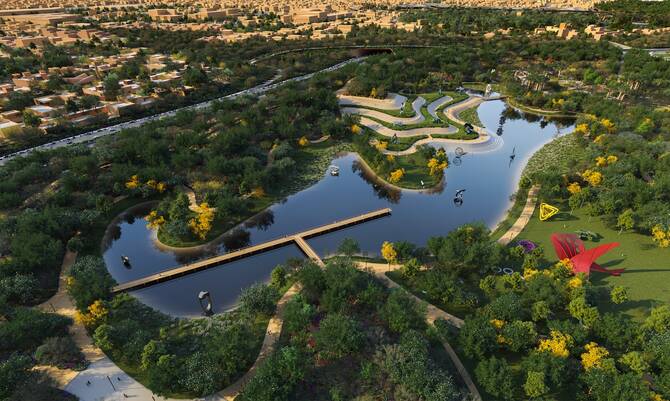

DUBAI: In the heart of Riyadh, a groundbreaking project is transforming a former airbase into a green oasis that promises to reshape the Saudi capital’s environmental and social landscape. King Salman Park — nominated for its inaugural Middle East Awards by the prestigious Royal Institute of British Architects — stands as a testament to innovative urban design in one of the world’s most challenging desert environments.
“Our primary vision was to transform this former (airbase) area from a desert flood zone into living, breathing nature in the heart of Riyadh,” Eckhard Gerber, founder of Gerber Architekten, the German firm behind the design and execution of the park, tells Arab News.
Thomas Lücking, the company’s managing director, adds, “The idea was to really create a forest and have under its canopy a thousand gardens. So, something to really increase the livability of the city, to attract the citizens into the green, and give them the opportunity to really understand and connect to nature.”

Concept image for Overlook Hill in King Salman Park. (Courtesy of Gerber Architekten)
The park, spanning 16 square kilometers, will reportedly be the largest urban park in the world. And it’s set to challenge conventional approaches to urban development in extreme climatic conditions.
“How to structure the park was the biggest initial challenge,” says Lücking. “And what helped us was really understanding Riyadh and the Arabian peninsulas and the wadis — a key element in the environment in and around Riyadh. Here, the main structuring element was creating a manufactured wadi.”
A second major challenge was connecting the city to the park. “That’s when we got this idea of an intertwining of the green fingers of the park with the urban ‘fingers’ of the city,” he continues. “So, the city reaches into the park, and the park reaches out into the city with those green fingers to make it, really, a vital part of the city — not just an island isolated there. And there’s no fence; there’s no boundary around the park.”

Concept image for Overlook Hill in King Salman Park. (Courtesy of Gerber Architekten)
The project’s ambition goes far beyond creating a simple green space. It represents a comprehensive approach to urban regeneration, addressing critical environmental challenges while giving citizens a new way to interact with nature in a desert metropolis.
Water management emerged as a crucial innovation. Lücking highlights the firm’s pioneering approach: “We’re using treated wastewater from the city — approximately 150,000 cubic meters daily — which is polished to near-drinking water quality.”
This approach not only solves waste-management issues but provides a sustainable irrigation solution for the park’s ambitious green infrastructure.

Concept image for Museum of the Earth. (Courtesy of Gerber Architekten)
Even the park’s soil is a marvel of scientific engineering. The team dug down 2.5 meters, breaking up compacted airport ground and creating what Lücking describes as “regenerative soil,” and by incorporating red sands, pumice, biochar, and microorganisms, they’ve developed a living ecosystem that can absorb rainwater like a sponge and support an extraordinary diversity of plant life.
The park — which should be complete by 2030, although some areas will open sooner than that — will apparently host more than 700 plant species, a dramatic increase from the 100-120 species currently cultivated in Riyadh. Approximately half of them are indigenous to Saudi Arabia, so many of them are being newly introduced to the region’s horticultural landscape. “We wanted to create a place where people can truly enjoy nature,” Gerber emphasizes.
The park’s design incorporates varied landscape types, including valleys, mountains, and water bodies, with elevation changes spanning 35 meters to create diverse microclimates and viewing experiences.

Concept image for one of the park's valleys. (Courtesy of Gerber Architekten)
Architectural elements are deliberately integrated into the landscape, rather than imposed on it. The Museum of the Earth, for instance, appears initially as a natural canyon, with building facades subtly emerging as visitors explore deeper. Pedestrian bridges mimic tree branches, and rest areas are designed to resemble natural caverns.
The park’s design philosophy rejects the typical approach of creating an entertainment zone. “We didn’t want hundreds of artificial attractions,” says Lücking. “Instead, we aimed to create a piece of manufactured nature where people can connect with their environment, explore, and occasionally get delightfully lost.”
The nomination for the RIBA Awards, for which the winners will be announced Nov. 5, represents more than just architectural recognition for the firm. “It’s our first opportunity to showcase what’s possible in Saudi Arabia,” notes Gerber.


