

Italy court stalls Sicily bridge, triggers PM fury

Italy's government said Thursday it would address concerns over a new bridge to Sicily, after Prime Minister Giorgia Meloni condemned a court ruling against the project as an "intolerable intrusion". (X/@ZSchneeweiss)
Short Url
Updated 30 October 2025
Follow

Italy court stalls Sicily bridge, triggers PM fury

  • In a ruling late Wednesday, the Court of Auditors, which oversees public spending, refused to approve the decision
  • Meloni condemned Wednesday’s ruling as “yet another encroachment on the jurisdiction of the government and parliament“

ROME: Italy’s government said Thursday it would address concerns over a new bridge to Sicily, after Prime Minister Giorgia Meloni condemned a court ruling against the project as an “intolerable intrusion.”
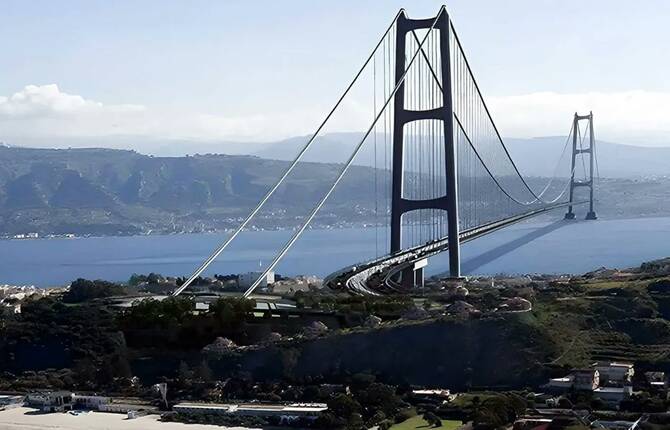
Meloni’s government in August approved the 13.5-billion-euro ($15.6-billion) project to build what would be the world’s longest suspension bridge connecting the island of Sicily to the mainland.
But in a ruling late Wednesday, the Court of Auditors, which oversees public spending, refused to approve the decision.
It said it would give its reasons within 30 days, but last month it had requested clarification about documentation used on the project, and on costs.
Meloni, leader of the far-right Brothers of Italy party, condemned Wednesday’s ruling as “yet another encroachment on the jurisdiction of the government and parliament.”
“The constitutional reform of the justice system and the reform of the Court of Auditors, both under discussion in the Senate and close to approval, represent the most appropriate response to this intolerable intrusion, which will not stop the government’s action,” she said in a statement.
At the same time, Matteo Salvini, head of the far-right League party who as deputy prime minister and transport minister has championed the bridge, said the ruling appeared to be a “political choice.”
Yet on Thursday, after Meloni called an emergency meeting with her ministers, the government adopted a more conciliatory tone.
“We await with extreme calm the Court of Auditors’ findings, to which we are confident we can respond point by point, because we have complied with the requirements,” Salvini told reporters.
In a statement, Meloni’s office confirmed the government would respond to each complaint, adding that “the objective... to proceed with the project remains firm.”
Italian politicians have for decades debated a bridge over the Strait of Messina, a narrow strip of water between the Sicily and the region of Calabria, at the toe of Italy’s boot.
“We have waited a century, and we will wait a century and two months,” Salvini added.

- ‘Respect for magistrates’ -

The approval in August by a government committee, CIPESS, is the furthest the project has ever got.
Advocates say the state-funded project will provide an economic boost for the impoverished south of Italy.
The government also hopes the bridge can be classified as a strategic asset, with its costs counting toward the money Italy has committed to spend on defense as part of the NATO military alliance.
However, critics warn that the project risks turning into a financial black hole.
It has also sparked local protests over the environmental impact, and complaints that the money could be better spent elsewhere.
The Court of Auditors on Thursday said its decision was based on legal aspects of the approval of the bridge, not on the merits of the project.
In a strongly worded decision, it added that any criticism of its decisions “must be conducted in a context of respect for the work of the magistrates.”
In three years in office, Meloni and her ministers have repeatedly taken aim at the judiciary for decisions they assert are political.
Parliament on Thursday approved a reform to separate the training, careers and status of judges and prosecutors, whom right-leaning governments in Italy have long accused of colluding to the detriment of the defense.
The reform must now go to a referendum.


House Republicans barely defeat Venezuela war powers resolution to check Trump’s military actions

Updated 23 January 2026
Follow

House Republicans barely defeat Venezuela war powers resolution to check Trump’s military actions

WASHINGTON: The House rejected a Democratic-backed resolution Thursday that would have prevented President Donald Trump from sending US military forces to Venezuela after a tied vote on the legislation fell just short of the majority needed for passage.
The tied vote was the latest sign of Republican House Speaker Mike Johnson’s tenuous hold on the majority, as well as some of the growing pushback in the GOP-controlled Congress to Trump’s aggressions in the Western Hemisphere. A Senate vote on a similar resolution was also tied last week until Vice President JD Vance broke the deadlock.
To defeat the resolution Thursday, Republican leaders had to hold the vote open for more than 20 minutes while Republican Rep. Wesley Hunt, who had been out of Washington all week campaigning for a Senate seat in Texas, rushed back to Capitol Hill to cast the decisive vote.
On the House floor, Democrats responded with shouts that Republican leaders were violating the chamber’s procedural rules. Two Republicans — Reps. Don Bacon of Nebraska and Thomas Massie of Kentucky — voted with all Democrats for the legislation.
The war powers resolution would have directed Trump to remove US troops from Venezuela. The Trump administration told senators last week that there are no US troops on the ground in the South American nation and committed to getting congressional approval before launching major military operations there.
But Democrats argued that the resolution is necessary after the US raid to capture Venezuelan leader Nicolás Maduro and since Trump has stated plans to control the country’s oil industry for years to come.
The response to Trump’s foreign policy
Thursday’s vote was the latest test in Congress of how much leeway Republicans will give a president who campaigned on removing the US from foreign entanglements but has increasingly reached for military options to impose his will in the Western Hemisphere. So far, almost all Republicans have declined to put checks on Trump through the war powers votes.
Rep. Brian Mast, the Republican chair of the House Armed Services Committee, accused Democrats of bringing the war powers resolution to a vote out of “spite” for Trump.
“It’s about the fact that you don’t want President Trump to arrest Maduro, and you will condemn him no matter what he does, even though he brought Maduro to justice with possibly the most successful law enforcement operation in history,” Mast added.
Still, Democrats stridently argued that Congress needs to assert its role in determining when the president can use wartime powers. They have been able to force a series of votes in both the House and Senate as Trump, in recent months, ramped up his campaign against Maduro and set his sights on other conflicts overseas.
“Donald Trump is reducing the United States to a regional bully with fewer allies and more enemies,” Rep. Gregory Meeks, the top Democrat on the House Foreign Affairs Committee, said during a floor debate. “This isn’t making America great again. It’s making us isolated and weak.”
Last week, Senate Republicans were only able to narrowly dismiss the Venezuela war powers resolution after the Trump administration persuaded two Republicans to back away from their earlier support. As part of that effort, Secretary of State Marco Rubio committed to a briefing next week before the Senate Foreign Relations Committee.
Yet Trump’s insistence that the US will possess Greenland over the objections of Denmark, a NATO ally, has alarmed some Republicans on Capitol Hill. They have mounted some of the most outspoken objections to almost anything the president has done since taking office.
Trump this week backed away from military and tariff threats against European allies as he announced that his administration was working with NATO on a “framework of a future deal” on Arctic security.
But Bacon still expressed frustration with Trump’s aggressive foreign policy and voted for the war powers resolution even though it only applies to Venezuela.
“I’m tired of all the threats,” he said.
Trump’s recent military actions — and threats to do more — have reignited a decades-old debate in Congress over the War Powers Act, a law passed in the early 1970s by lawmakers looking to claw back their authority over military actions.
The war powers debate
The War Powers Resolution was passed in the Vietnam War era as the US sent troops to conflicts throughout Asia. It attempted to force presidents to work with Congress to deploy troops if there hasn’t already been a formal declaration of war.
Under the legislation, lawmakers can also force votes on legislation that directs the president to remove US forces from hostilities.
Presidents have long tested the limits of those parameters, and Democrats argue that Trump in his second term has pushed those limits farther than ever.
The Trump administration left Congress in the dark ahead of the surprise raid to capture Maduro. It has also used an evolving set of legal justifications to blow up alleged drug boats and seize sanctioned oil tankers near Venezuela.
Democrats question who gets to benefit from Venezuelan oil licenses
As the Trump administration oversees the sale of Venezuela’s petroleum worldwide, Senate Democrats are also questioning who is benefiting from the contracts.
In one of the first transactions, the US granted Vitol, the world’s largest independent oil broker, a license worth roughly $250 million. A senior partner at Vitol, John Addison, gave roughly $6 million to Trump-aligned political action committees during the presidential election, according to donation records compiled by OpenSecrets.
“Congress and the American people deserve full transparency regarding any financial commitments, promises, deals, or other arrangements related to Venezuela that could favor donors to the President’s campaign and political operation,” 13 Democratic senators wrote to White House Chief of Staff Susie Wiles Thursday in a letter led by Democratic Sen. Adam Schiff of California.
The White House has said it is safeguarding the South American country’s oil for the benefit of both the people of Venezuela and the US