

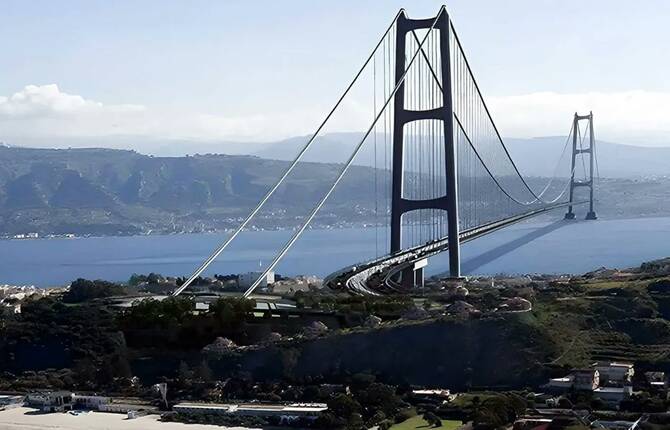
Italy court stalls Sicily bridge, triggers PM fury

Italy's government said Thursday it would address concerns over a new bridge to Sicily, after Prime Minister Giorgia Meloni condemned a court ruling against the project as an "intolerable intrusion". (X/@ZSchneeweiss)
Short Url
Updated 30 October 2025
Follow

Italy court stalls Sicily bridge, triggers PM fury

  • In a ruling late Wednesday, the Court of Auditors, which oversees public spending, refused to approve the decision
  • Meloni condemned Wednesday’s ruling as “yet another encroachment on the jurisdiction of the government and parliament“

ROME: Italy’s government said Thursday it would address concerns over a new bridge to Sicily, after Prime Minister Giorgia Meloni condemned a court ruling against the project as an “intolerable intrusion.”
Meloni’s government in August approved the 13.5-billion-euro ($15.6-billion) project to build what would be the world’s longest suspension bridge connecting the island of Sicily to the mainland.
But in a ruling late Wednesday, the Court of Auditors, which oversees public spending, refused to approve the decision.
It said it would give its reasons within 30 days, but last month it had requested clarification about documentation used on the project, and on costs.
Meloni, leader of the far-right Brothers of Italy party, condemned Wednesday’s ruling as “yet another encroachment on the jurisdiction of the government and parliament.”
“The constitutional reform of the justice system and the reform of the Court of Auditors, both under discussion in the Senate and close to approval, represent the most appropriate response to this intolerable intrusion, which will not stop the government’s action,” she said in a statement.
At the same time, Matteo Salvini, head of the far-right League party who as deputy prime minister and transport minister has championed the bridge, said the ruling appeared to be a “political choice.”
Yet on Thursday, after Meloni called an emergency meeting with her ministers, the government adopted a more conciliatory tone.
“We await with extreme calm the Court of Auditors’ findings, to which we are confident we can respond point by point, because we have complied with the requirements,” Salvini told reporters.
In a statement, Meloni’s office confirmed the government would respond to each complaint, adding that “the objective... to proceed with the project remains firm.”
Italian politicians have for decades debated a bridge over the Strait of Messina, a narrow strip of water between the Sicily and the region of Calabria, at the toe of Italy’s boot.
“We have waited a century, and we will wait a century and two months,” Salvini added.

- ‘Respect for magistrates’ -

The approval in August by a government committee, CIPESS, is the furthest the project has ever got.
Advocates say the state-funded project will provide an economic boost for the impoverished south of Italy.
The government also hopes the bridge can be classified as a strategic asset, with its costs counting toward the money Italy has committed to spend on defense as part of the NATO military alliance.
However, critics warn that the project risks turning into a financial black hole.
It has also sparked local protests over the environmental impact, and complaints that the money could be better spent elsewhere.
The Court of Auditors on Thursday said its decision was based on legal aspects of the approval of the bridge, not on the merits of the project.
In a strongly worded decision, it added that any criticism of its decisions “must be conducted in a context of respect for the work of the magistrates.”
In three years in office, Meloni and her ministers have repeatedly taken aim at the judiciary for decisions they assert are political.
Parliament on Thursday approved a reform to separate the training, careers and status of judges and prosecutors, whom right-leaning governments in Italy have long accused of colluding to the detriment of the defense.
The reform must now go to a referendum.


Why Somali migrants may still aim for US despite travel restrictions

Updated 2 sec ago
Follow

Why Somali migrants may still aim for US despite travel restrictions

MOGADISHU: Somali migrant Mohamed Abdi Awale endured horrors on an ill-fated journey across Africa to seek a better life in the West — but he’s determined to try again one day, even aiming for the US despite increasing restrictions.
Awale is one of 165 Somali migrants recently repatriated after being detained in Libya, where the International Organization for Migration says those caught on journeys to Europe face “unacceptable and inhumane conditions.”
Awale undertook a more than 5,000-kilometer (3,100-mile) journey, leaving Somali capital Mogadishu to cross Kenya, Uganda, South Sudan and Sudan.
He was captured by smugglers near the Sudan-Libyan border and taken to the Sahara oasis town of Kufra, where captors filmed him being tortured in a bid to extract a ransom from his family.
“Torture became normal,” Awale said. “If you failed to pay, they beat you until you fainted. Some people lost their minds. Others didn’t survive.”
Unable to afford the ransom, his mother, Hawo Elmo Rage, turned to social media, pleading with Somalis at home and abroad to help her save her son.
“They told me to send the money or they would take his life,” Rage said. She ultimately raised $17,000, enough to free him.
Awale was released from Kufra and put in a car bound for the Mediterranean coast with other migrants. After their vehicle broke down, the group trekked for more than two weeks, facing starvation and dehydration.
“I thought we would die there,” Awale said.
The group was then detained outside of Tripoli, and Awale spent a month in prison in the coastal town of Sirte and another two months in detention in Tripoli before his repatriation to Somalia in November.
Awale became one of hundreds of thousands of Somalis that have fled the country in more than three decades of civil war, according to UNHCR, the UN refugee agency, which estimates that another 3.5 million people are displaced within Somalia itself.
While most Somali refugees live in neighboring countries like Kenya, according to UNHCR, many like Awale have been inspired to seek a future in the West. Awale said that he dreamed of moving to the US since he was a child.
“I want him to stay,” his mother said. “But I know he wishes for a better life. I pray God gives him a safe future— not the dangerous one he found.”
Changes to immigration policy this year under Trump administration changed the calculus of migrants like Awale. US President Donald Trump banned travel to the US by citizens of Somalia and 11 other countries in June — so Awale set his sights on Europe.
Awale remains hopeful that he will reach the US one day, despite anti-Somali sentiment from the White House and a further tightening of immigration restrictions for Somalis.
The White House also announced this week that it was pausing all immigration applications for people from 19 countries, including Somalia.
“My dream was America, but I felt like Trump closed that door,” Awale said. “Maybe after Trump’s term ends.”