

Ukraine struggling to hold eastern city of Pokrovsk, military analysts say

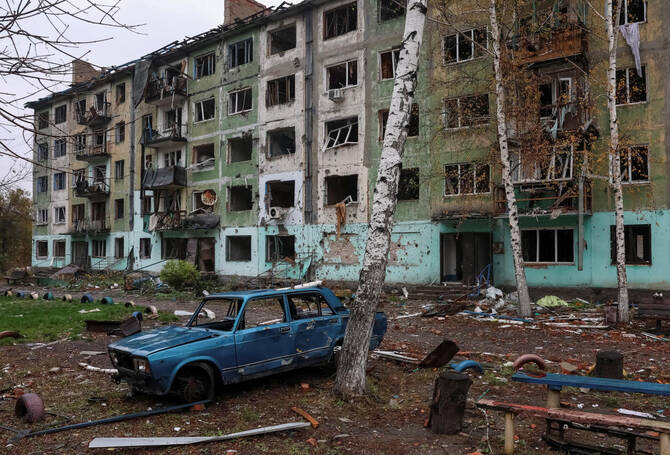
A destroyed car sits near an apartment building damaged by Russian military strike, amid Russia’s attack on Ukraine, in the frontline town of Bilozerske in Donetsk region, Oct. 27, 2025. (Reuters)
Short Url
Updated 30 October 2025
Follow

Ukraine struggling to hold eastern city of Pokrovsk, military analysts say

  • Moscow’s troops have in recent weeks closed in on the key logistics hub
  • “As in previous weeks, this is the area with the most intensive combat activity, with a strong concentration of Russian forces,” Zelensky said

KYIV: Ukrainian forces are struggling to fend off intensifying Russian advances on the eastern city of Pokrovsk, the military and open-source analysts said on Wednesday.
Moscow’s troops have in recent weeks closed in on the key logistics hub after more than a year of grinding advances, which Kyiv says have come at a staggering human cost to Russia.
In a statement, Ukraine’s 7th Corps said Russian forces had deployed some 11,000 troops in an attempt to encircle the greater Pokrovsk area.
Enemy groups that had already infiltrated the city were attempting to push further north and northwest, it said.

’MOST DIFFICULT’ SITUATION: ZELENSKIY
Ukrainian President Volodymyr Zelensky, in his nightly video address, said the situation around Pokrovsk was “the most difficult” along the 1,250-km (775-mile) front line.
“As in previous weeks, this is the area with the most intensive combat activity, with a strong concentration of Russian forces,” Zelensky said after a discussion with Ukraine’s top commander, Oleksandr Syrskyi.
He said the situation around the northeastern city of Kupiansk “remains difficult, but our forces have more control in recent days. We are continuing to defend our positions.”
Zelensky this week said around 200 Russian troops were in various parts of Pokrovsk, whose capture he said would be critical for Moscow to demonstrate it has the upper hand on the battlefield.
Capturing Pokrovsk, as well as Kostiantynivka to its northeast, would give Moscow a platform to drive toward the two biggest remaining Ukrainian-controlled cities in Donetsk.
Also on Wednesday, Ukrainian open-source group DeepState said Russia has been able to break a military logistics route to the neighboring city of Myrnohrad through infantry ambushes and drone attacks.
It warned that Ukraine would need to deploy a brigade-level force, rather than smaller units, to block further Russian infiltration of Pokrovsk.
“The situation in Pokrovsk is on the verge of critical and continues to deteriorate to the point that fixing everything may be too late,” the group said.
It also posted what it said was footage of Ukrainian forces destroying a Russian flag that had been briefly hoisted over the city gates.
In a later update, DeepState said Russian forces were trying to infiltrate Pokrovsk and a nearby village in small groups. Russian troops, it said, had taken advantage of bad weather and identified gaps in Ukrainian defenses.
Russian President Vladimir Putin said on Wednesday Ukrainian forces were surrounded in Pokrovsk and in Kupiansk.
Ukraine’s military rejected the claim about Kupiansk as “fantasies” and said Pokrovsk had not been blockaded, adding that supply lines in the area remained intact.
Reuters was unable to independently verify battlefield reports from either side.

ZELENSKIY SAYS RUSSIAN CAMPAIGN FALTERING
Moscow has stepped up a battlefield offensive amid a stalled US-led diplomatic effort to end the war, now well into its fourth year after Russia’s February 2022 full-scale invasion.
The Kremlin has repeatedly demanded that Ukraine cede its entire Donbas region, where Pokrovsk is located, as a precondition for peace talks — something Kyiv has rejected.
Speaking to reporters on Monday, Zelensky said Russia’s year-long effort to capture Pokrovsk showed that it was unable to accomplish its goal of militarily seizing the rest of the region.
“That’s why the fact that we hold Pokrovsk and that they continue to put off the plans for their (wider) campaign proves to the world that they are lying.”


Greenland prepares next generation for mining future

Updated 8 sec ago
Follow

Greenland prepares next generation for mining future

SISIMIUT: At the Greenland School of Minerals and Petroleum, a dozen students in hi-viz vests and helmets are out for the day learning to operate bulldozers, dump trucks, excavators and other equipment.
The Greenlandic government is counting on this generation to help fulfill its dream of a lucrative mining future for the vast Arctic territory coveted by US President Donald Trump.
Founded in 2008, the school, based in El-Sisimiut in the southwest of the island, offers students from across Greenland a three-year post-secondary vocational training.
Apart from their practical classes, the students, aged 18 to 35, also learn the basics of geology, rock mechanics, maths and English.
Teacher Kim Heilmann keeps a watchful eye on his students as they learn to maneuver the heavy equipment.
“I want them to know it’s possible to mine in Greenland if you do it the right way,” he told AFP.
“But mostly the challenge is to make them motivated about mining,” he added.
The remote location of Greenland’s two operational mines, and the ensuing isolation, puts many people off, the school’s director Emilie Olsen Skjelsager said.
A Danish autonomous territory, Greenland gained control over its raw materials and minerals in 2009.
The local government relies heavily on Danish subsidies to complement its revenues from fishing, and is hoping that mining and tourism will bring it financial independence in the future so that it can someday cut ties with Denmark.
“The school was created because there is hope for more activities in mining, but also to have more skilled workers in Greenland for heavy machine operating and drilling and blasting, and exploration services,” Olsen Skjelsager said.
By the end of their studies, some of the students — “a small number, maybe up to five” — will go on to work in the mines.
The rest will work on construction sites.

- Lack of skills -

Greenland is home to 57,000 people, and has historically relied on foreign workers to develop mining projects due to a lack of local know-how.
“We have some good people that can go out mining and blasting and drilling and all that kind of stuff,” explained Deputy Minister of Minerals Resources, Jorgen T Hammeken-Holm.
“But if you have a production facility close to the mining facility, then you need some technical skills in these processing facilities,” he said.
“There is a lack of educated people to do that.”
Going forward, geologists, engineers and economists will be needed, especially as Greenland’s traditional livelihoods of hunting and fishing are expected to gradually die out as professions.
The students’ tuition is paid by the Greenland government, which also gives them a monthly stipend of around 5,000 kroner ($800).
Inside the school, a glass case displays some of the minerals that lie — or are believed to lie — under Greenland, including cryolite, anorthosite and eudialyte, which contains rare earth elements essential to the green and digital transitions.
“New mine sites have been searched (for) all over Greenland,” said Angerla Berthelsen, a 30-year-old student who hopes to find a job in the mining sector one day.
There are “lots of possibilities” in Greenland, he said, sounding an optimistic note.

- Doubts over deposits -

But questions remain about Greenland’s actual resources, with the existence and size of the deposits still to be confirmed.
According to the Geological Survey of Denmark and Greenland (GEUS), Greenland is home to 24 of the 34 critical raw materials identified by the EU as essential for the green and digital transitions.
“A large variety of geological terrains exists, which have been formed by many different processes. As a result, Greenland has several types of metals, minerals and gemstones,” it says in a document on its website.
“However, only in a few cases have the occurrences been thoroughly quantified, which is a prerequisite for classifying them as actual deposits,” it stressed.
Deputy minister Hammeken-Holm said it was “more or less a guess” for now.
“Nobody knows actually.”
In addition, the island — with its harsh Arctic climate and no roads connecting its towns — currently doesn’t have the infrastructure needed for large-scale mining.
There are currently only two operational mines on the island — one gold mine in the south, and one for anorthosite, a rock containing titanium, on the west coast.