

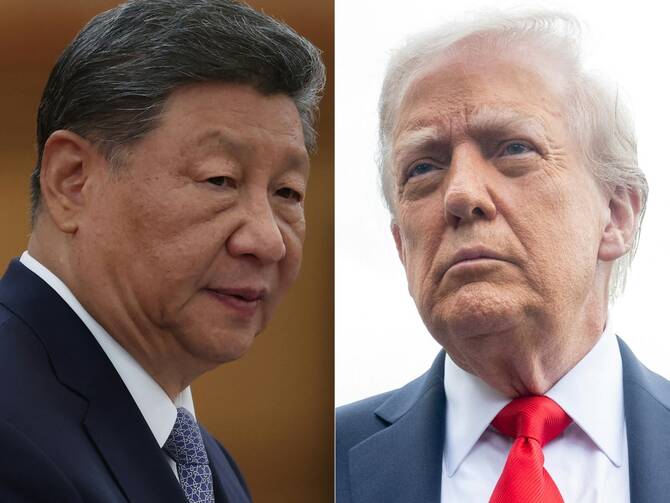

TOKYO: US President Donald Trump heads Wednesday for South Korea, where a key meeting with Chinese leader Xi Jinping could produce a truce in the blistering trade war between the world’s two largest economies.
Trump’s two-day visit to key US ally South Korea is the third leg of a trip to Asia that has seen him lauded at a regional summit in Malaysia and flattered as a “peacemaker” by Japan’s Prime Minister Sanae Takaichi.
But the eyes of the world will be on a meeting set for Thursday — the first time in six years Trump sits down with Xi.
It could determine whether the United States and China can halt a trade war that has roiled global markets and sent international supply chains into panic.
Negotiators from Beijing and Washington have both confirmed a “framework” has been agreed.
It is now down to Trump and Xi, who will meet on the sidelines of the Asia-Pacific Economic Cooperation (APEC) summit in the city of Gyeongju, to sign off on it.
“There seems to be a mismatch in terms of where both countries are, heading into the Trump-Xi summit,” said William Yang, an analyst at the International Crisis Group.
The United States “is eager to reach any trade deal that Trump could declare as a victory,” while China is focused on “building more mutual trust, managing longstanding differences, and steadying the bilateral trade relationship,” he added.
- ‘Complicated’ -
Trump is due to land in the South Korean city of Busan, fresh from two days in Tokyo, where Japan’s new conservative premier Takaichi hailed a “golden age” in bilateral ties.
The US president will head to Gyeongju for a summit with South Korean President Lee Jae Myung — their second in-person talks just two months after a meeting in Washington.
Discussion will likely be focused on trade, with the two sides still deadlocked over a deal between the major economic partners.
In July, Trump said Washington had agreed to cut tariffs on South Korean imports to 15 percent in exchange for a $350 billion investment pledge by Seoul.
Steep auto tariffs, however, remain in place, and the two governments remain divided over the structure of the investment pledge.
US Treasury Secretary Scott Bessent admitted Monday there was still “a lot of details to work out” in what he said was a “complicated” deal, while Trump has denied that there was a “snag” in the talks.
Activists plan to welcome the US leader, whose sweeping tariffs triggered the trade war, with anti-Trump demonstrations in Gyeongju condemning his “predatory investment demands.”
- DMZ meeting? -
Adding to the diplomatic high drama, Trump has also extended an invitation to North Korean leader Kim Jong Un to meet while he is on the peninsula.
The two leaders last met in 2019 at the Demilitarised Zone (DMZ), the fraught Cold War frontier that has separated the two Koreas for decades.
Trump has said that he would “love to meet” Kim and even suggested sanctions could be a topic for conversation.
But North Korea is yet to respond publicly to the invitation. Officials in Seoul appear divided as to whether it will go ahead.
Kim said last month he had “fond memories” of his meetings with Trump.
He also expressed openness to talks if the United States dropped its “delusional” demand that Pyongyang give up its nuclear weapons.
“Trump’s made it clear he wants to meet,” Chad O’Carroll, founder of the specialist website NK News, told AFP.
“The ball is in Kim Jong Un’s court.”
But the US leader now faces a different Kim than in 2019 — one emboldened since their diplomatic love affair during Trump’s first term, having secured crucial backing from Russia after sending thousands of North Korean troops to fight alongside Moscow’s forces.
“North Korea has time on its side and isn’t as isolated as before,” said Hong Min, a senior analyst at the Korea Institute for National Unification.
“A surprise event to show personal rapport is possible, but a negotiation with tangible results — like denuclearization talks — will not happen,” he told AFP.


