

Lahore tops global pollution index as Punjab cracks down on crop burning

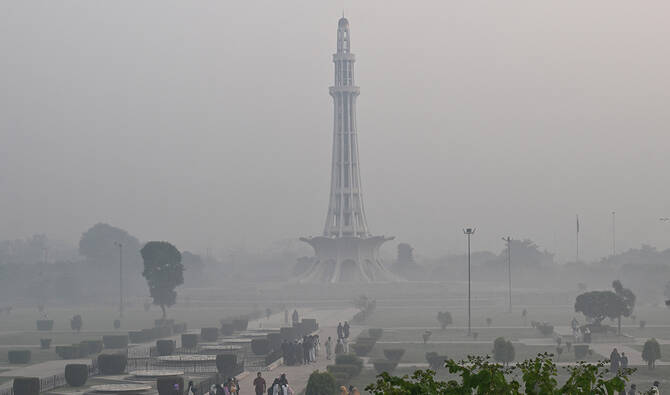
People visit Minar-e-Pakistan amid heavy smoggy conditions in Lahore on October 26, 2025. (AFP)
Short Url
Updated 28 October 2025
Follow

Lahore tops global pollution index as Punjab cracks down on crop burning

  • Lahore recorded an AQI of 196, placing it in the ‘unhealthy’ category and ahead of New Delhi
  • Punjab to seize vehicles lacking green stickers certifying emission compliance from Nov. 15

ISLAMABAD: Lahore once again topped the list of the world’s most polluted major cities on Tuesday, according to Swiss air quality monitor IQAir, as the Punjab administration said it was taking stern action against farmers burning crop residue that worsens smog across the province each winter.

The smog season in Pakistan begins in late October, peaks from November to January and lasts through February.

It affects much of the eastern province of Punjab, which faces worsening air quality each year due to multiple factors, including vehicle emissions and industrial pollution, which threaten public health and daily life.

“In line with the Chief Minister’s directives, strict action is being taken against those burning crop stubble,” the provincial authorities said in a statement, adding that 27 cases had been registered and fines totaling Rs405,000 ($1,450) imposed in districts including Mandi Bahauddin and Hafizabad.

The Punjab administration also announced that vehicles without a valid “green sticker” certifying compliance with the province’s environmental standards would be seized after November 15.

Only those meeting emission norms will be allowed on the roads, according to an official statement.

Lahore recorded an AQI of 196 at around 1:30 p.m. local time, placing it in the “unhealthy” category and ahead of New Delhi (192) and Beijing (172).

The IQAir live ranking also listed Karachi as the seventh most polluted city globally, underscoring Pakistan’s persistent urban air quality crisis.

Smog can cause sore throats, eye irritation and respiratory illnesses, while long-term exposure increases the risk of stroke, heart disease and lung cancer.

Children are particularly vulnerable due to higher breathing rates and weaker immune systems.

Lahore, a city of around 14 million people, began using anti-smog guns, spraying fine water mist across major roads, for the first time this month in an effort to reduce airborne pollutants.


Pakistan reviews austerity measures amid Middle East crisis, urges strict nationwide implementation

Updated 11 March 2026
Follow

Pakistan reviews austerity measures amid Middle East crisis, urges strict nationwide implementation

  • Deputy Prime Minister Ishaq Dar chairs review meeting of austerity steps
  • Officials briefed on salary cuts, school closures, four‑day week, petrol conservation

ISLAMABAD: Pakistan’s government on Wednesday assessed progress on a sweeping set of austerity measures introduced to mitigate the country’s economic strain from sharply rising global oil prices and supply disruptions linked to the ongoing war in the Middle East.

Prime Minister Shehbaz Sharif this week announced a series of austerity steps, including a four‑day work week for government offices, requiring 50  percent of staff to work from home, cutting fuel allowances for official vehicles by half, grounding up to 60  percent of the government fleet and closing all schools for two weeks to conserve fuel amid the global oil crisis.

The measures were unveiled in response to global oil market volatility triggered by the conflict involving the United States, Israel and Iran, which has disrupted supply routes such as the Strait of Hormuz and pushed crude prices sharply higher, straining Pakistan’s heavily import‑dependent energy sector.

“The meeting stressed the importance of strict and transparent adherence to the austerity measures, promoting fiscal responsibility and prudent use of public resources,” Deputy Prime Minister and Foreign Minister Senator Mohammad Ishaq Dar said in a statement.

He was chairing a meeting of the Committee for Monitoring and Implementation of Conservation and Additional Austerity Measures, constituted under the directions of the PM, bringing together federal and provincial officials to review execution of the broad cost‑cutting plan. 

Dar emphasized the government’s commitment to enforcing the PM’s austerity steps nationwide. The committee’s review also covered reductions in departmental expenditure, deductions from salaries of senior officials earning over Rs. 300,000 ($1,120), and coordination with provincial administrations to ensure uniform implementation of the plan.

Participants at the meeting reiterated that all ministries and divisions must continue strict monitoring and reporting, with transparent oversight mechanisms, as Pakistan navigates the economic pressures from the prolonged Middle East crisis and its fallout on global energy and trade markets.