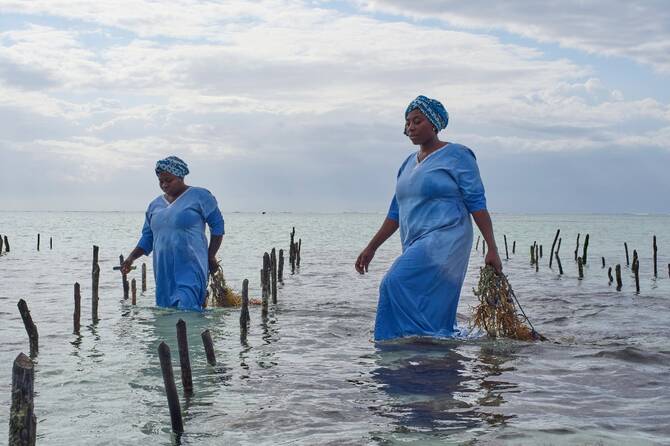
ZANZIBAR: The women wade with baskets near the beaches, their colorful dresses a magnet for tourist cameras. Sunscreen worn by the holidaymakers may even contain the product the women are collecting: Zanzibar’s seaweed.
An eco-friendly local industry that employs thousands of women, the seaweed farming looks like a picture postcard — even if the reality of the work is grimmer than what meets the eye.
“I experience pain in my back, waist and chest due to the labor in the sea. There are also risks of being stung or bitten,” said one farmer, Mwanaisha Makame Simai. “Sometimes strong waves sweep you away. I have personally witnessed three cases of people drowning.”
Growing global demand
Seaweed has been farmed off Zanzibar, part of Tanzania’s Indian Ocean coast, for decades but there is a new boom underway as global demand increases.
Seaweed is primarily exported to the global food, cosmetics and pharmaceutical industries, which extract their thickening and stabilizing agents.
In Zanzibar, private investment and donor dollars have been increasing. Seaweed is the third largest contributor to the local economy after tourism and spices.
“Ten years ago, people thought you were crazy for working in seaweed,” said Klara Schade, director at Mwani Zanzibar, which describes itself as a boutique seaweed farm and factory in the village of Paje. “Now it’s become a buzzword.”
Mwani even runs seaweed tours in Paje to introduce the work.
For the government of the semi-autonomous archipelago, seaweed is at the heart of its “blue economy” initiative to drive growth from sustainable marine and coastal resources.
Cargill, one of the world’s largest commodity trading firms, invested an unspecified amount in Zanzibari seaweed in 2020 in a partnership with The Nature Conservancy, with a view to improving yields and farmers’ incomes.
Other nongovernmental organizations have stepped up funding, including the Global Seaweed Coalition, which oversees the safety and sustainability of the sector as it scales up.
Most of Zanzibar’s 25,000 seaweed farmers are women, notable in a society where fewer than half of women are employed, according to a government census taken in 2021.
Sun exposure, stings and drowning
The Associated Press spoke with five of the women, who described sometimes harsh working conditions in the manual labor. The vast majority of seaweed farmers work independently or in collectives, selling to local middlemen. There are few if any protections.
Long days are spent wading under the equatorial sun. Back aches and skin irritation can result, with stings from sea urchins or other creatures being another worry.
“There are health and safety challenges in this work,” said Simai, an independent farmer who said she makes around $50 per month to help support her small family of two. The work may be more challenging for those with larger families, she said.
“It’s not an easy job, it’s tiresome,” said Pili Khalid Pandu, 43, who works for Mwani, doing rotations between its factory and collecting in the sea.
A new risk has come in recent years from rising sea temperatures.
“Climate change is forcing women to go into deeper water” for optimal collection, said Mhando Waziri, project manager for blue economy initiatives at the nonprofit Milele Zanzibar Foundation.
Milele’s programs include teaching women seaweed farmers to swim, in order to combat what Waziri called a growing drowning crisis.
Local women seek more benefit
The hope for the sector, as with many natural resource industries in Africa, is making more of the supply chain local. This is the goal at Mwani Zanzibar, where Schade has focused on training seaweed farmers in cosmetics manufacturing.
Workers at Mwani spend more of their time in its Paje workshop and less in the sea. Schade said Mwani’s high-end cosmetics — a bottle of its “face and body skin superfood” sells online for $140 — mean its workers make far more than the average seaweed farmer. She would not give details.
“Empowerment is giving them the means and the options to continue further,” Schade said.
Fauzia Abdalla Khamis, 45, said she has progressed from farm worker to supervisor in the factory during more than a decade.
Milele also has programs to help women develop products out of seaweed, mostly cosmetics. Waziri estimated they can fetch 10 times as much money locally as the raw, unprocessed product.
“A lot of partners want to engage more in seaweed,” Waziri said. “But people raise the challenge: ‘If a program comes here, how will it benefit farmers?’”
Simai expressed concern that seaweed farmers like her are too far down the value chain to benefit from the new investments in the local industry.
“Most of the money ends up with those who have office jobs, rather than the hardworking farmers,” she said.


![]()

Zanzibar is seeing a seaweed boom. Can the women collecting it cash in?
Short Url
https://arab.news/5s8fv
Zanzibar is seeing a seaweed boom. Can the women collecting it cash in?
- Seaweed has been farmed off Zanzibar, part of Tanzania’s Indian Ocean coast, for decades but there is a new boom underway as global demand increases
- Most of Zanzibar’s 25,000 seaweed farmers are women, notable in a society where fewer than half of women are employed, according to a government census taken in 2021


Latest updates


© 2026 SAUDI RESEARCH & PUBLISHING COMPANY, All Rights Reserved And subject to Terms of Use Agreement.