


JEDDAH: As the world marks Desertification and Drought Day on June 17, global attention is focused on the future of rangelands, which cover more than half of the Earth’s land surface and support the livelihoods of around 2 billion people.
This year’s theme, “Rangelands: Recognize. Respect. Restore,” highlights the urgent need to protect and restore these ecosystems, which play a critical role in food security, biodiversity conservation, and climate resilience.
The message carries particular significance for Saudi Arabia, where ambitious plans under the Saudi Green Initiative aim to restore degraded landscapes amid some of the world’s most fragile soils.

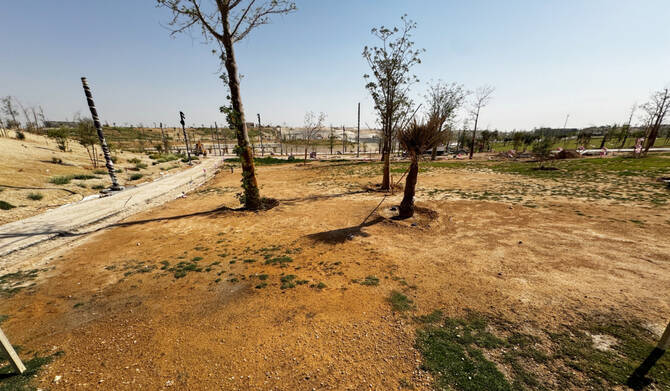
With Saudi Arabia aiming to restore 40m hectares and plant 10bn trees, sustainable solutions for soil health and ecosystem recovery are becoming vital. (Supplied)
With the Kingdom aiming to rehabilitate 40 million hectares of land and plant 10 billion trees, sustainable solutions to improve soil health and restore ecosystem function are becoming increasingly important.
In an interview with Arab News, Prof. Himanshu Mishra of KAUST, co-founder of Terraxy, said recent scientific breakthroughs are offering new reasons for optimism.
“What gives me hope is that we now understand the chemistry of why desert soils fail, and that understanding points directly to solutions,” he said.

The center highlighted Saudi Arabia’s regional leadership through the Middle East Green Initiative, which aims to plant 50 billion trees across the region. (Supplied)
At KAUST, Mishra and his team identified a key obstacle to plant growth in irrigated desert environments.
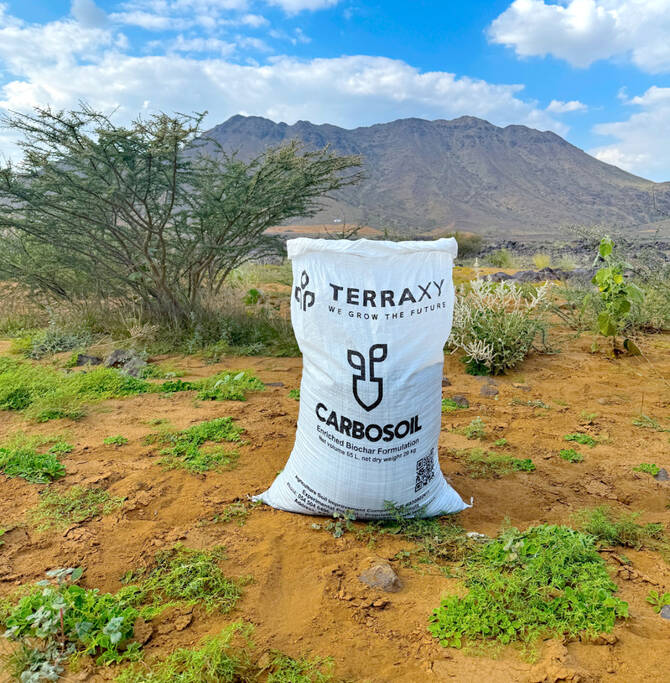
“The bottleneck for plant growth in irrigated desert soils is not water alone, but nutrient retention under alkaline conditions,” he said. “That insight led us to develop CarboSoil, an engineered biochar that works with desert soil chemistry rather than against it.”
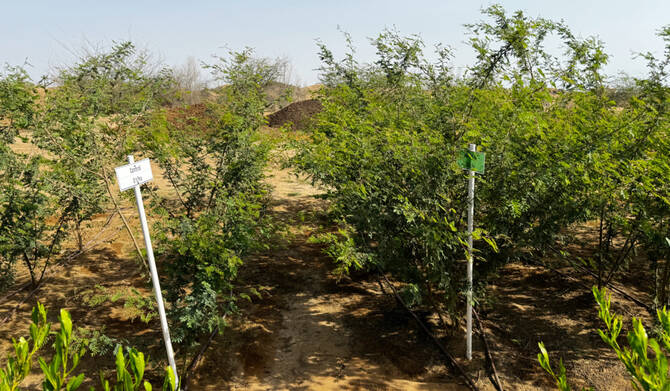
In a two-year field trial involving 580 native acacia trees, CarboSoil-treated plots achieved net carbon sequestration, while untreated plots were net carbon emitters, as emissions from irrigation and fertilizer use exceeded the carbon captured by the plants.

KAUST researcher says soil innovation can restore degraded lands and cut carbon emissions. (Supplied)
“The result changed my perspective entirely,” Mishra said. “With the right soil amendment, desert greening can be carbon-negative from day one. The science is ready.”
Mishra developed the award-winning CarboSoil and SandX technologies, which convert organic waste into soil amendments that improve nutrient retention, reduce water loss, and store carbon in degraded soils. Supported by organizations including KAUST, Saudi Aramco, Neom, and King Salman Park, the technologies are now being deployed across Saudi Arabia.
CarboSoil is produced from organic waste that would otherwise decompose in landfills and release greenhouse gases, including animal manure, date palm fronds, and agricultural residues.

Prof. Himanshu Mishra, KAUST & Co-Founder, Terraxy.
The biomass is converted into biochar — a highly porous and stable form of carbon — before undergoing a proprietary treatment process that adjusts its pH and nutrient composition for alkaline sandy soils.
While biochar is widely recognized as an effective soil amendment and accounts for more than 90 percent of durable carbon removal credits globally, raw biochar is often unsuitable for desert environments because it is highly alkaline and can further reduce nutrient availability in already alkaline soils.
“Our treatment process lowers the pH to near neutral and enriches the material with slow-release phosphorus and essential micronutrients,” Mishra said.
“When incorporated into sandy soils at 5 to 10 percent by volume, CarboSoil acts as a reservoir for nutrients and water, improving plant growth and yields.”
According to Mishra, the technology enables farmers to reduce fertilizer use, minimize nutrient losses through leaching, and improve crop health. Unlike peat moss or compost, whose benefits decline rapidly under Saudi Arabia’s harsh climate, CarboSoil can remain effective for centuries.
SandX complements CarboSoil by reducing evaporative water loss. The biomimetic mulch consists of sand grains coated with a nanoscale biodegradable wax layer.
“Applied as a thin one-centimeter layer on irrigated soil, it reduces evaporation by up to 80 percent, allowing more irrigation water to reach plant roots,” he said.
Mishra also challenged several common assumptions about farming in arid regions.
A widespread misconception, he said, is that water is the primary limiting factor in desert agriculture. However, two-year field trials showed that water-focused amendments such as hydrogels, superabsorbent polymers, and SandX did not significantly increase plant growth when irrigation and fertilization levels were kept constant.
In contrast, CarboSoil increased biomass by up to 68 percent, highlighting the importance of nutrient retention in alkaline soils once water is available.
Another misconception is that desert soils cannot be permanently improved. While conventional amendments such as peat moss and compost provide only temporary benefits before degrading, advanced soil technologies can enhance nutrient-holding capacity and microbial activity for generations.
The findings point to a broader shift in thinking about arid agriculture — away from simply increasing water inputs and toward improving soil function — with potentially far-reaching implications for agriculture and land restoration across the Middle East and North Africa.
Saudi Arabia generates more than 20 million tonnes of organic waste annually, including poultry manure, date palm residues, crop waste, and food waste. Much of it ends up in landfills, where it emits carbon dioxide and methane as it decomposes.
According to Mishra, every tonne of CarboSoil diverts roughly three tonnes of organic waste from landfills while locking carbon into a stable form for centuries and creating a valuable product for agriculture and landscaping.
He added that CarboSoil is commercially viable without subsidies and competitively priced compared with imported peat moss.
Unlike peat moss and compost, which require repeated applications and generate additional long-term costs, CarboSoil delivers benefits that persist for centuries, making it particularly attractive for large-scale and long-term restoration projects.
Each tonne of CarboSoil also removes approximately two tonnes of carbon dioxide from the atmosphere, creating carbon credits that can be sold to emissions-intensive sectors such as aviation and heavy industry.
Marking World Desertification and Drought Day, the Saudi National Center for Vegetation Cover Development and Combating Desertification highlighted the Kingdom’s efforts to expand vegetation cover, increase afforestation, and protect water resources to address the impacts of desertification and drought.
The center said Saudi Arabia is implementing environmental regulations, protecting forests, promoting sustainable rangeland management, and rehabilitating degraded land in line with Vision 2030 goals.
It also emphasized the importance of restoring degraded ecosystems to strengthen food and water security and support global climate action.
The center highlighted the Kingdom’s regional leadership through the Middle East Green Initiative, which aims to plant 50 billion trees across the region — equivalent to about 5 percent of the global afforestation target — and is expected to contribute to a 2.5 percent reduction in global carbon emissions.
Saudi Arabia’s efforts also include a cloud-seeding program launched in 2022 to enhance rainfall and support renewable water resources.


