

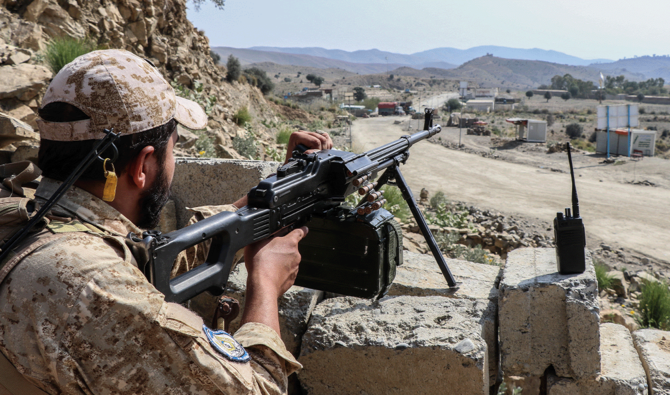

ISLAMABAD: Pakistan is making a “last-ditch effort” to convince the Afghan Taliban to take decisive action against militants targeting its civilians and security forces, a Pakistani security official said on Tuesday, as both neighbors engage in peace talks in Türkiye said to be moving toward a final round.
Delegations from Pakistan and Afghanistan have been holding peace talks since Saturday in Istanbul after the two countries saw the worst fighting in decades, leaving dozens dead and several wounded earlier this month. Clashes erupted after Pakistan conducted airstrikes near Kabul as it went after Pakistani Taliban militants, which Islamabad alleges operate from sanctuaries in Afghanistan. The Taliban responded with attacks on Pakistani military posts along the length of the 2,600-km (1,600-mile) contested border.
The Tehreek-e-Taliban Pakistan (TTP), also known as the Pakistani Taliban, is an umbrella organization of militant groups separate from the Afghan Taliban but sharing ideological ties. The group has carried out thousands of attacks inside Pakistan over the last two decades, and Islamabad accuses the Taliban-led government in Kabul of sheltering its leadership.
The two sides agreed to a ceasefire in Doha on Oct. 19, mediated by Türkiye and Qatar, and agreed to hold talks in Istanbul on Oct. 25 to hammer out a lasting truce. Pakistan has sought assurances from Afghanistan that it would not let militants, especially the TTP, operate from its territory and carry out cross-border attacks. Kabul wants Islamabad to respect its territorial sovereignty and refrain from carrying out strikes inside its borders.
“On the third day, the talks continued for 18 hours,” a Pakistani security official told Arab News, requesting anonymity.
“During the 18 hours, the Afghan Taliban delegation repeatedly agreed to Pakistan’s logical and legitimate demand for credible and decisive action against the TTP and terrorism. Even in the presence of the hosts, the Afghan delegation acknowledged this central issue. However, each time the Afghan Taliban delegation’s position changed due to instructions received from Kabul.”
According to the official, “illogical and illegal advice received from Kabul during the talks is responsible for the failure of the talks.”
“Pakistan and the hosts want to resolve these complex issues in a very thoughtful and serious manner,” he added. “A last-ditch effort is still underway, despite the Taliban’s stubbornness, to somehow resolve this issue through logic and talks and the talks are moving toward a final round.”
Afghan state broadcaster Radio Television of Afghanistan (RTA) reported on Monday that “most issues have been resolved” between Pakistan and Afghanistan during the ongoing talks, with a few points yet to be finalized.
In a later report, the state outlet said the Afghan delegation sought “result-oriented” discussions but claimed the Pakistani side was “unwilling to engage seriously.”
The broadcaster added that “certain circles within the Pakistani military establishment are obstructing the negotiation process,” and quoted officials as saying Kabul “cannot prevent attacks inside Pakistan nor represent the TTP,” describing it as an “internal issue rooted in Pakistan’s own past.”
“The Islamic Emirate has reaffirmed that Afghanistan’s territory will not be used against any other country,” the RTA said.
Spokespersons for Afghanistan’s Taliban government and defense ministry, and for Pakistan’s army, defense and foreign ministries, have not yet commented on the talks.
However, insiders said Pakistan’s central demand is simple in formulation but hard in practice: it wants Kabul to guarantee that Afghan territory will not be used as a sanctuary for militants who cross into Pakistan to carry out attacks, and where possible to hand over militant leaders operating from Afghan soil.
Speaking to Arab News, defense analyst Maj. Gen. (r) Inam-ul-Haq, who is keeping a close watch on the situation, said the Taliban were unlikely to accede to Pakistan’s key demands.
“Pakistan’s principal demands are handing over TTP top leaders and giving ironclad guarantees against cross-border attacks,” he said.
“Afghanistan is not a normal state,” he continued, arguing the Taliban leadership lacks the diplomatic craft needed for complex talks and has changed negotiators repeatedly.
Asked what would happen if talks fail, he said a full-scale war was unlikely given Pakistan’s military advantage.
“There will be border skirmishes but the situation will cool down as Afghanistan will de-escalate,” Haq added, saying Kabul cannot afford a long war because it depends on Islamabad for trade routes.
Haq said Pakistan has made two major policy shifts: it would strike militant bases inside Afghanistan if attacks emanate from there, and it will back an inclusive Afghan government rather than exclusively supporting the Taliban.
Afghan commentator Sami Yousafzai warned the collapse of talks would be disastrous but said both sides were trying to salvage them.
“According to my information both sides are trying to salvage talks despite tensions between them,” he noted. “Taliban sent moderate negotiators for talks who are pro-peace.”
He noted the TTP has been largely dormant since the ceasefire but cautioned: “If they launch major attacks again, that will determine the future of Pakistan and Taliban relations.”
“In my view, the way forward is that Pakistan should take action against the TTP inside its territory and also eliminate TTP leaders through covert operation inside Afghanistan,” he added. “Also Islamabad can engage other countries like China to influence Taliban.”
However, he maintained it was impossible the Taliban would expel TTP fighters, calling it against the Afghan culture and pointing out that Kabul was concerned the TTP could turn against them.
Ihsan Tipu Mehsud, co-founder of The Khorasan Diary, agreed with Yousafzai, saying the Afghans in the past refused to hand over Osama bin Laden to the United States in the wake of the September 11, 2001, attacks.
He maintained failure of talks could leave Pakistan with little choice but to use force or expand support for anti-Taliban actors inside Afghanistan, risking regional escalation.
These analysts also noted that, even if negotiators reach a deal in Istanbul, its implementation will be another challenge.
Pakistan wants verifiable mechanisms — joint monitoring, handovers of specific individuals and guarantees that Kabul will act against militant sanctuaries — but Kabul, which says it does not control all armed factions and faces internal divisions, is unlikely to accept terms seen as compromising sovereignty or inviting domestic backlash.
The border between Pakistan and Afghanistan, known as the Durand Line, has long been a flashpoint, with both sides accusing each other of harboring militants and violating sovereignty. Relations have sharply deteriorated since the Taliban’s return to power in 2021, with Pakistan reporting a surge in cross-border attacks attributed to the TTP.
While the two sides engage in talks in Istanbul, tensions remain high at the border.
Clashes between Pakistan and the Pakistani Taliban over the weekend killed five Pakistani soldiers and 25 militants near the border with Afghanistan, the military said on Sunday.
On Saturday, Pakistan’s defense minister Khawaja Asif said he believed Afghanistan wanted peace but that failure to reach an agreement in Istanbul would mean “open war.”


