

Doctors granted Saudi premium residency praise benefits of scheme

1 / 2
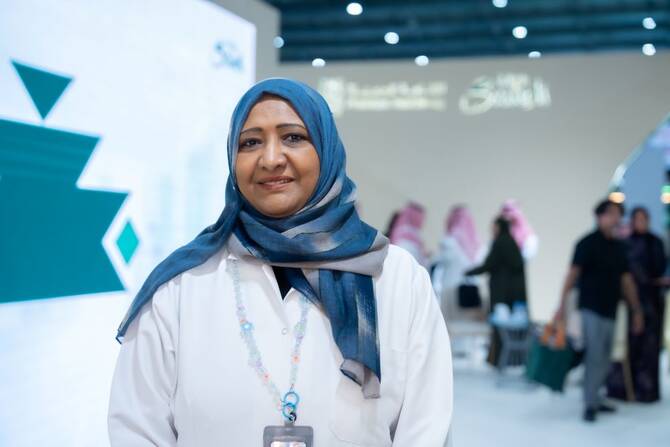
Dr. Seham Othman Omar, an associate consultant in the pediatric cardiology department at the National Guard Hospital in Riyadh. (AN Photo/Huda Bashatah)
2 / 2
Dr. Eyhab Solaiman, a consultant cardiologist and advanced cardiac imaging specialist at the King Abdulaziz Center for Heart and Lung Diseases. (AN Photo/Huda Bashatah)
Short Url
Updated 28 October 2025
Follow

Doctors granted Saudi premium residency praise benefits of scheme

  • Dr. Seham Othman Omar: The premium residency has many benefits, including freedom of movement
  • Othman Omar: Before the distinguished residency, a person was restricted to working in the hospital where he was employed

RIYADH: Doctors who were granted premium residency status in Saudi Arabia praised the benefits of the scheme at an event in Riyadh on Monday.

Speaking to Arab News at the Global Health Exhibition, Dr. Seham Othman Omar, an associate consultant in pediatric cardiology at the National Guard Hospital in Riyadh, said: “The premium residency has many benefits, including freedom of movement.”

She added that the premium residency gave her greater flexibility over where she worked, which allowed her to treat patients “in many hospitals, and in many cities.”

Dr. Omar came to Saudi Arabia in 2000 and worked in several different places, including Qassim and Jubail, before settling in Riyadh at the National Guard Hospital.

The premium residency “allowed us to move from hospital to hospital and from city to city to assist in some hospitals, such as those that lack cardiologists,” she said.

“Before the distinguished residency, a person was restricted to working in the hospital where he was employed.

“Now, however, the doctor can work in other places and contribute to transferring expertise and helping patients in hospitals that do not have consultants specializing in cardiology,” Dr. Omar said.

In the pursuit of securing high-quality services and developing the economy, the Premium Residency Card was introduced in 2019 to retain and attract exceptional professionals to the country.

At last year’s health exhibition, a number of physicians were granted premium residency status.

The scheme, unofficially known as the “Saudi Green Card,” aims to contribute to the national economy and boost the country’s position as a global hub for attracting talent, investors and entrepreneurs.

The center offers seven categories of premium residencies, including the special talent residency, investor residency, entrepreneur residency, real estate owner residency, limited duration residency and unlimited duration residency.

Dr. Eyhab Solaiman also shared his experience with the scheme, and said that it allowed him to travel, work and share his expertise in other locations.

“I applied for the card last year and within a few months, the Premium Residency was issued after fulfilling the requirements,” he said.

“It did not require permission when leaving the country and returning to Saudi Arabia.”

Dr. Solaiman is a consultant cardiologist and advanced cardiac imaging specialist at the King Abdulaziz Center for Heart and Lung Diseases, Surgery and Transplantation.


Saudi Cabinet reviews cooperation and agreements with other nations

Updated 25 February 2026
Follow

Saudi Cabinet reviews cooperation and agreements with other nations

  • Crown Prince Mohammed bin Salman chairs meeting and briefs ministers on his recent meeting with Egypt’s President Abdel Fattah El-Sisi
  • Cooperative efforts includes projects focusing on development and education, political consultations, environmental protection, health, investment and air transport

RIYADH: Saudi Arabia’s Council of Ministers reviewed a number of domestic and international matters during a session in Jeddah on Tuesday chaired by Crown Prince Mohammed bin Salman.

The crown prince briefed the Cabinet on his recent meeting with the Egyptian president, Abdel Fattah El-Sisi, which included discussions about regional security and stability, the latest developments in the Middle East, and other topics of importance to the Arab and Islamic world, the Saudi Press Agency reported.

He also shared with ministers the contents of a letter he received from the president of Kazakhstan, Kassym-Jomart Tokayev.

The council discussed progress in cooperative efforts involving Saudi Arabia and other countries including Kyrgyzstan, Pakistan, Armenia, Turkmenistan, Estonia, Cuba and Kiribati, and approved a number of memorandums of understanding.

The cooperation includes projects focusing on development and education, political consultations, environmental protection, health, investment and air-transport services, the press agency said. Ministers also approved an agreement between the Saudi General Authority for Awqaf and its Omani counterpart relating to endowments.

They reviewed national initiatives, including one for the promotion of charitable work, and the enhancement of humanitarian and developmental efforts across the country.

A merger of the National Competitiveness Center with the Saudi Center for Economic Business to create a combined Saudi Competitiveness and Business Center was authorized.