

Saudi Ministry of Health inaugurates Global Health Exhibition

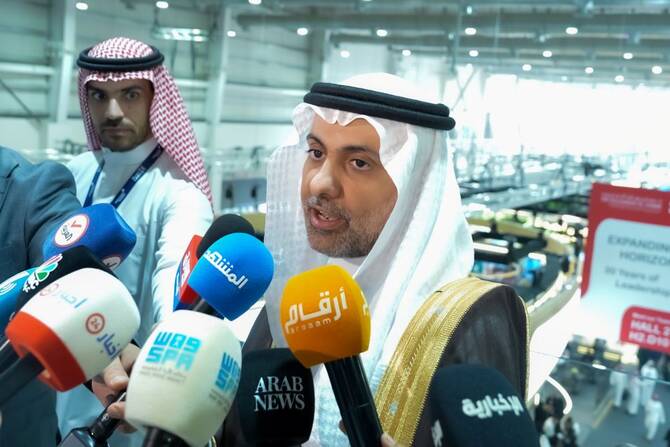
Health Minister Fahad Al-Jalajel speaks to the press at the Global Health Exhibition 2025 in Riyadh. (AN Photo)
Short Url
Updated 28 October 2025
Follow

Saudi Ministry of Health inaugurates Global Health Exhibition

  • Exhibition, in its eigth edition, will run until Thursday under the theme Invest in Health
  • Event organized by events company Tahaluf with the support of the Ministry of Health

RIYADH: The Global Health Exhibition 2025 was inaugurated today by Saudi Minister of Health Fahad Al-Jalajel at the Riyadh Exhibition and Convention Center.

The exhibition, in its eigth edition, will run until Thursday under the theme “Invest in Health.”

It was organized by events company Tahaluf with the support of the Ministry of Health.

“I am delighted to be here today at the Global Health Exhibition, in its eighth edition, and happy to see the numbers increasing every year, including the number of international speakers, CEOs of major companies or even the number of investments,” Al-Jalajel told Arab News.

He added that he was “happy to see that in the previous edition of the summit, we have reached SR55 billion ($14.66 billion) in investment, this year we have witnessed partnerships and projects totaling SR124 billion thus far and will continue to follow up in the coming days.”

During his opening remarks, the minister noted that the world continues to face growing health challenges including a rise in chronic diseases, escalating healthcare costs and a shortage of qualified medical professionals.

Speaking to Arab News, he elaborated on the methods that the Ministry of Health uses to measure the quality of services provided in the Kingdom.

“Measuring the quality of healthcare services involves numerous indicators, whether related to patient outcomes and their perception of care quality, patient satisfaction, or the quality of the healthcare services themselves, based on operational and health quality standards.”

He continued: “Within the Health Transformation Program, several organizations monitor these aspects, including the Facility Safety Program, the Saudi Patient Safety Center, the Council of Health Insurance, and the Saudi Health Council.

“Each entity tracks a specific set of indicators, whether related to healthcare practitioners, medical devices in coordination with the Saudi Food and Drug Authority, or the performance of healthcare facilities.”

The minister highlighted some of the major news during the opening ceremony such as Saudi Arabia achieving a 40 percent reduction in deaths from chronic diseases since 2017.

He also highlighted how the Kingdom has seen a nearly 60 percent decrease in traffic accident fatalities since 2016, and a growth in the rate of life expectancy to 79 years in 2025 from 74 in 2016.

Additionally, several announcements were made regarding the launch of new initiatives, including the AI Physician experience which aims to improve disease diagnosis, the localization of vaccine manufacturing in collaboration with leading global companies, and the introduction of the Smart Health Coach which was developed in partnership with Google through the Sehhaty application.


Iranian ambassador thanks Saudi for not allowing territory to be used during war

Updated 43 min 55 sec ago
Follow

Iranian ambassador thanks Saudi for not allowing territory to be used during war

  • Alireza Enayati tells AFP Iran appreciates Kingdom's pledge not to allow its 'airspace, waters, or territory' to be used in US attacks
  • Envoy also denies that his country hit the US embassy in Riyadh this week with drones

RIYADH: Iran’s ambassador to Saudi Arabia Alireza Enayati said on Thursday his country remained appreciative of Saudi Arabia’s pledge to not allow its airspace or territory to be used during the ongoing war with the US and Israel.
“We appreciate what we have repeatedly heard from Saudi Arabia — that it does not allow its airspace, waters, or territory to be used against the Islamic Republic of Iran,” he told AFP.
Before the outbreak of war, Riyadh had thrown its support behind diplomatic efforts to diffuse tensions between Tehran and Washington and vowed that its airspace would not be allowed to be used for attacks against Iran.
Enayati also categorically denied that his country hit the US embassy in Riyadh this week, after Saudi officials said Iran targeted the compound with drones.
Saudi Arabia has repeatedly accused Tehran of launching missile salvos and drone attacks at its territory and warned that the kingdom reserved the right to defend itself, including by retaliating.
Iran had earlier denied attacking the sprawling Ras Tanura refinery — one of the largest in the Middle East — which Riyadh had also accused Tehran of targeting twice with drones.
Enayati added to the denial, saying Iran also had no hand in the targeting of the US embassy that triggered a fire at the compound.
“We confirmed that Iran has no role in the attack on the US embassy in Riyadh,” the ambassador told AFP.
“If the operations command in Tehran attacks somewhere, it takes responsibility for it.”
The war in the Middle East has engulfed the otherwise stable Gulf region as Iran retaliates over US and Israeli strikes that killed its supreme leader, launching strikes at Israel, the wider region and beyond.
At least 13 people have been killed in the Gulf, including seven civilians, since Iran began its attacks on Saturday.
Enayati, however, denied that Iran was waging a regional war as retaliation for the attacks on his country by the US and Israel.
“This is not a regional war and it is not our war. It was imposed on the region,” he told AFP.