

Pakistan central bank holds key policy rate at 11 percent for fourth straight meeting

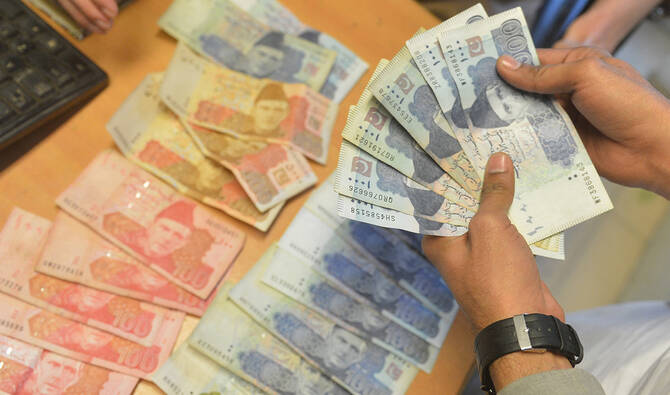
A money changer counts Pakistan's currency at a market in Karachi on January 6, 2023. (AFP/ file)
Short Url
Updated 27 October 2025
Follow

Pakistan central bank holds key policy rate at 11 percent for fourth straight meeting

  • The move comes at a time when the central bank is juggling modest economic growth, external‐sector vulnerabilities and inflation risks
  • The central bank has lowered rates by 1,100 basis points since June 2024, when they peaked at 22 percent after inflation neared 40 percent a year before

ISLAMABAD: The Monetary Policy Committee (MPC) of the State Bank of Pakistan on Monday decided to keep the policy rate unchanged at 11 percent, marking the fourth consecutive meeting in which borrowing costs have been held steady.

The SBP’s decision comes at a time when the central bank is juggling modest economic growth, external‐sector vulnerabilities and inflation risks. After having slashed rates significantly in 2024, it entered a pause campaign earlier this year, choosing stability over further easing given flood-related supply disruptions, rising food inflation and pressures on the current account.

“The Monetary Policy Committee decided to keep the policy rate unchanged at 11 percent in its meeting held on October 27, 2025,” the central bank said on X.

The central bank added that the current account deficit is expected to remain within the 0–1 percent of GDP range in fiscal 2026, with the realization of official inflows projected to raise foreign exchange reserves to $15.5 billion by December 2025 and around $17.8 billion by June 2026.

Last week, all 10 analysts surveyed by Reuters said they expected the State Bank of Pakistan (SBP) to keep the policy rate unchanged, extending its pause as recent floods ravaged farmland and border closures with Afghanistan since Oct. 11 drove up prices of staples like tomatoes and apples.

“The SBP [maintained] status quo amid concerns about rising inflation following flood losses and [to] support rupee,” Ahsan Mehanti of Arif Habib Commodities said, attributing the central bank decision to the “IMF (International Monetary Fund) pressure to keep a tight fiscal and monetary policy.”

The SBP last held rates in September, warning floods could push inflation above its 5–7 percent target. Pakistan’s headline inflation rate accelerated to 5.6 percent on a year-on-year basis, up 2 percent from the previous month.

Monsoon floods swamped farmland and industrial hubs in Pakistan’s breadbasket Punjab province, killing more than 1,000 people nationwide, displacing 2.5 million and damaging crops and factories.

The central bank has lowered rates by 1,100 basis points since June 2024, when they peaked at 22 percent after inflation neared 40 percent the year before. Its last 100-bps cut came in May, followed by holds in June, July, and September amid uncertainty over energy and food prices.


Battered by floods, Pakistani school named among Zayed Sustainability Prize finalists

Updated 4 sec ago
Follow

Battered by floods, Pakistani school named among Zayed Sustainability Prize finalists

  • Award recognizes SMEs, nonprofits and high schools for impactful, innovative sustainable solutions
  • Qadar Nagar High School’s project aims to plant 10,000 trees using sensors, drip irrigation, solar energy

BUNER: With large cracks on its once solid walls and massive rocks lying scattered outside the school’s premises, Qadar Nagar High School (QNHS) is a stark reminder of the havoc wreaked by climate change. Torrential floods, however, have done little to dampen the spirits of the students and the management of this one resilient school. 

Torrential rains triggered devastating floods in Pakistan’s northwestern Buner district this August, killing more than 200 people and washing away critical infrastructure. QNHS, a public high school established in 2010 under the Qadar Nagar Trust (QNT), bore the brunt of the deluges. 

School officials say 60 percent of QNHS’s building was damaged by the August floods, with it STEM lab, workshop, mosque and various other facilities destroyed by the deluges.

The school, however, has made headlines worldwide after it was selected as one of the finalists of the Zayed Sustainability Project. The award recognizes and rewards small to medium-sized enterprises (SMEs), nonprofit organizations (NPOs) and global high schools for impactful, innovative and inspiring sustainable solutions.

QNHS was named as one of the finalists for its project to restore 20 acres of underutilized land through smart afforestation and climate-resilient farming, using native trees, fruit crops, smart irrigation and farming tunnel set-ups for vegetable production.

“We are turning barren land into a forest area which is essential to minimize the effects of floods and other mother nature events that are happening,” Mughal Khan, the section in-charge at QNHS and assistant supervisor of the project, told Arab News. 

Titled, ‘From Roots to Sustainability, Afforestation, Smart Farming and Youth Empowerment,’ the project aims to plant 10,000 trees in the land where the dilapidated school is located, eighth grader Arfa Fatima Alisha said.

“And in this, we are going to use tools like sensors and solar power and drip irrigation to save water and energy as well,” Alisha told Arab News on Friday. 

Amina Afreen Yousafzai, another student of grade eight, says adopting technology in plantation is what makes the project “special.”

“We use sensors to check the moisture and temperature of the soil,” Yousafzai explained. “This will help us to water plants at the right time and save water.”

‘FLUSHED AWAY BY THE FLOOD’

Khan and many like him remember the devastating effects of the August floods all too well. Before the deluges struck, over 500 students were studying in the school which was established in 1990. 

Several students were asked to migrate after floods damaged its infrastructure in August. Now, only 300 remain. 

“If I call it one of the most horrific and catastrophic events in the history of Buner, I will not be wrong because of the magnitude of destruction,” Khan said. 

“As you can see, nearly 60 percent of our architecture (building) has been flushed away by the flood.”

The school has previously taken part in environmental projects as well. According to Khan, the school launched a project in 2011 with the local government in which it planted nearly 4,000 pine trees, Khan said. 

 “In 2016, the school partnered with another organization to plant 1,500 more trees,” he added. 

QNHS is one of 33 finalists of the Zayed Sustainability Prize selected from 7,761 submissions across 173 countries in six categories. 

While the winners will be revealed at the prize awards ceremony on Jan. 13, 2026, during the Abu Dhabi Sustainability Week, Khan is already proud of the nomination. 

“Linking and aligning our efforts with this award, I think it is a golden opportunity for us [and] for the recognition of our efforts on a global arena,” Khan said.