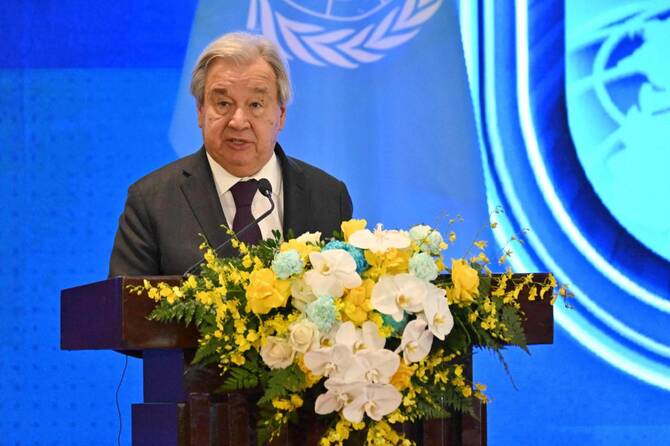
UN secretary-general calls for end to ‘deplorable’ violence in Myanmar

Myanmar’s military rulers must put an end to the ‘deplorable’ violence inflicted on the population since 2021, UN chief Secretary-General Antonio Guterres said on Monday. (AFP)
Short Url
Updated 27 October 2025
Follow

UN secretary-general calls for end to ‘deplorable’ violence in Myanmar

  • UN chief: Military takeover had not only ‘piled calamity upon calamity’ on Myanmar but also threatened regional stability

KUALA LUMPUR: Myanmar’s military rulers must put an end to the “deplorable” violence inflicted on the population since 2021 and find a “credible path” back to civilian government, United Nations Secretary-General Antonio Guterres said on Monday.

Speaking at a press conference on the sidelines of the ASEAN summit in Kuala Lumpur, Guterres said the military takeover had not only “piled calamity upon calamity” on Myanmar but also threatened regional stability.

“I reiterate my call for an immediate end to the violence, a genuine commitment to inclusive dialogue and a credible path back to civilian rule,” he said.

Since the 2021 coup against the democratically elected government led by Aung San Suu Kyi, Myanmar has been locked in turmoil, with an armed rebellion seizing control of large swathes of territory.

The military government says it intends to return Myanmar to democratic rule via a general election at the end of this year, even as the civil war rages, but the credibility of the vote has been questioned and the junta’s critics expect it to stay in power through proxies.

Opposition parties have been dissolved for failing to register, rebel groups and a shadow government have refused to join the political fold and junta chief Min Aung Hlaing has admitted that a vote cannot be held nationwide.

“The way forward must lead to a restoration of democratic institutions anchored in the rule of law and human rights,” Guterres said. Asked about the election, he said: “I don’t think anybody believes that those elections will be free and fair.”

He also gave his backing to a peace plan drawn up in 2021 by ASEAN to end hostilities and start dialogue, which the military government has largely ignored.

“It’s time to open humanitarian channels, end the violence and facilitate a comprehensive political solution,” he said. “The people of Myanmar are counting on our collective support.”


I want answers from my ex-husband, Gisele Pelicot tells AFP

Updated 6 sec ago
Follow

I want answers from my ex-husband, Gisele Pelicot tells AFP

  • Gisele Pelicot, the French woman who became a symbol in the global fight against sexual violence, told AFP why she wants to visit her ex-husband in jail and her joy at finding love again
PARIS: Gisele Pelicot, the French woman who became a symbol in the global fight against sexual violence, told AFP why she wants to visit her ex-husband in jail and her joy at finding love again.
In an interview ahead of the publication of her memoirs on Tuesday, she also said she hopes to inspire other rape victims to believe in a brighter future — and to change attitudes along the way.
Her book, titled “A Hymn to Life,” covers the full arc of her 50-year marriage which ended when she discovered that her husband had been repeatedly drugging her and inviting strangers over to their house to rape her.
It will be published in 22 languages.
The title of your book in French is “And the joy of living.” Have you found joy again?
“I’m doing better. After the trial (of her husband and 50 other men in 2024), I took stock of my life and today I am trying to rebuild on this field of ruins.
Despite all these ordeals, even in the darkest periods, I have always sought flashes of joy; I am looking toward the future, toward joy. I know this may surprise some who expect to see me in tatters, but I am determined to remain standing and dignified.”
Some describe you as an icon. Do you embrace that status?
“I do not use that word. I think my story has become a symbol. I know where I come from and who I am. It seems to me that we do not suspect the strength we have inside us until we are forced to draw on it, and that is also what I would like to say to victims.”
Why did you write this book?
“I needed to bear witness to my life journey, to address all those who supported me; it was a way of responding to them. Writing this book with (French author) Judith Perrignon, in whom I had complete trust, was both painful and fascinating.
Beyond the case itself, it retraces my life, the journey of three generations of women: my grandmother, my mother and myself. Their example explains my strength because I experienced tragedies very young. When you lose your mother at age nine, you grow up faster than others.”
Have you had professional psychological help to overcome your trauma?
“Of course, I could not get through this alone. How do you sort through 50 years of memories tainted by this series of crimes? I lived for half a century with Mr. Pelicot and I have no memory of the rapes, only the memory of happy days.
I cannot throw my whole life in the bin and tell myself that those years were nothing but a lie. If I did that, I’d collapse.”
At the end of the book, you announce your intention to visit Mr.Pelicot in prison. Why?
“I would like to do it for myself. That visit would be a stage in my reconstruction, an opportunity, for the first time since his arrest in November 2020, to confront him face to face.
How could he have done this to me? How could he have put our entire family through hell? What did he do to (our daughter) Caroline? He may not answer my questions, but I need to ask them.
For the moment, no date has been set for the visit. I do not think it will take place before the end of the year.”
In the book, you speak about your relationships with your three children. Where do they stand?
“It is wrong to think that such a tragedy brings a family together. It is impossible. Each of my children is now trying to rebuild as best they can.
Caroline’s suffering devastates me. She is in a state of anger that I do not share. And there is this doubt (about whether she was raped by her father) that condemns her to a perpetual hell.
I do not question her word, but I do not have the answers. Today, our relationship is calmer and I am happy about that. I will try to support her as best I can.”
Do you intend to remain a public figure?
“I am in my 74th year. I long for calm. I am not a radical feminist; I am a feminist in my own way. I know there is still a long way to go, despite progress on consent. I leave it to the younger generations to change this patriarchal society.
We can pass all the laws we want, but if we do not change mindsets, we will not succeed. That therefore begins above all with the education of our children. Parents must get involved.”
You are about to begin a tour to present your book. With what message?
“A message of hope. After hardship, you can once again allow yourself happiness and be happy. That is what I am doing. I am lucky enough to love again — it is magnificent. I think a life without love is a life without sunshine.”