Pakistan aims to lower business costs to spur growth, investment and jobs

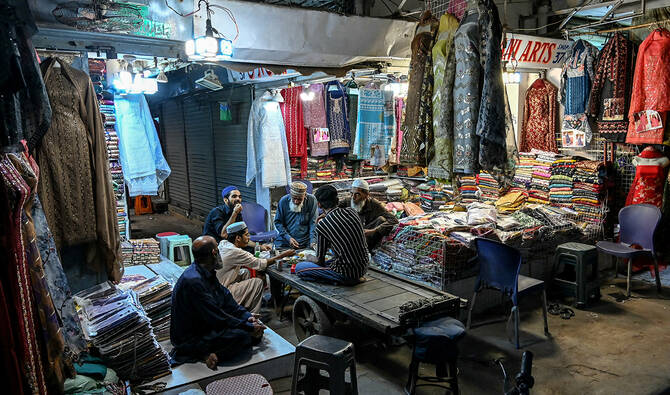
Shopkeepers break their fast at a market during the Islamic holy fasting month of Ramadan in Karachi on March 9, 2025. (AFP/ file)
Short Url
Updated 26 October 2025
Follow

Pakistan aims to lower business costs to spur growth, investment and jobs

  • The country is currently navigating a tricky path to economic recovery under a $7 billion IMF program since averting a default in 2023
  • The government has reduced energy costs, halved interest rates and ensured faster approvals, simpler procedures for sake of regulatory ease

ISLAMABAD: Pakistan is taking policy measures to increase the ease of doing business in a bid to boost growth, investment and employment opportunities in the South Asian country, the country's finance adviser said on Sunday.

The South Asian country of more than 241 million people is currently navigating a tricky path to economic recovery under a $7 billion International Monetary Fund (IMF) program since averting a default in 2023.

Besides introducing structural reforms relating to expansion of the country's tax base and privatization of loss-making entities, the government of Prime Minister Shehbaz Sharif is striving to boost foreign investment and trade.

Khurram Schehzad, an adviser to the finance minister, said the government has reduced energy costs from Rs38/unit to Rs23/unit, interest rate to 11% from an all-time high of 22% in June last year among other measures.

"The direction is clear: lowering the cost of doing business to make way for growth, investment and jobs," Schehzad said on X, adding that the tax structure has been rationalized, while the government is ensuring faster approvals and simpler procedures to increase regulatory ease for businesses.

Pakistani tax authorities have shifted their focus from salaried individuals and corporate sector to bringing people, who do not file their wealth statements, by increasing compliance and enforcement.

For the first time in 14 years, the South Asian country posted a current account surplus of $2.1 billion (0.5% of GDP) in the outgoing fiscal year 2024-25 that ended in June, marking a sharp turnaround from a $2 billion deficit in FY2023-24, driven by a 27% increase in remittances and a 16% drop in services deficit.

The government is now pursuing privatization, tax and energy sector reforms, and an accelerated digitalization drive to strengthen the economy. These measures are designed to improve fiscal stability and rebuild confidence among both investors and international lenders.



Pakistan, global crypto exchange discuss modernizing digital payments, creating job prospects 

Updated 05 December 2025
Follow

Pakistan, global crypto exchange discuss modernizing digital payments, creating job prospects 

  • Pakistani officials, Binance team discuss coordination between Islamabad, local banks and global exchanges
  • Pakistan has attempted to tap into growing crypto market to curb illicit transactions, improve oversight

ISLAMABAD: Pakistan’s finance officials and the team of a global cryptocurrency exchange on Friday held discussions aimed at modernizing the country’s digital payments system and building local talent pipelines to meet rising demand for blockchain and Web3 skills, the finance ministry said.

The development took place during a high-level meeting between Finance Minister Muhammad Aurangzeb, Pakistan Virtual Assets Regulatory Authority (PVARA) Chairman Bilal bin Saqib, domestic bank presidents and a Binance team led by Global CEO Richard Teng. The meeting was held to advance work on Pakistan’s National Digital Asset Framework, a regulatory setup to govern Pakistan’s digital assets.

Pakistan has been moving to regulate its fast-growing crypto and digital assets market by bringing virtual asset service providers (VASPs) under a formal licensing regime. Officials say the push is aimed at curbing illicit transactions, improving oversight, and encouraging innovation in blockchain-based financial services.

“Participants reviewed opportunities to modernize Pakistan’s digital payments landscape, noting that blockchain-based systems could significantly reduce costs from the country’s $38 billion annual remittance flows,” the finance ministry said in a statement. 

“Discussions also emphasized building local talent pipelines to meet rising global demand for blockchain and Web3 skills, creating high-value employment prospects for Pakistani youth.”

Blockchain is a type of digital database that is shared, transparent and tamper-resistant. Instead of being stored on one computer, the data is kept on a distributed network of computers, making it very hard to alter or hack.

Web3 refers to the next generation of the Internet built using blockchain, focusing on giving users more control over their data, identity and digital assets rather than big tech companies controlling it.

Participants of the meeting also discussed sovereign debt tokenization, which is the process of converting a country’s debt such as government bonds, into digital tokens on a blockchain, the ministry said. 

Aurangzeb called for close coordination between the government, domestic banks and global exchanges to modernize Pakistan’s payment landscape.

Participants of the meeting also discussed considering a “time-bound amnesty” to encourage users to move assets onto regulated platforms, stressing the need for stronger verifications and a risk-mitigation system.

Pakistan has attempted in recent months to tap into the country’s growing crypto market, crack down on money laundering and terror financing, and promote responsible innovation — a move analysts say could bring an estimated $25 billion in virtual assets into the tax net.

In September, Islamabad invited international crypto exchanges and other VASPs to apply for licenses to operate in the country, a step aimed at formalizing and regulating its fast-growing digital market.