JERUSALEM: Prime Minister Benjamin Netanyahu said on Sunday Israel would determine which foreign forces it would allow as part of a planned international force in Gaza to help secure a fragile ceasefire under US President Donald Trump’s plan.
It remains unclear whether Arab and other states will be ready to commit troops, in part given the refusal of Palestinian Hamas militants to disarm as called for by the plan, while Israel has voiced concerns about the make-up of the force.
While the Trump administration has ruled out sending US soldiers into the Gaza Strip, it has been speaking to Indonesia, the United Arab Emirates, Egypt, Qatar, Turkiye and Azerbaijan to contribute to the multinational force.
“We are in control of our security, and we have also made it clear regarding international forces that Israel will determine which forces are unacceptable to us, and this is how we operate and will continue to operate,” Netanyahu said.
“This is, of course, acceptable to the United States as well, as its most senior representatives have expressed in recent days,” he told a session of his cabinet.
Israel, which besieged Gaza for two years to back up its air and ground war in the enclave against Hamas after the Palestinian militant group’s cross-border attack on October 7, 2023, continues to control all access to the territory.
Israel opposed to Turkish role in Gaza force
Last week Netanyahu hinted that he would be opposed to any role for Turkish security forces in Gaza. Once-warm Turkish-Israeli relations soured drastically during the Gaza war, with Turkish President Tayyip Erdogan lambasting Israel’s devastating air and ground campaign in the small Palestinian enclave.
US Secretary of State Marco Rubio, on a visit to Israel aimed at shoring up the truce, said on Friday the international force would have to be made up of “countries that Israel’s comfortable with.” He made no comment on Turkish involvement.
Rubio added that Gaza’s future governance still needed to be worked out among Israel and partner nations but could not include Hamas.
Rubio later said US officials were receiving input on a possible UN resolution or international agreement to authorize the multinational force in Gaza and would discuss the issue in Qatar, a key Gulf mediator on Gaza, on Sunday.
A major challenge to Trump’s plan is that Hamas has balked at disarming. Since the ceasefire took hold two weeks ago as the first stage of Trump’s 20-point plan, Hamas has waged a violent crackdown on clans that have tested its grip on power.
Israel says Hamas knows where hostage remains are
At the same time, the remains of 13 deceased hostages remain in Gaza with Hamas citing obstacles to locating them in the pervasive rubble left by the fighting.
An Israeli government spokesperson said on Sunday Hamas, which released the remaining 20 living hostages it took in its October 2023 assault, knew where the bodies were.
“Israel is aware that Hamas knows where our deceased hostages are, in fact, located. If Hamas made more of an effort, they would be able to retrieve the remains of our hostages,” the spokesperson said.
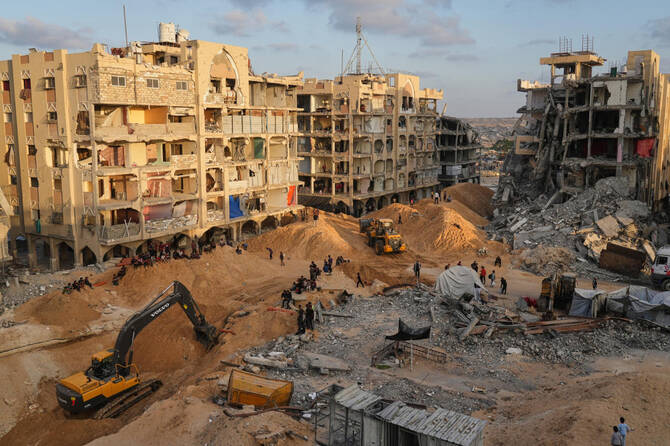
Israel had, however, allowed the entry of an Egyptian technical team to work with the Red Cross to locate the bodies. She said the team would use excavator machines and trucks for the search beyond the so-called yellow line in Gaza behind which Israeli troops have initially pulled back under Trump’s plan.
Netanyahu began the cabinet session by stressing Israel was an independent country, rejecting the notion that “the American administration controls me and dictates Israel’s security policy.” Israel and the US, he said, are a “partnership.”
Diplomats and analysts say Trump managed to push Netanyahu, who had long rejected global pressure for a ceasefire in Gaza, to accept his framework for a broader peace deal and also forced Netanyahu to call Qatar’s leader to apologize after a failed bombing raid targeting Hamas negotiators in that country.
Trump also persuaded Arab states to convince Hamas to return all the Israeli hostages, its key leverage in the war.


![]()

Netanyahu says Israel to decide which foreign troops acceptable to secure Gaza truce
Short Url
https://arab.news/vn8dd
Netanyahu says Israel to decide which foreign troops acceptable to secure Gaza truce
- Trump administration has been speaking to Indonesia,UAE, Egypt, Qatar, Turkiye and Azerbaijan to contribute to the multinational force


Latest updates


© 2026 SAUDI RESEARCH & PUBLISHING COMPANY, All Rights Reserved And subject to Terms of Use Agreement.