

In emotional speech, Zohran Mamdani defends Muslim identity against ‘racist’ attacks

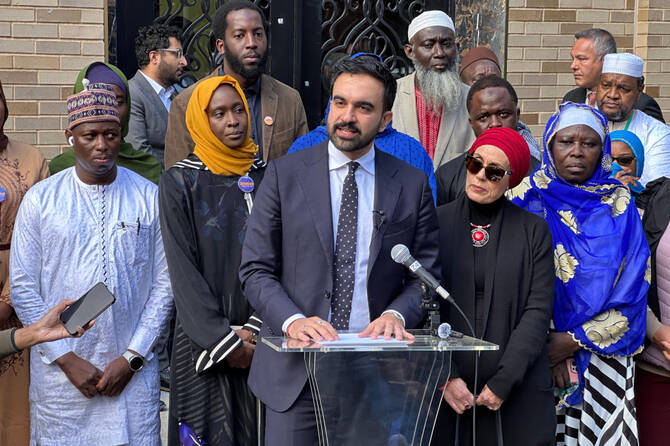
New York City Democratic mayoral candidate Zohran Mamdani speaks at the Islamic Cultural Center of the Bronx mosque in New York on Friday. (AP)
Short Url
Updated 05 November 2025
Follow

In emotional speech, Zohran Mamdani defends Muslim identity against ‘racist’ attacks

  • Democratic nominee for New York City mayor, is pledging to embrace his Muslim identity amid growing attacks in the final days of the campaign
  • Speaking outside a Bronx mosque, Mamdani spoke about the 'indignities' long faced by the city’s Muslim population

NEW YORK: Zohran Mamdani, the Democratic nominee for New York City mayor, pledged Friday to further embrace his Muslim identity in response to growing attacks by former Gov. Andrew Cuomo and his surrogates that he characterized as “racist and baseless.”
Encircled by faith leaders outside a Bronx mosque, Mamdani spoke in emotional terms about the “indignities” long faced by the city’s Muslim population, choking back tears as he described his aunt’s decision not to ride the subway after the Sept. 11 attacks because she didn’t feel safe being seen in a religious head covering.
He recounted how, when he first entered politics, an uncle gently suggested he keep his faith to himself.
“These are lessons that so many Muslim New Yorkers have been taught,” Mamdani said. “And over these last few days, these lessons have become the closing messages of Andrew Cuomo, Curtis Sliwa and Eric Adams.”
At a news conference later Friday, Cuomo accused Mamdani of “playing the victim” for political purposes and denied that Islamophobia existed on a wide scale in New York.
Throughout the race, Mamdani, a democratic socialist, has been criticized by Cuomo and others over his criticism of Israel’s government which he had accused of committing genocide against Palestinians in Gaza.
But the tone of those attacks have amped up in recent days, drawing allegations from some Democrats that Cuomo’s campaign is leaning into Islamophobia in the final stretch of the campaign.

Appearing on a conservative radio station Thursday, Cuomo appeared to laugh along at host Sid Rosenberg’s suggestion that Mamdani would “be cheering” another 9/11 attack. “That’s another problem,” Cuomo replied.
A Cuomo social media account posted, then removed, a video depicting Mamdani eating rice with his hands and describing his supporters as criminals. A campaign spokesperson said the video was posted in error.
At an event endorsing the former governor, Mayor Eric Adams invoked the possibility of terrorist attacks in New York City, seeming to suggest — without explanation — they would be more likely under a Mamdani administration.
“New York can’t be Europe. I don’t know what is wrong with people,” Adams said, standing alongside Cuomo. “You see what’s playing out in other countries because of Islamic extremism.”
At a debate earlier this week, Sliwa, the Republican candidate, falsely smeared Mamdani as a supporter of “global jihad.”
Asked about Rosenberg’s comments, Cuomo said he “didn’t take the remarks seriously at the time.”
“Of course I think it’s an offensive comment. But it did not come out of my mouth,” he added.
Messages left with Adams’ and Sliwa’s campaign were not immediately returned.
In his speech Friday, Mamdani said he was aiming his remarks not at political opponents but at his fellow Muslim New Yorkers.
“The dream of every Muslim is simply to be treated the same as any other New Yorker,” he said. “And yet for too long we have been told to ask for less than that, and to be satisfied with whatever little we receive.”
“No more,” he said.
To that end, Mamdani said he would further embrace his Muslim identity, a decision he said he consciously avoided at the start of his campaign.
“I thought that if I behaved well enough, or bit my tongue enough in the face of racist, baseless attacks, all while returning back to my central message, it would allow me to be more than just my faith,” Mamdani said. “I was wrong. No amount of redirection is ever enough.”
He continued: “I will not change who I am, how I eat, or the faith that I’m proud to call my own. But there is one thing that I will change. I will no longer look for myself in the shadows. I will find myself in the light.”
Mamdani, who won the primary in stunning fashion, has faced skepticism from some in the Democratic establishment, particularly over his criticism of Israel. On Friday, Mamdani earned the endorsement of House Minority Leader Hakeem Jeffries.
Cuomo told reporters that Mamdani’s criticism of Israel had made Jewish people afraid to leave their homes.
He also rejected Mamdani’s claim that Muslim New Yorkers have been made to feel uncomfortable in their own city.
“Don’t tell me New Yorkers are Islamophobic. They’re not,” Cuomo said.
“What he is doing is the oldest, dirtiest political trick in the book: divide people,” Cuomo said.


How decades of deforestation led to catastrophic Sumatra floods

Updated 9 sec ago
Follow

How decades of deforestation led to catastrophic Sumatra floods

  • At least 1.4m hectares of forest in flood-affected provinces were lost to deforestation since 2016
  • Indonesian officials vow to review permits, investigate companies suspected of worsening the disasters

JAKARTA: About a week after floods and landslides devastated three provinces in Indonesia’s Sumatra island, Rubama witnessed firsthand how the deluge left not only debris and rubble but also log after log of timber.

They were the first thing that she saw when she arrived in the Beutong Ateuh Banggalang district of Aceh, where at least two villages were wiped out by floodwaters.

“We saw these neatly cut logs moving down the river. Some were uprooted from the ground, but there are logs cut into specific sizes. This shows that the disaster in Aceh, in Sumatra, it’s all linked to illegal forestry practices,” Rubama, empowerment manager at Aceh-based environmental organization HAKA, told Arab News.

Monsoon rains exacerbated by a rare tropical storm caused flash floods and triggered landslides across Aceh, North Sumatra, and West Sumatra in late November, killing 969 people and injuring more than 5,000 as of Wednesday, as search efforts continue for 252 others who remain missing.

In the worst-hit areas, residents were cut off from power and communication for days, as floodwater destroyed bridges and torrents of mud from landslides blocked roads, hampering rescue efforts and aid delivery to isolated villages.

When access to the affected regions gradually improved and the scale of the disaster became clearer, clips of washed-up trunks and piles of timber crashing into residential areas circulated widely online, showing how the catastrophic nature of the storm was compounded by deforestation.

“This is real, we’re seeing the evidence today of what happens when a disaster strikes, how deforestation plays a major role in the aftermath,” Rubama said.

For decades, vast sections of Sumatra’s natural forest have been razed and converted for mining, palm oil plantations and pulpwood farms.

Around 1.4 million hectares of forest in Aceh, North Sumatra and West Sumatra were lost to deforestation between 2016 and 2025 alone, according to Indonesian environmental group WALHI, citing operations by 631 permit-holding companies.

Deforestation in Sumatra stripped away natural defenses that once absorbed rainfall and stabilized soil, making the island more vulnerable to extreme weather, said Riandra Purba, executive director of WALHI’s chapter in North Sumatra.

Purba said the Sumatra floods should serve as a “serious warning” for the government to issue permits more carefully.

“Balancing natural resource management requires a sustainable approach. We must not sacrifice natural benefits for the financial benefit of a select few,” he told Arab News.

“(The government) must evaluate all the environmental policies in the region … (and) implement strict monitoring, including law enforcement that will create a deterrent effect to those who violate existing laws.”

In Batang Toru, one of the worst-hit areas in North Sumatra where seven companies operate, hundreds of hectares had been cleared for gold mining and energy projects, leaving slopes exposed and riverbeds choked with sediment.

When torrential rains hit last month, rivers in the area were swollen with runoff and timber, while villages were buried or swept away.

As public outrage grew in the wake of the Sumatra floods, Indonesian officials, including Environment Minister Hanif Faisol Nurofiq, have moved to review existing permits and investigate companies suspected of worsening the disaster. 

“Our focus is to ensure whether company activities are influencing land stability and (increasing) risks of landslides or floods,” Nurofiq told Indonesian magazine Tempo on Saturday.

Sumatra’s natural forest cover stood at about 11.6 million hectares as of 2023, or about 24 percent of the island’s total area, falling short of the 30 to 33 percent forest coverage needed to maintain ecological balance.

The deadly floods and landslides in Sumatra also highlighted the urgency of disaster mitigation in Indonesia, especially amid the global climate crisis, said Kiki Taufik, forest campaigner at Greenpeace Indonesia. 

Over two weeks since floods and landslides inundated communities in Sumatra, a few villages remain isolated and over 800,000 people are still displaced. 

“This tropical cyclone, Senyar, in theory, experts said that it has a very low probability of forming near the equator, but what we have seen is that it happened, and this is caused by rapid global warming … which is triggering hydrometeorological disasters,” Taufik told Arab News.

“The government needs to give more attention, and even more budget allocation, to mitigate disaster risks … Prevention is much more important than (disaster) management, so this must be a priority for the government.”