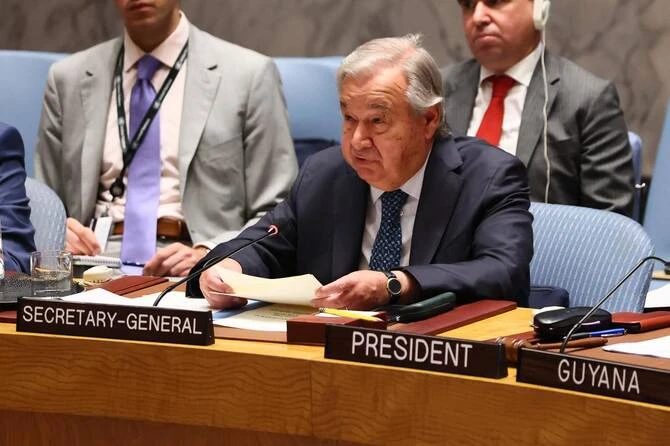
NEW YORK CITY: The UN’s secretary-general, Antonio Guterres, warned on Friday that the Security Council’s “legitimacy is fragile.”
He urged member states to recommit to the founding principles of the UN Charter and take urgent action to reform the council so that it better reflects the geopolitical realities of today.
“Too often, we have seen members of this body act outside the principles of the Charter, principles we have all freely agreed to as sovereign nations,” Guterres said.
“When that happens, it not only stalls action in the moment, it erodes trust in the entire United Nations project. It also puts us all in great danger.”
Speaking from Hanoi, he was addressing a Security Council open debate convened by Russia, which holds the rotating presidency of the council this month, to mark the 80th anniversary of the UN. It was titled “The United Nations Organization: Looking Into the Future.”
The council remains a “vital necessity and a powerful force for good,” Guterres said. He credited it with helping to end apartheid in South Africa, restore peace in post-genocide Cambodia, and prevent a major-power war for eight decades.
But he cautioned that there was now a risk that these achievements would be undermined by paralysis, geopolitical rivalries and a lack of representativeness.
Reform of the Security Council, Guterres said, is “imperative and long overdue.”
He called for an expansion of its membership, noting that nearly half of all UN peacekeeping missions are deployed in Africa, yet the continent still lacks a permanent seat on the council. Latin America and the Caribbean also remain underrepresented, while the Asia-Pacific region, home to more than half of the world’s population, has only one permanent seat.
“Expanding the membership is not only about justice, it is also about results,” he said. “It has the potential to undo deadlocks and offer stability in our increasingly multipolar world.”
Guterres welcomed proposals by France and the UK to voluntarily limit the use of the power of veto held by them and the other permanent members of the council (Russia, China and the US). Such a measure has long been debated as a way to ensure the council can be more responsive to crises, including conflicts such as those in Ukraine, Gaza and Sudan.
“The Security Council is not about hegemons and empires,” he said. “It is about parents who have lost their children, refugees flung far from their homes, soldiers who have sacrificed their limbs.”
Calling for a renewed moral purpose and greater inclusivity, Guterres added: “The time has come to open the doors of the chamber and let in the light. Without a Security Council fit for purpose, the world is in grave danger.”
Security Council’s legitimacy at stake as it marks its 80th anniversary, UN chief warns
Short Url
https://arab.news/2wp6z
Security Council’s legitimacy at stake as it marks its 80th anniversary, UN chief warns
- Secretary-General Antonio Guterres urges members to recommit to founding principles and reform the council to better reflect modern geopolitical realities
- ‘The time has come to open the doors of the chamber and let in the light. Without a Security Council fit for purpose, the world is in grave danger,’ he says
Missiles pound Ukraine capital ahead of Russian invasion anniversary
- Kyiv has faced waves of overnight strikes in recent weeks as Moscow has intensified its winter assaults
- The strikes also prompted heightened vigilance across Ukraine’s western border
KYIV: Explosions rocked Kyiv before dawn on Sunday after officials warned of a ballistic missile attack, just two days before the fourth anniversary of Russia’s invasion.
AFP journalists in the capital heard a series of loud blasts beginning around 4:00 a.m. (0200 GMT), shortly after an air raid alert was issued.
“The enemy is attacking the capital with ballistic weapons,” the head of Kyiv’s military administration Tymur Tkachenko said on Telegram, urging people to remain in shelters.
The air force later extended the alert nationwide, warning of a broader missile threat.
Kyiv, regularly targeted by Russian missile and drone attacks since the start of the invasion on Feb. 24, 2022, has faced waves of overnight strikes in recent weeks as Moscow has intensified its winter assaults on energy and military infrastructure.
Temperatures had plunged to nearly minus 10C when the capital was struck again, with emergency services deployed across the city.
Tkachenko later said the attacks had caused a fire on the roof of a residential building.
The strikes also prompted heightened vigilance across Ukraine’s western border.
Poland’s Operational Command said early Sunday it was scrambling jets after detecting “long-range aviation of the Russian federation conducting strikes on the territory of Ukraine.”
It also came hours after blasts in Lviv, a western city near the Polish border that rarely sees deadly attacks.
Explosions ripped through a central shopping street around 12:30 am (2230 GMT Saturday), killing a policewoman and injuring 15 people after officers responded to a reported break-in.
“This is clearly an act of terrorism,” mayor Andriy Sadovyi said, offering no details on perpetrators.
Such attacks far from the front line have become more frequent over the past two years.
Four years of war
Ukraine will mark four years since Russia’s assault on Feb. 24, 2022, a withering war that has shattered towns, uprooted millions and killed large numbers on both sides.
Moscow occupies close to a fifth of Ukrainian territory and continues to grind forward in places, especially in the eastern Donbas region, despite heavy losses and repeated Ukrainian strikes on logistics.
Ukrainian President Volodymyr Zelensky said on Friday that Ukraine “is definitely not losing” the war and that victory remains the goal.
He said Ukrainian forces had clawed back about 300 square kilometers (116 square miles) of territory in recent counterattacks, gains AFP could not immediately verify.
If confirmed, they would be Kyiv’s most significant advances since 2023.
Sweeping outages of Starlink Internet terminals across the Ukraine front, shut down by owner Elon Musk following a plea from Kyiv, have enabled the push, according to Zelensky.
The bombardment also came amid a diplomatic push by Washington to end the four-year war.
Ukrainian, Russian and US envoys have met several times since January, but without a breakthrough.
Zelensky, under mounting pressure from Washington to consider concessions, plans consultations with European leaders in the coming days and wants deeper involvement from Middle Eastern states and Turkiye.
AFP journalists in the capital heard a series of loud blasts beginning around 4:00 a.m. (0200 GMT), shortly after an air raid alert was issued.
“The enemy is attacking the capital with ballistic weapons,” the head of Kyiv’s military administration Tymur Tkachenko said on Telegram, urging people to remain in shelters.
The air force later extended the alert nationwide, warning of a broader missile threat.
Kyiv, regularly targeted by Russian missile and drone attacks since the start of the invasion on Feb. 24, 2022, has faced waves of overnight strikes in recent weeks as Moscow has intensified its winter assaults on energy and military infrastructure.
Temperatures had plunged to nearly minus 10C when the capital was struck again, with emergency services deployed across the city.
Tkachenko later said the attacks had caused a fire on the roof of a residential building.
The strikes also prompted heightened vigilance across Ukraine’s western border.
Poland’s Operational Command said early Sunday it was scrambling jets after detecting “long-range aviation of the Russian federation conducting strikes on the territory of Ukraine.”
It also came hours after blasts in Lviv, a western city near the Polish border that rarely sees deadly attacks.
Explosions ripped through a central shopping street around 12:30 am (2230 GMT Saturday), killing a policewoman and injuring 15 people after officers responded to a reported break-in.
“This is clearly an act of terrorism,” mayor Andriy Sadovyi said, offering no details on perpetrators.
Such attacks far from the front line have become more frequent over the past two years.
Four years of war
Ukraine will mark four years since Russia’s assault on Feb. 24, 2022, a withering war that has shattered towns, uprooted millions and killed large numbers on both sides.
Moscow occupies close to a fifth of Ukrainian territory and continues to grind forward in places, especially in the eastern Donbas region, despite heavy losses and repeated Ukrainian strikes on logistics.
Ukrainian President Volodymyr Zelensky said on Friday that Ukraine “is definitely not losing” the war and that victory remains the goal.
He said Ukrainian forces had clawed back about 300 square kilometers (116 square miles) of territory in recent counterattacks, gains AFP could not immediately verify.
If confirmed, they would be Kyiv’s most significant advances since 2023.
Sweeping outages of Starlink Internet terminals across the Ukraine front, shut down by owner Elon Musk following a plea from Kyiv, have enabled the push, according to Zelensky.
The bombardment also came amid a diplomatic push by Washington to end the four-year war.
Ukrainian, Russian and US envoys have met several times since January, but without a breakthrough.
Zelensky, under mounting pressure from Washington to consider concessions, plans consultations with European leaders in the coming days and wants deeper involvement from Middle Eastern states and Turkiye.
© 2026 SAUDI RESEARCH & PUBLISHING COMPANY, All Rights Reserved And subject to Terms of Use Agreement.